Operating Principles of Fabric Filter Dust Collectors & Multi-Chamber Offline Cleaning
Designed for demanding cement kiln lines, clinker coolers, and raw grinding circuits, heavy-duty industrial dust collection equipment utilizes engineered inlet gas distribution and isolated offline pulse cleaning to maintain sub-5 mg/Nm³ particulate emissions under continuous production loads.
Inlet Aerodynamics, Baffle Deceleration, and Gas Distribution
Effective flue gas cleaning in high-dust cement manufacturing begins at the raw intake manifold. Unfiltered flue gas bearing heavy particulate concentrations enters through fluid-dynamically profiled inlet plenums. Heavy-duty internal deflection plates and directional flow vanes trigger an immediate velocity drop from 18–22 m/s down to laminar interstitial velocities below 1.2 m/s.
This rapid deceleration drives primary inertial separation, shedding abrasive clinker and raw meal particles directly into the hopper valley before they can scour the filter array. The stabilized gas stream then ascends uniformly through the filter matrix, where micro-porous needle felts or ePTFE membranes capture fine particulate while clean gas vents through the upper plenum.
- ✓ Interstitial Velocity Control: Prevents upward dust drag and mitigates premature bag abrasion across the lower matrix.
- ✓ Balanced Air-to-Cloth Distribution: DARKO computational fluid dynamic (CFD) modeling guarantees uniform filter loading across every active module.
Multi-Chamber Offline Isolation and High-Pressure Pulse Dynamics
Unlike standard online units, heavy-duty multi-chamber offline pulse jet dust collectors isolate each compartment during regeneration. A pneumatic poppet damper seals the clean-gas outlet of the target compartment, instantly creating a zero-velocity environment within that individual cell.
Submerged pulse valves discharge a 0.35–0.50 MPa compressed air shockwave through precision Venturi nozzles, creating an outward shock expansion along the entire bag length. Because upward airflow is fully stopped, dislodged dust cakes fall straight into the collection hopper without re-entraining onto neighboring filter bags.
- ✓ Zero Dust Re-Entrainment: Cakes drop uninhibited into hoppers, cutting compressed air consumption by up to 35%.
- ✓ Low Differential Pressure Baseline: A consistent 1,000–1,200 Pa operating drop significantly lowers process ID fan power draw.
Three-Stage Filtration and Cleaning Architecture
Continuous industrial gas cleaning cycle engineered for abrasive clinker cooling, rotary kiln exhausts, and closed-circuit finish grinding.
Inertial Gravitational Settling
High-velocity dust-laden flue gas hits heavy-duty inlet deflector plates. Providing initial inertial separation akin to heavy-duty cyclone dust collectors, coarse particulate (≥ 50 µm) drops straight into the collection hopper, eliminating up to 60% of the dust burden.
Fiber Media Surface Filtration
Decelerated gas passes through high-efficiency needle felts or ePTFE-laminated filter bags. Fine particulate matter (0.1–5 µm) forms a structured, permeable dust cake on the bag exterior, while scrubbed air discharges smoothly through the clean plenum.
Millisecond Reverse Pulse Jet
Poppet dampers seal the target compartment while high-flow submerged pulse valves deliver a 0.08–0.15 s reverse jet of dry compressed air. The cake dislodges completely into the hopper without re-depositing on neighboring filter bags.
Engineering Comparison: Multi-Chamber Offline vs. Standard Online Pulse Cleaning
Operational performance across high-load cement production stages including rotary kilns, clinker coolers, and raw grinding circuits.
| Operational Parameter | DARKO Multi-Chamber Offline Pulse | Conventional Online Pulse Jet | Plant Operation Impact |
|---|---|---|---|
| Dust Re-Entrainment Risk | Near Zero (Isolated Compartment) | High (Upward draft re-deposits dust) | Prevents localized bag abrasion & eliminates differential pressure spikes |
| Design Air-to-Cloth Ratio | 0.8 – 1.1 m/min (Net Filtration) | 0.6 – 0.8 m/min (Gross Filtration) | Enables compact unit footprints without risking premature media blinding |
| Compressed Air Consumption | Low (0.35 – 0.45 MPa intermittent) | High (0.55 – 0.70 MPa continuous) | Cuts plant compressor power demands and reduces moisture ingress risk |
| Average Filter Bag Lifespan | 36 to 48 Months | 18 to 24 Months | Extends maintenance turnaround intervals and lowers media changeout costs |
| Online Maintenance Capability | Full Single-Chamber Damper Isolation | Complete System Shutdown Required | Enables safe bag inspections and replacements while the main process line runs |
DARKO Fluid-Dynamically Optimized Inlet Distributors
Conventional baghouses often experience localized high-velocity hot spots that cause uneven bag wear, cage fatigue, and premature blinding. DARKO fabric filter dust collectors feature CFD-engineered flow-guide vanes and gradual-expansion intake manifolds that distribute flue gas evenly across every chamber.
By equalizing static pressure and velocity across the housing, operating system resistance stays reliably below 1,200 Pa, ensuring extended filter bag service life in high-temperature flue gas streams up to 260°C.
Industrial Baghouse Product Series and Structural Configurations
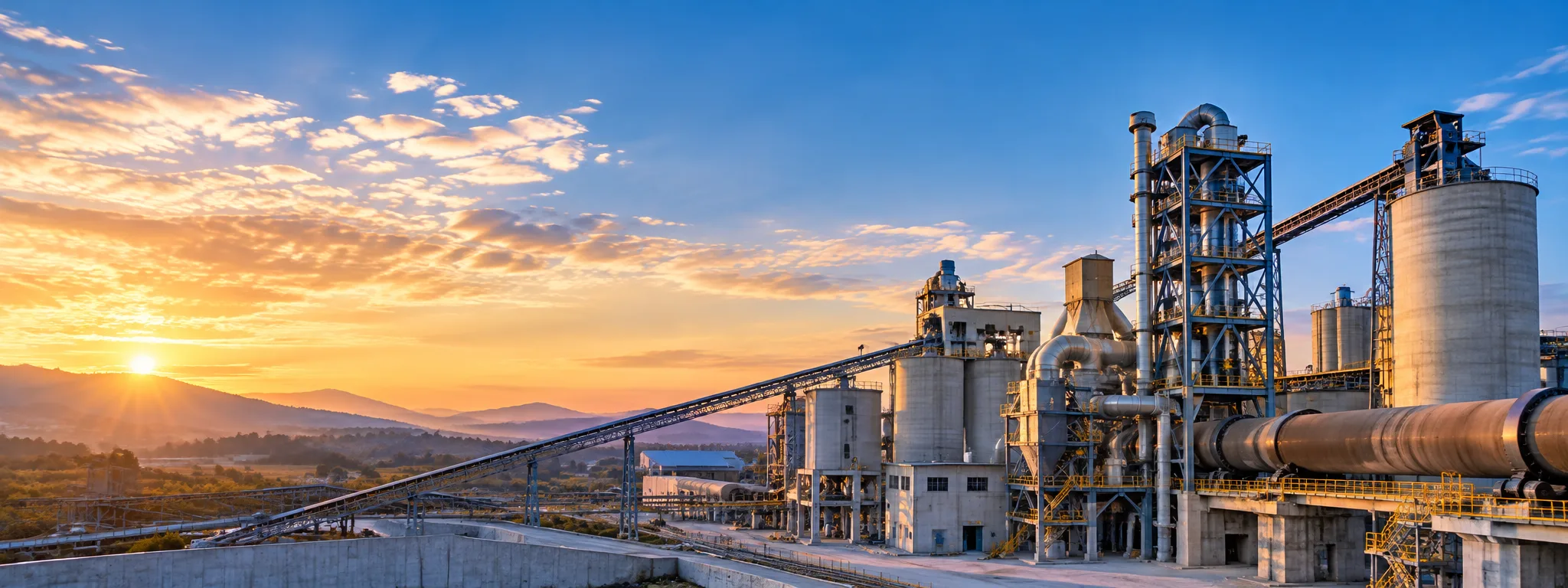
As a foundational line of our specialized dust collection equipment, DARKO Cement Machinery manufactures heavy-duty pulse jet baghouse systems, high-temperature long-bag fabric filter collectors, and ATEX/NFPA-compliant explosion-proof units. Built for demanding pyroprocessing, clinker handling, and raw material grinding, our structural architectures are engineered in modular single-row, double-row parallel, and space-optimized compact footprints to guarantee continuous dust collection with ultra-low particulate emissions down to <5 mg/Nm³.
Large Modular Offline Pulse Jet Baghouses
Engineered specifically for massive gas volumes and heavy dust loads in cement rotary kilns, raw grinding systems, and in-line roller press circuits, these heavy-duty pulse jet dust collectors utilize precision pneumatic poppet isolation dampers to take individual chambers completely offline during cleaning cycles, entirely eliminating secondary dust re-entrainment and lowering overall operating differential pressure across the system.
Zero-leakage pneumatic poppet dampers seal off isolated compartments for thorough reverse-pulse regeneration.
Graduated internal distribution plates balance flue gas velocity and facilitate primary coarse dust settling into hoppers.
Operational Engineering Highlights
- Online Compartment Servicing: Dedicated isolation valves enable maintenance personnel to service bags and cages safely in one compartment while the main production kiln continues uninterrupted.
- Optimized Air-to-Cloth Ratios: Conservative filtration velocities between 0.8 and 1.0 m/min maintain low drag resistance under heavy particulate concentrations exceeding 1,000 g/Nm³.
- High-Flow Submerged Pulse Valves: Direct-immersion diaphragm valves fire high-volume compressed air pulses in under 0.1 seconds to thoroughly dislodge dense filter cakes along 8-meter bags.
| Design Parameter | Modular Offline Series Specification |
|---|---|
| Airflow Capacity | 80,000 – 1,200,000 m³/h (47,000 – 700,000 CFM) |
| Filter Bag Length | 6.0 m to 8.0 m (19.7 ft to 26.2 ft) standard |
| Pulse Cleaning Pressure | 0.20 – 0.35 MPa (Low-Pressure High-Volume Jet) |
| Structural Metallurgy | Heavy Q235B / Corten Weathering Steel (5–8 mm casing) |
| Operating Temperature | Up to 260°C continuous / 280°C peak excursion |
Shared Heavy-Duty Manufacturing Standards Across All Series
Every industrial fabric filter collector and related filtration product manufactured by DARKO Cement Machinery undergoes rigorous quality verification, finite element modeling, and precision CNC fabrication to deliver predictable long-term performance under demanding plant conditions.
Casing Deflection & Draft Integrity
All structural casing panels, external stiffeners, and clean-air plenums are FEA-modeled to maintain structural deflection under L/500 at full system negative pressure, holding casing air leakage strictly below 2%.
Laser-Cut Tubesheet Precision
CNC fiber-laser tubesheets ensure hole pitch tolerances within ±0.1 mm with perfectly deburred apertures, forming an airtight snap-band seal that eliminates bag collar wear and fine dust bypass.
Integrated Material Handling Interfaces
Collection hoppers come standard with heavy ANSI/DIN flanged connections designed for direct bolting to DARKO rotary airlock valves, twin-screw conveyors, and air gravity conveying systems.
Engineered Dedusting Solutions Across the Entire Cement Production Line
Modern cement plants require specialized air pollution control systems designed to withstand abrasive mineral dust, extreme thermal swings, high moisture loads, and strict emission caps. DARKO Cement Machinery builds heavy-duty dust collection equipment and industrial baghouses custom-engineered for every critical stage—from kiln exhaust gas cleaning and clinker cooler dedusting to finish grinding circuits and silo terminal venting. Our installations consistently guarantee ultra-low particulate emissions (< 5 mg/Nm³) while maintaining high thermal efficiency and non-stop plant availability.
Kiln Exhaust & Raw Mill Dedusting
Extremely high dust loadings (up to 100 g/Nm³), corrosive acid gas compounds, and rapid temperature shifts between direct kiln operation and combined raw mill grinding modes.
Multi-compartment offline pulse jet dust collectors utilizing woven fiberglass with expanded ePTFE membranes, automated bypass dampers, and aerodynamic gas distribution plates.
- Emission: < 5 mg/Nm³ ultra-low baseline
- Media: Woven Fiberglass + ePTFE Membrane
- Thermal Range: Up to 260°C continuous
Clinker Grate Cooler Dust Removal
Coarse, highly abrasive clinker particulates entering at high velocity, accompanied by sudden thermal spikes above 280°C during kiln upsets and cooler bed disturbances.
Integrated aerodynamic pre-settling dropout chambers with wear-resistant liners, automated cold-air tempering dampers, and P84 polyimide high-efficiency filter media.
- Protection: Heavy gravity dropout chamber
- Media: P84 / Polyimide blended felts
- Discharge: Abrasion-resistant rotary airlocks
Cement Grinding & Roller Press
Elevated static negative pressures, micron-sized finished cement dust, and high relative humidity from internal water cooling sprays that risk dew-point bag blinding.
Reinforced high-negative-pressure casings insulated with 100mm mineral wool cladding, heated pulse air manifolds, and hydrophobic/oleophobic treated needle felts.
- Casing Rating: Reinforced up to -8,000 Pa
- Thermal Care: Full rockwool insulation
- Media: Oil & moisture repellent felt
Silo Tops & Bulk Terminals
Pneumatic conveyance pressure surges, confined footprint on silo heads, and heavy fugitive dust dispersion during high-rate bulk truck and railcar loading operations.
Flanged insertable bin vent filters and compact pulse jet collectors directly interlocked with telescopic loading spouts, bulk conveying equipment such as air gravity conveyors, and rotary feed valves.
- Configuration: Direct-mount insertable / cased
- Cleaning: Automatic high-pressure pulse jet
- Reclaim: Zero-loss direct silo recovery
Engineering High Operational Reliability Across Pyroprocessing Lines
Cement manufacturing requires baghouse dust collection systems to operate as integral components of the plant's thermal and pneumatic process loops. Achieving reliable performance involves precise air-to-cloth ratio selection, CFD gas distribution modeling, and rigorous chemical-thermal compatibility analysis across every filter compartment.
DARKO structures each baghouse with heavy-gauge welded steel casings, CNC-machined tubesheet openings, and automated bypass and isolation dampers. This structural integrity shields your downstream fans, ensures safe startup and shutdown transitions, and maintains uninterrupted clinker throughput under extreme industrial conditions.
Engineering Quality Guarantees
- Guaranteed Outlet Emissions
- < 5 mg/Nm³ (Ultra-Clean)
- Casing Air Infiltration Rate
- < 2.0% at Design Pressure
- Filter Bag Service Life
- 24 to 36 Months Continuous
- Continuous Operating Temperature
- Up to 260°C (Peaks to 280°C)
- Pulse Valve Actuation Life
- 1,000,000 Pulse Cycles
| Process Area | Typical Gas Temp (°C) | Inlet Dust Load (g/Nm³) | Recommended Filter Media | Target Air-to-Cloth Ratio | Auxiliary System Integration |
|---|---|---|---|---|---|
| Preheater Kiln Exhaust & Raw Mill | 180 – 240 | 40 – 100 | Woven Fiberglass + ePTFE Membrane | 0.7 – 0.9 m/min (2.3 – 3.0 ft/min) | Conditioning Tower & Modulating Bypass Dampers |
| Raw Material Vertical Roller Mill | 80 – 120 | 300 – 800 | Polyester / PPS Needle Felt with PTFE Coating | 0.8 – 1.0 m/min (2.6 – 3.3 ft/min) | Air Gravity Conveyors & Star Rotary Airlocks |
| Clinker Grate Cooler Exhaust | 180 – 260 | 20 – 50 | P84 Polyimide / Fiberglass Composite | 0.7 – 0.85 m/min (2.3 – 2.8 ft/min) | Tempering Dampers & Heavy Screw Conveyors |
| Finish Cement Ball Mill & Separator | 90 – 130 | 100 – 350 | Hydrophobic & Oleophobic Polyester Needle Felt | 0.9 – 1.1 m/min (3.0 – 3.6 ft/min) | Rigid Rotary Discharge Airlock Feeders |
| Coal Preparation & Grinding Circuit | 60 – 85 | 50 – 150 | Antistatic Conductive Polyester Needle Felt | 0.6 – 0.8 m/min (2.0 – 2.6 ft/min) | Flameless Explosion Vents & N₂ Inerting System |
Heavy-Duty Manufacturing Standards for Industrial Baghouse Dust Collectors
Engineered for abrasive clinker handling, rotary kiln exhaust lines, and high-load raw milling, DARKO fabric filter systems deliver structural longevity under extreme thermal and mechanical stresses. Every welded casing joint, filter cage assembly, high-flow pulse valve, and ash discharge mechanism is built to satisfy stringent continuous-duty cement plant specifications.
High-Temp Filter Bags & Precision Filter Cage Design
Long-term filtration efficiency depends on thermal resilience and mechanical support. DARKO pairs advanced woven and needle-felt filter media with rigid cage assemblies designed to eliminate bag flexing wear, bypass leakage, and premature thermal degradation in aggressive flue gas environments.
- Filter Media: PTFE membrane, PPS, Nomex, P84, & woven fiberglass
- Thermal Threshold: Rated for up to 260°C (500°F) continuous duty
- Filter Cage Design: 16-to-24 wire CNC welded rigid support
- Metallurgy Options: Galvanized, 304, or 316L stainless steel
Submerged Diaphragm Pulse Jet Cleaning System
Effective online and offline cleaning demands instantaneous peak pressure with optimized compressed air volume. Our submerged manifold configurations for advanced pulse-jet dust collectors integrate fast-acting diaphragm valves to drive high-velocity sonic shockwaves across extended 6-meter to 8-meter filter bags.
Heavy-Gauge Reinforced Housing & Vacuum Resistance
Main process baghouses deployed on cement kiln lines operate under severe induced draft fan suction. DARKO constructs heavy structural casings utilizing externally stiffened carbon steel plates, validated by finite element analysis (FEA) to endure extreme vacuum levels without casing deflection or panel fatigue.
Steep Valley Hoppers & Rotary Airlock Valve Integration
Hopper dust accumulation and clinker bridging cause severe bag re-entrainment and elevated differential pressure. DARKO collection hoppers feature valley angles exceeding 60 degrees, internal strike plates, fluidizing pads, and direct integration with heavy-duty rotary airlock valves, high-capacity screw conveyors, and pneumatic air slide conveyors for reliable, continuous dust evacuation.
Differential Pressure Tracking & Thermal Bypass Protection
Centralized PLC and plant DCS connectivity enables real-time tracking of tube sheet differential pressure, hopper ash levels, and flue gas temperature profiles. High-speed pneumatic bypass dampers and cold-air bleed valves actuate within milliseconds during thermal excursion events to safeguard filter media from scorching.
System Component Matrix
Submerged Header & Pulse Valves
Cleaning StageSubmerged pulse valve mounting directly inside the compressed air header reduces air loss by 25%, delivering instant supersonic cleaning jets through calibrated blowpipes.
DARKO Quality Assurance Standard
From precision laser-drilled tubesheets held to ±0.1 mm tolerances to submerged-arc welded heavy shell plates, DARKO enforces rigorous quality controls across all stages of fabrication to prevent structural fatigue and maximize industrial uptime.
Standard Model Engineering & Sizing Matrix
Cross-reference volumetric airflow capacity, net cloth area, and chamber layouts. DARKO Cement Machinery supplies high-efficiency pulse jet dust collectors and pre-engineered dust collection equipment configurations tailored to strict footprint and elevation constraints.
CFM Airflow Capacity
3,000 – 700,000+ CFM
5,000 to 1,200,000 m³/h coverage
Dust Emission Limits
< 5 mg/Nm³
EPA NESHAP & EU IED compliant
System Differential Drop
1,200 – 1,650 Pa
Low-resistance steady-state operation
Structural Compliance
ASME / EN 1090
Seismic Zone 4 & 10 kPa rating
| Model Designation | Filtration Area (m²) | Airflow Capacity (m³/h) | Net Air-to-Cloth (m/min) | Bags (Qty × Length) | Pulse Valve | System ΔP (Pa) |
|---|---|---|---|---|---|---|
| DK-PPC-120 | 120 | 6,000 – 8,500 | 0.85 – 1.15 | 96 × 2.5 m | 1.5" (DN40) | 1,200 – 1,450 |
| DK-PPC-360 | 360 | 18,000 – 24,000 | 0.85 – 1.10 | 192 × 3.0 m | 2.5" (DN65) | 1,250 – 1,500 |
| DK-PPC-720 | 720 | 38,000 – 48,000 | 0.88 – 1.10 | 384 × 3.0 m | 3.0" (DN80) | 1,300 – 1,550 |
| DK-PPC-1440 | 1,440 | 78,000 – 95,000 | 0.90 – 1.10 | 576 × 4.0 m | 3.0" (DN80) | 1,350 – 1,600 |
| DK-PPC-2880 | 2,880 | 155,000 – 190,000 | 0.90 – 1.10 | 1,152 × 4.0 m | 3.0" (DN80) | 1,400 – 1,650 |
Engineering Notes & Structural Manufacturing Standards
Standard collector housings are fabricated from heavy-gauge Q235B or Corten-A weathering steel, protected by high-build epoxy or heat-resistant phenolic coatings. High-temperature gas applications (up to 260°C continuous) incorporate PTFE-membrane composite media and precision CNC-welded 316L stainless steel cages. All modular enclosures comply with ASME Section VIII, EN 1090-2 execution class EXC3, and UBC Seismic Zone 4 structural criteria under continuous negative working pressures up to 10,000 Pa, with discharge hoppers engineered for direct integration with plant bulk conveying equipment.
Cement Baghouse Sizing Calculation and Engineering Evaluation Guide
Accurate dimensional sizing and thermodynamic modeling are critical to preventing premature bag blinding, excessive differential pressure spikes, and unbudgeted plant shutdowns. DARKO Cement Machinery applies computational fluid dynamics (CFD) and rigorous thermodynamic balancing across industrial dust collection equipment—from high-temperature kiln exhaust lines to moisture-laden raw grinding circuits—guaranteeing ultra-low emissions (<5 mg/Nm³) and reliable continuous duty.
Flue Gas and Process Characterization
Evaluate exact operational gas volumes by converting standard baseline flow (Nm³/h) to actual volumetric airflow (m³/h), accounting for process temperature swings, plant altitude, and system negative static pressure.
- • Moisture & Acid Dew Point: Accurately model H₂O and SO₃ condensation thresholds (typically 95°C–140°C).
- • Inlet Dust Concentration: Accommodate high particulate loadings from 30 g/Nm³ to over 1,000 g/Nm³, frequently pre-separated using heavy-duty cyclone dust collectors.
- • Operating Thermal Range: Factor continuous baselines and transient preheater/kiln upset excursions.
Scientific Air-to-Cloth Ratio Determination
Filtration velocity, or the Air-to-Cloth (A/C) ratio (m³/min/m² or m/min), dictates interstitial velocity, cleaning frequency, and fabric mechanical life under severe industrial particulate loads in pulse jet dust collectors.
- • Kiln Exhaust & Raw Mill: 0.70 – 0.85 m/min (high dust density and thermal fluctuation).
- • Clinker Cooler Dedusting: 0.80 – 1.00 m/min (highly abrasive clinker particles).
- • Coal Grinding Circuit: 0.60 – 0.80 m/min (explosion-proof antistatic needle felt).
Filtration Area & Chamber Redundancy
Total active fabric area is determined by dividing peak operational airflow by the target net A/C ratio, adding safety multipliers for offline multi-compartment isolation during online maintenance and pulse pulsing.
- • Net Area (A_net): Operating Airflow (m³/h) / (60 × Net A/C Velocity).
- • Gross Area (A_gross): A_net × [N_chambers / (N_chambers - 1)].
- • Total Bag Count: Gross Area / (π × Bag Diameter × Filter Bag Length).
Rapid Baghouse Sizing Estimator
Calculate the required total filtration area, filter bag quantities, and chamber distribution based on real cement plant process conditions.
Engineering Parameters by Cement Production Circuit
Standardized sizing criteria formulated for industrial heavy-duty baghouse filtration systems handling severe dust loading.
| Process Circuit | Gas Temp. (°C) | Recommended A/C | Preferred Filter Media | Typical Pulse Pressure | Emission Standard |
|---|---|---|---|---|---|
| Kiln Line & Preheater Exhaust | 180 – 240 °C | 0.70 – 0.85 m/min | ePTFE Membrane Woven Fiberglass / FMS | 0.20 – 0.35 MPa | < 5 mg/Nm³ |
| Clinker Grate Cooler Exhaust | 160 – 220 °C | 0.80 – 1.00 m/min | Aramid (Nomex) / PPS Composite Needle Felt | 0.30 – 0.40 MPa | < 10 mg/Nm³ |
| Raw Grinding & Vertical Roller Mill | 80 – 110 °C | 0.80 – 0.95 m/min | Oleophobic/Hydrophobic Polyester + PTFE | 0.25 – 0.35 MPa | < 5 mg/Nm³ |
| Coal Preparation & Pulverizing | 60 – 85 °C | 0.60 – 0.80 m/min | Antistatic Epitropic Polyester / Nomex | 0.25 – 0.30 MPa | < 10 mg/Nm³ |
| Cement Grinding Ball Mill System | 90 – 120 °C | 0.85 – 1.05 m/min | High-Density Hydrophobic Polyester Felt | 0.30 – 0.40 MPa | < 5 mg/Nm³ |
Critical Engineering Advisory: Dew Point Blinding & Thermal Excursions
In cement pyroprocessing circuits, high concentrations of sulfur oxides (SO₂/SO₃) and moisture elevate flue gas acid dew points. Operating within 20°C of the acid condensation threshold leads to severe calcium sulfate and moisture crusting on filter media, causing unrecoverable differential pressure build-up (>2,000 Pa) and accelerated structural corrosion on bag cages and tube sheets.
Baghouse Dust Collector Operation, Maintenance & FAQ
Cement pyroprocessing, clinker cooling, and raw milling generate high dust loadings, severe thermal fluctuations, and chemical condensation risks. Review practical engineering troubleshooting protocols to resolve elevated differential pressure, prevent premature bag wear, and maintain ultra-low particulate emissions across heavy-duty dust collection equipment.
Target Differential Pressure Range
Standard operating differential pressure should remain between 900 Pa and 1,300 Pa (3.6–5.2 in. w.g.). Baseline readings exceeding 1,500 Pa indicate filter cake consolidation, pulse cleaning failure, or moisture condensation blinding.
Continuous Thermal Limits
Kiln upset conditions can escalate exhaust temperatures past 280°C (536°F). PTFE membrane fiberglass, Nomex, and polyimide media require automated fresh-air dilution loops and fast-acting emergency bypass valves to prevent media burnout.
Ultra-Low Particulate Emissions
Consistently achieving stack emissions below 5 mg/Nm³ requires precision laser-cut tubesheet cell plates, multi-ribbed snap band seals, and high-efficiency micro-porous membrane surface filtration.
Frequently Asked Questions on Heavy-Duty Baghouse Operation
Engineering guidelines and root-cause solutions for cement plant managers, reliability engineers, and maintenance crews.
When overall baghouse differential pressure continuously exceeds 1,500 Pa (6.0 in. w.g.), follow this structured diagnostic sequence to isolate pneumatic, mechanical, and process causes:
- Pulse Compressed Air Pressure: Confirm manifold header pressure maintains 0.35–0.50 MPa for low-pressure high-volume cleaning tanks or 0.5–0.7 MPa for standard pulse jet dust collectors. Verify pressure recovery time between valve pulses.
- Compressed Air Quality: Inspect instrument air filters for oil or free water carryover. Wet or oily compressed air causes instant agglomeration, forming an impermeable crust on filter media.
- Solenoid and Diaphragm Valves: Verify electrical firing sequences on the timer board or PLC rack. Audible continuous air blow-by indicates ruptured diaphragms, weakened return springs, or stuck pilot armatures.
- Flue Gas Acid Dew Point Condensation: For kiln and mill exit gases, confirm internal casing temperatures stay at least 20–30°C above the acid dew point (typically >130°C to 145°C depending on SOx and moisture levels) to avoid chemical caking.
If normal cleaning cycles cannot restore pressure below 1,200 Pa, perform an off-line fluorescent powder leak inspection and evaluate filter media residual permeability.
Facing High Bag Wear, Pressure Spikes, or Stack Emissions?
DARKO field service specialists provide on-site fluorescent leak detection, system airflow balancing, and remote DCS diagnostics.
Ensure Reliable Emission Compliance with DARKO Engineering
From full baghouse engineering upgrades and system flow balancing to high-temperature filter media supplies and pulse jet valve rebuilds, our technical specialists help keep your plant fully compliant and operating at peak uptime.
Planning a Cement Plant Ultra-Low Emission Upgrade or New Dust Collection System?
With decades of heavy machinery expertise, DARKO provides global cement and mineral producers with efficient, compliant, and durable industrial dust collection equipment tailored to harsh clinker, raw meal, and finish grinding processes.
24-Hour Engineering Turnaround
Preliminary general arrangement (GA) sizing drawings and custom pulse jet dust collectors quote delivered within 24 hours.
Strict Compliance Guarantee
Guaranteed particulate emissions control down to <5–10 mg/Nm³ to surpass national environmental thresholds.
Full-Scope Turnkey Execution
Heavy-gauge modular fabrication, ductwork balancing, rotary airlocks, integrated air slide conveyors, and lifetime spare parts support.
Request Engineering Proposal
Receive customized filtration calculations and technical specifications.