Heavy-Duty Belt Conveyor Types & Mechanical Layout Classifications
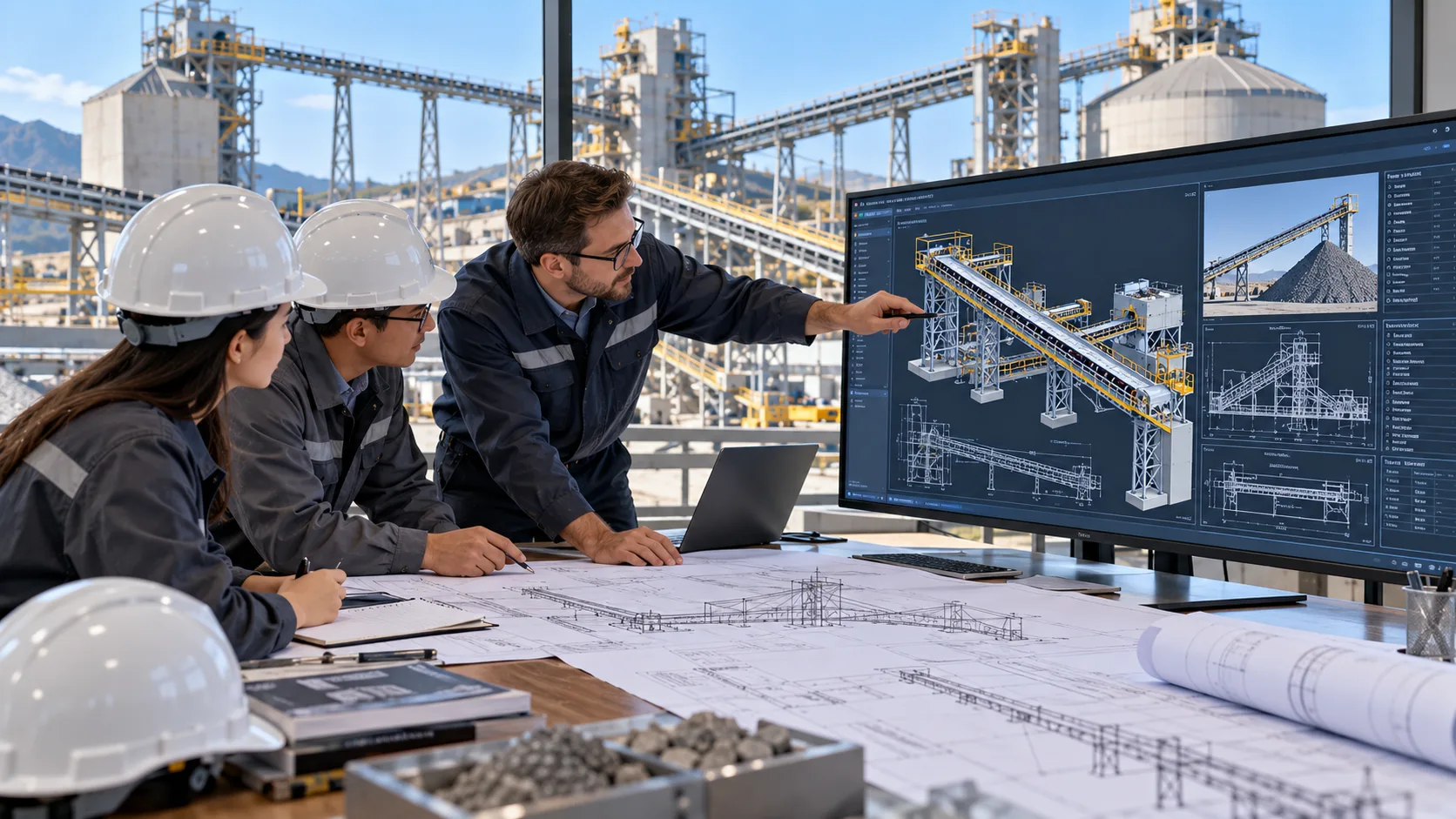
Continuous bulk solids transportation in cement manufacturing, aggregate quarries, and mineral processing requires conveyor architectures matched to specific site topographies, elevation profiles, and material characteristics. DARKO Cement Machinery manufactures custom troughed, overland curved, enclosed pipe, high-angle sidewall, and low-friction air-supported belt conveyor systems designed to lower cost-per-ton logistics and eliminate production bottlenecks.
Universal Troughed Belt Conveyor Systems
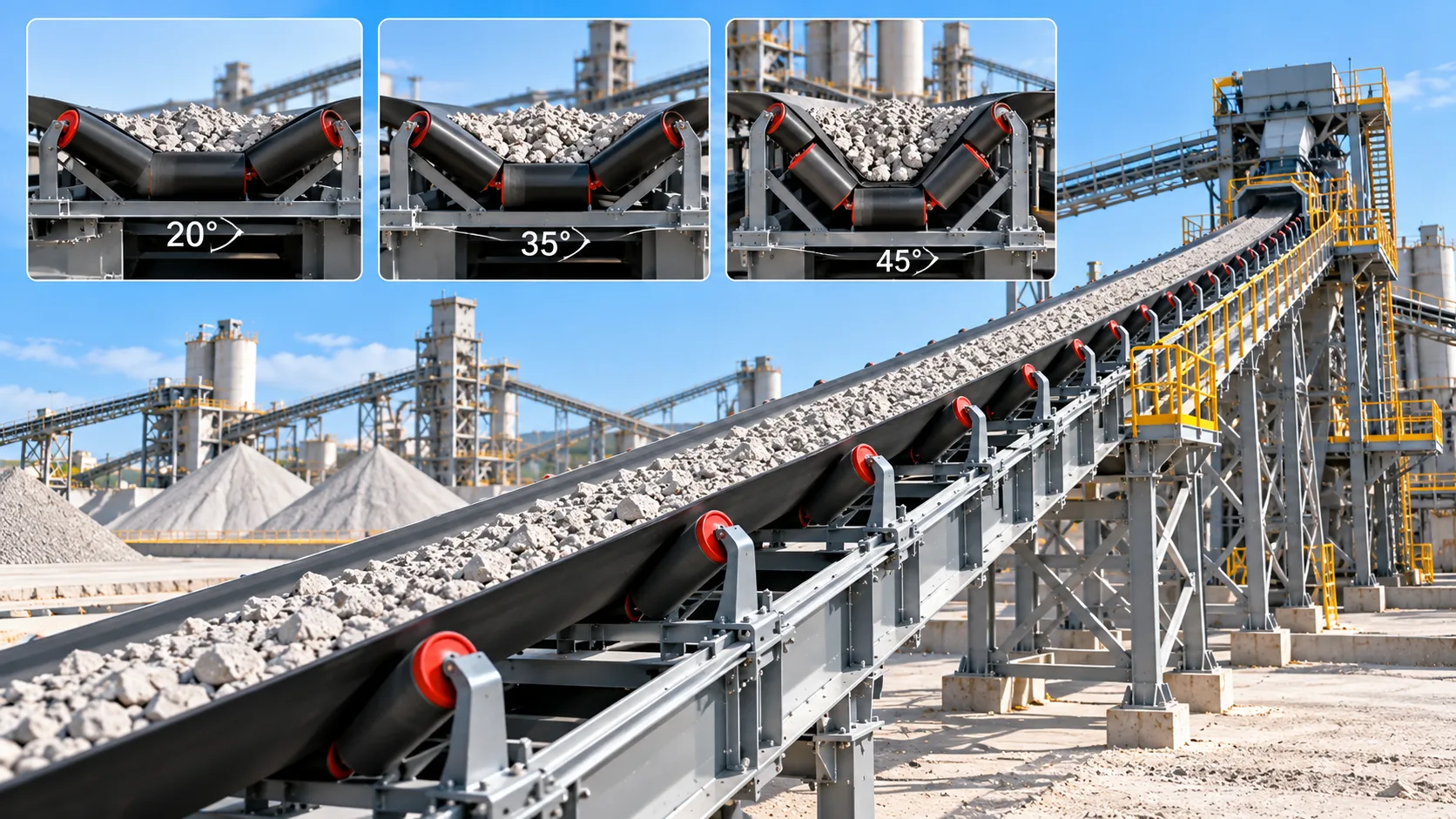
Engineered with rigid structural channel or modular box-truss stringers, DARKO troughed belt conveyors utilize precision 3-roll and 5-roll idler sets positioned at 20°, 35°, and 45° troughing angles. This deep-pocket geometry maximizes cross-sectional volumetric capacity while eliminating material edge spillage during high-capacity transfer between primary crushing, homogenization yards, and grinding mills.
Standard Trough Angles
20°, 35°, and 45° fixed or garland idler sets
Available Belt Widths
500 mm to 2,400 mm (20 in to 96 in)
Conveying Capacity
Up to 6,000 t/h continuous bulk flow
Standard Flight Distance
10 m to 1,500 m intermediate plant spans
Designated Bulk Materials:
Heavy-Duty Frame Architecture
Standardized CEMA-C/D/E and DIN idlers with multi-labyrinth sealed bearings are paired with hot-dip galvanized weather hoods, delivering dependable 24/7 runtimes under abrasive mineral dust and integrating smoothly with plant-wide dust collection equipment.

Belt Conveyor Structural Configurations Engineering Matrix
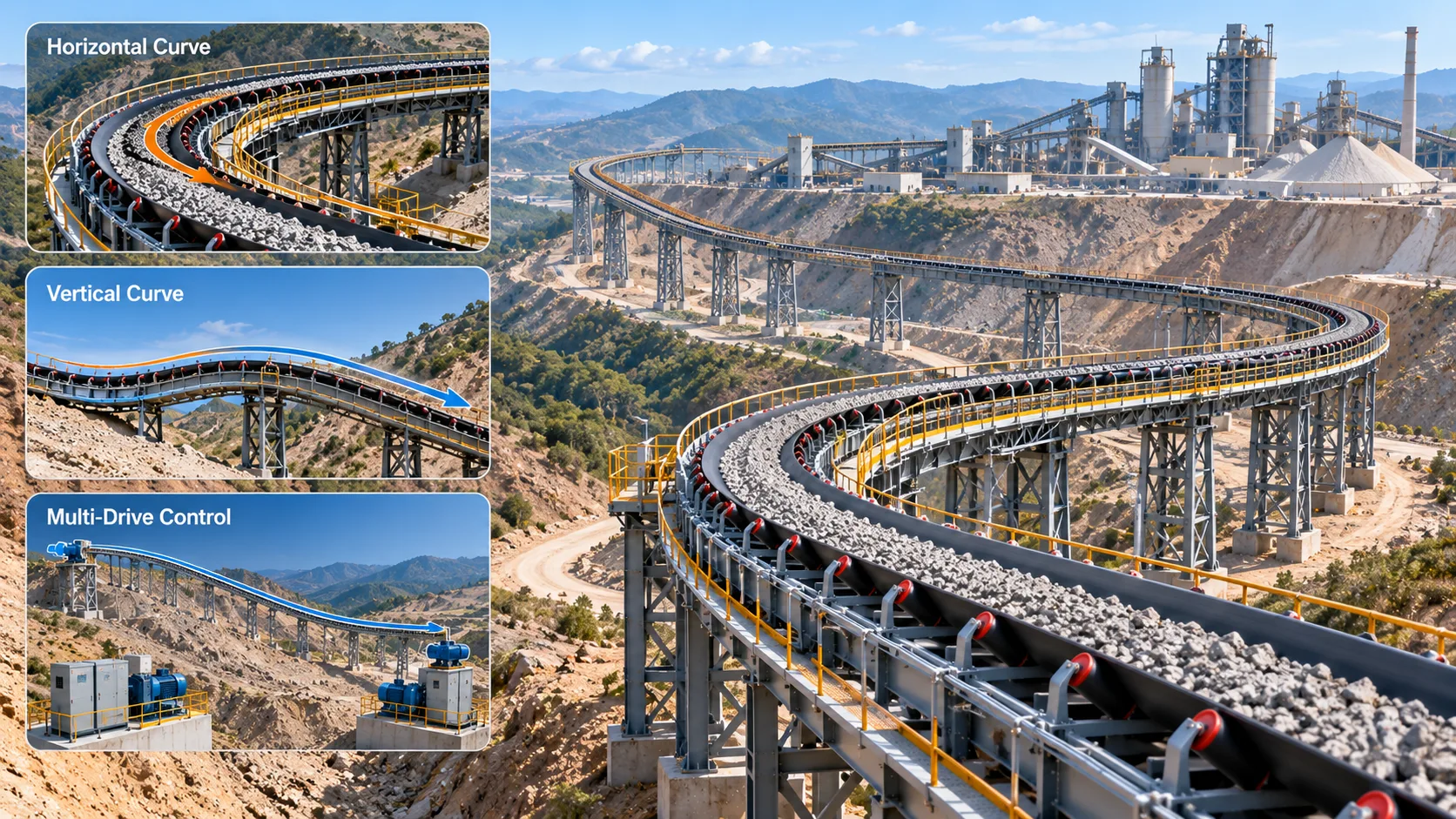
Compare maximum incline angles, curve navigation capabilities, dust containment levels, and optimal cement plant process zones across DARKO belt conveyor configurations.
| Configuration Type | Max Incline Angle | Curve Capabilities | Dust Containment | Optimal Plant Zones |
|---|---|---|---|---|
| Troughed Belt Conveyor | Up to 18° (smooth) / 28° (chevron) | Linear alignments & vertical curves | Enclosed gallery & hood options | Primary crushers, stockyards, loading docks |
| Overland Curved Conveyor | Up to 16° – 20° terrain-adaptive | 3D horizontal & vertical curves (R ≥ 800 m) | Aerodynamic weather hood covers | Quarry-to-plant cross-country hauling |
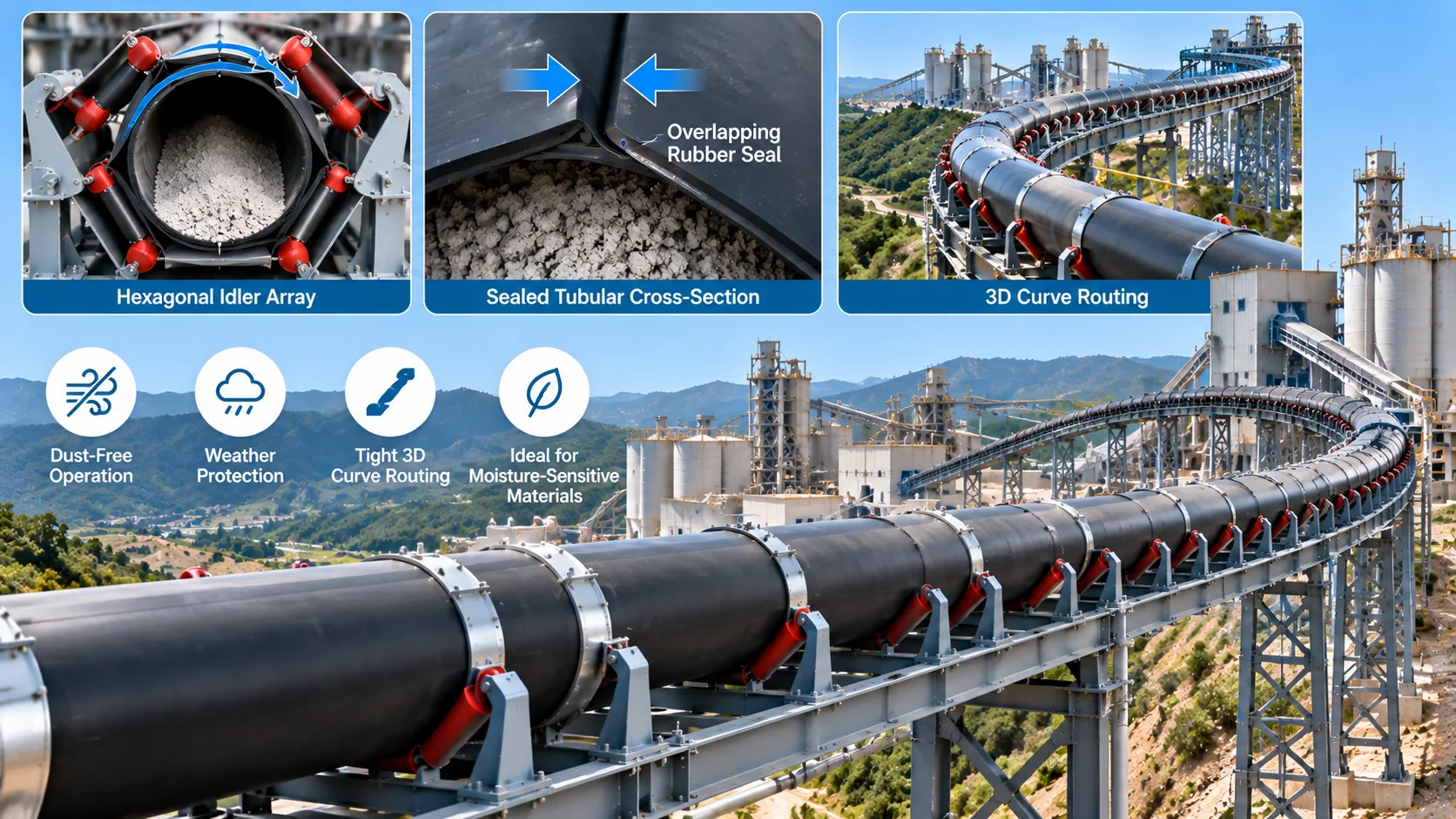
| Enclosed Pipe Conveyor | Up to 30° steep continuous | Tight 3D spatial curves (R ≥ 300 × D) | 100% Hermetic Seal | Raw meal, fly ash, additive intake lines |
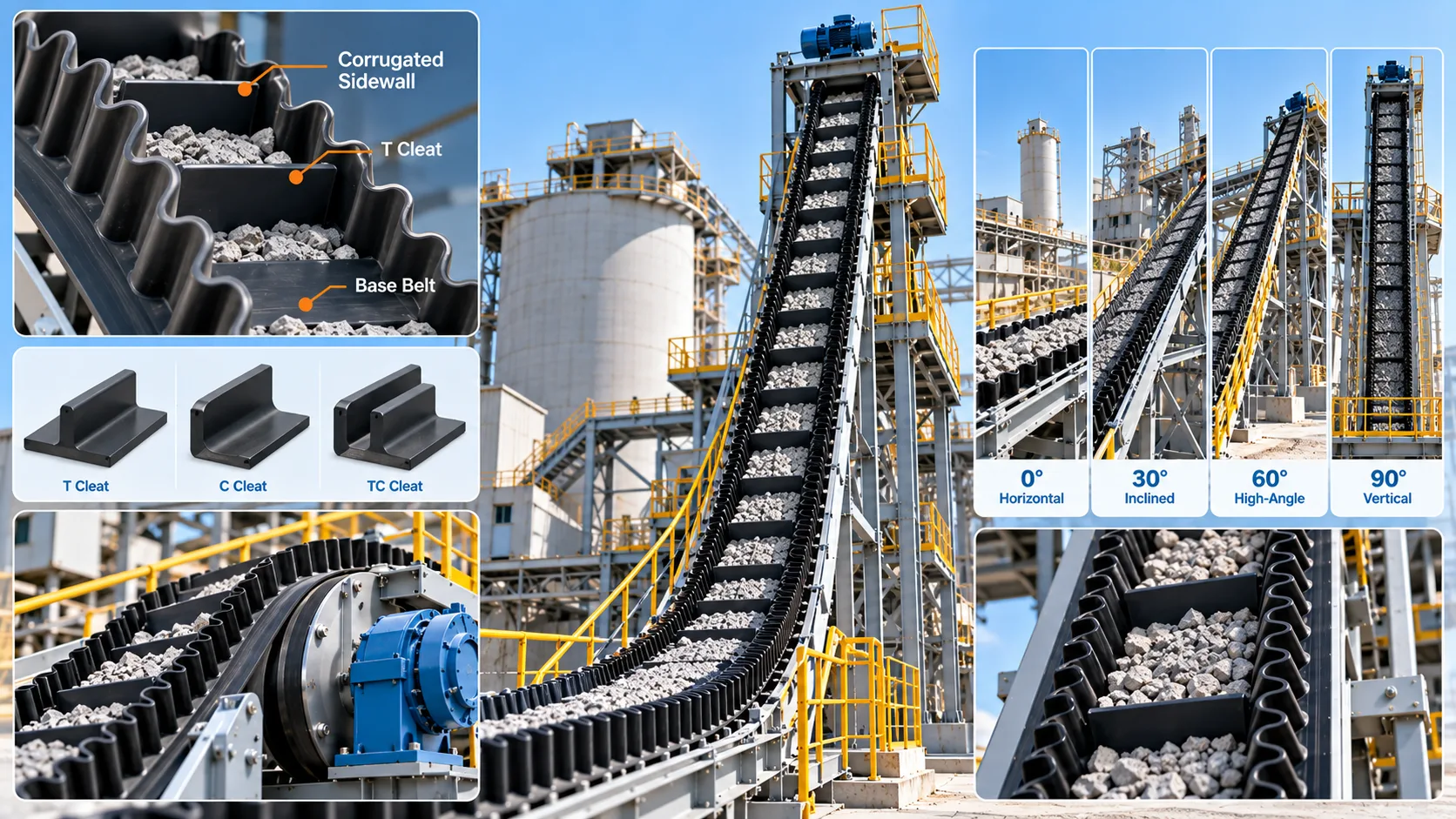
| Corrugated Sidewall Conveyor | Up to 90° True Vertical | S-shape & Z-shape vertical transitions | Fully enclosed casing available | Silo top infeed, tight hopper pits, mill circuits |
| Air-Supported Belt Conveyor | Up to 15° standard | Straight line or shallow vertical curves | Sealed Duct Containment | Fine dry powders, biomass, bulk ship loaders |
Heavy-Duty Mechanical Engineering & Component Architecture
Continuous bulk handling across harsh mineral extraction, limestone quarries, and high-temperature clinker processing requires uncompromising mechanical durability. DARKO Cement Machinery builds industrial belt conveyor systems with failure-resistant components designed to mitigate localized point wear, absorb high transient starting loads, and guarantee continuous 24/7 volumetric throughput under severe industrial conditions.
Drive Stations & High-Friction Engineered Pulleys
Our conveyor drive stations utilize heavy-duty helical and bevel-helical gear reducers integrated with variable frequency drives (VFD) to deliver controlled acceleration profiles, reduce electrical surge spikes, and ensure precise load sharing across multi-motor head and tail configurations. Pulley shells are fabricated from heavy-wall seamless carbon steel pipe, thermal stress-relieved, and dynamically balanced before precision final machining.
- ✓ Pulley Lagging: Hot-vulcanized herringbone grooving or 80% direct-bond ceramic tile lagging to eliminate belt slip under wet, muddy conditions.
- ✓ Shaft Connection: Keyless friction locking assemblies (B-LOC / Ringfeder standard) that eliminate keyway notch stress concentrations.
- ✓ Gearbox Rating: AGMA and ISO mechanical service factor ≥ 2.0 with forced-oil lubrication circuits and thermal RTD sensors.
- ✓ Shaft Metallurgy: Forged 42CrMo4 / AISI 4140 alloy steel, 100% ultrasonic tested for internal flaw-free structural integrity.
Engineering Specifications Matrix
Bearing & Sealing Benchmark
Heavy-Duty Roller Idler Sets & Multi-Stage Sealing
Idler rolling resistance represents the single largest contributor to continuous power consumption along long-distance overland conveyors. DARKO precision-welds deep-drawn bearing housings to heavy-gauge steel tubing, ensuring low moment of inertia, precise shell concentricity, and multi-stage labyrinth protection that completely isolates bearings from abrasive dust and moisture ingress.
- ✓ Troughed Assemblies: Standard 20°, 35°, and 45° 3-roll frame geometries manufactured from rigid structural channel.
- ✓ Impact Idler Rows: Heavy-duty synthetic rubber cushion rings positioned under transfer chutes to absorb dynamic lump energy.
- ✓ Return Configurations: Flat steel rollers, spiral rubber cleaning discs, and inverted V-return self-aligning tracking sets.
- ✓ Anti-Corrosion Shell: Hot-dip galvanized structural steel frames or electrostatically applied two-part epoxy finishes.
Impact-Resistant Rubber Belting & Steel Cord Carcasses
We engineer custom carcass constructions matched directly to material abrasiveness, drop energy, and tensile demand. From multi-ply polyester-polyamide (EP) fabric belts for standard quarry runs to ultra-high-tensile steel cord (ST) belts for multi-kilometer overland links, our belting solutions ensure low elongation, exceptional troughability, and superior dynamic splice fatigue life.
EP Fabric Plies
High elasticity, deep troughing compliance, and rapid impact recovery under primary quarry shock loads.
ST Steel Cord Series
ST500 to ST5400 ratings for overland conveyor profiles requiring minimal working belt stretch and high safety factors.
Heat-Resistant EPDM
Engineered for continuous 180°C hot cement clinker transport with thermal peak resistance exceeding 200°C.
Belt Specification Range
Take-Up Engineering Characteristics
Dynamic Hydraulic & Gravity Take-Up Systems
Belt elasticity during acceleration ramps and sudden emergency braking creates dynamic stress waves that can induce pulley slippage, excessive belt sag between idlers, and structural racking. DARKO designs proportional hydraulic winches and counterweighted gravity take-up towers that maintain uniform working tension across all operational and variable tonnage conditions.
- ✓ Transient Shock Absorption: Rapid tension compensation prevents hazardous belt sag, belt slap, and harmonic vibration during VFD ramp-up.
- ✓ Load Cell Integration: Continuous electronic tension telemetry connected via 4-20mA signals directly to the central plant DCS.
- ✓ Travel Limit Switches: Redundant upper and lower carriage travel sensors to prevent mechanical bottoming-out and rope slack.
Multi-Stage Scraping & Engineered Chute Transfer Systems
Material carryback and unconstrained transfer chute turbulence lead to premature idler abrasion, belt mistracking, and airborne fugitive dust. Often paired with specialized dust-collection equipment and high-capacity baghouse dust collectors to capture particulate at loading zones, our heavy-duty belt cleaning packages integrate spring-tensioned tungsten-carbide primary scrapers, segmented polyurethane secondary blades, internal return V-plows, and rock-box transfer chutes engineered to control flow velocity and absorb severe rock impact.
- ✓ Primary Blade: Dynamic spring-tensioned tungsten-carbide tips positioned directly at the discharge trajectory of the head pulley.
- ✓ Secondary Cleaner: Segmented polyurethane cushions that flex automatically across mechanical splices without belt damage.
- ✓ Engineered Chutes: Rock-box step geometry creating "rock-on-rock" impact to absorb kinetic drop energy from large limestone blocks.
- ✓ Wear Liners: Bolted high-chromium cast alloy wear plates (60–65 HRC), Hardox 500 liners, and 95% alumina ceramic mosaic tiles.
Cleaning & Containment Ratings
Ultrasonic Testing & Dynamic Balancing Protocols
Every rotating component manufactured by DARKO Cement Machinery undergoes rigorous quality verification. Drive shafts undergo 100% ultrasonic flaw detection (UT), idler sets pass submersion ingress testing, and all conveyor pulleys are balanced in accordance with ISO 1940 standards to guarantee reliable continuous operation in severe mining and cement environments.
Belt Conveyor Capacity Chart & Engineering Sizing Matrix
Verified preliminary sizing benchmarks for plant engineers, EPC contractors, and procurement teams evaluating high-performance bulk conveying equipment and continuous material handling lines.
All volumetric ratings are calculated in accordance with CEMA standards at a reference material bulk density of 1.6 t/m³ (100 lb/ft³) with continuous nominal cross-sectional loading.
Standard Belt Conveyor Specifications & Throughput Matrix
Horizontal scroll enabled for comprehensive sizing data| Series | Belt Width (mm) | Conveying Speed (m/s) | Idler Trough Angle | Nominal Capacity (TPH @ 1.6 t/m³) | Max Allowable Lump (mm) | Standard Idler Bearing |
|---|---|---|---|---|---|---|
| B500 | 500 mm (20 in) | 0.8 – 2.0 m/s | 20° / 35° | 78 – 195 TPH | 100 mm | 6204 / 6205 2RS |
| B650 | 650 mm (26 in) | 1.0 – 2.5 m/s | 30° / 35° | 170 – 425 TPH | 150 mm | 6204 / 6205 2RS |
| B800 | 800 mm (32 in) | 1.25 – 3.15 m/s | 35° / 45° | 335 – 845 TPH | 200 mm | 6205 / 6305 2RS |
| B1000 | 1000 mm (40 in) | 1.6 – 4.0 m/s | 35° / 45° | 620 – 1,550 TPH | 280 mm | 6305 / 6306 2RS |
| B1200 | 1200 mm (48 in) | 1.6 – 4.5 m/s | 35° / 45° | 960 – 2,700 TPH | 350 mm | 6306 / 6308 2RS |
| B1400 | 1400 mm (56 in) | 2.0 – 5.0 m/s | 35° / 45° | 1,580 – 3,950 TPH | 400 mm | 6307 / 6308 2RS |
| B1600 | 1600 mm (64 in) | 2.0 – 5.6 m/s | 35° / 45° | 2,150 – 6,020 TPH | 480 mm | 6308 / 6309 2RS |
| B1800 | 1800 mm (72 in) | 2.5 – 6.0 m/s | 35° / 45° | 3,120 – 7,500 TPH | 550 mm | 6309 / 6310 2RS |
| B2000 | 2000 mm (80 in) | 2.5 – 6.3 m/s | 35° / 45° | 4,050 – 10,200 TPH | 600 mm | 6310 / 6312 2RS |
| B2400 | 2400 mm (96 in) | 3.15 – 7.0 m/s | 35° / 45° | 6,100 – 13,800 TPH | 700 mm | 6312 / 6314 2RS |
Drive Motor Power Selection Guide
Estimated motor power configurations (15 kW to 2×1000 kW) determined by horizontal centerline distance and total vertical elevation lift.
Single Drive Units
- • Power range: 15 kW – 132 kW (IEC / NEMA)
- • Shaft-mounted helical-bevel gear reducers
- • Direct coupling or hydrodynamic fluid coupling start
- • Integrated low-speed mechanical backstop for inclined runs
Dual Tandem Drive Stations
- • Power range: 160 kW – 2×450 kW
- • Dual drive pulley arrangement with ceramic lagging
- • VFD controlled master-slave dynamic load sharing
- • High-capacity hydraulic disc brakes on high-speed shaft
Multi-Drive Overland Systems
- • Power range: 2×500 kW – 2×1000 kW
- • Medium-voltage (3.3 kV / 6.6 kV / 10 kV) wound-rotor / VVVF
- • Real-time torque synchronization and transient wave damping
- • Active hydraulic tension winches with position feedback
Non-Standard Custom Sizing Guidelines
Complex bulk handling conditions demand derating formulas, specialized liner selections, and dynamic safety margins.
High-Moisture & Sticky Clays
Materials containing over 12% moisture flatten dynamic surcharge angles by 5° to 10°. We recommend derating theoretical volumetric capacity by 15%–20% and adopting 45° trough idlers with UHMW-PE low-friction chute liners.
Capacity Derating Factor: 0.80 – 0.85Abrasive Primary Limestone & Clinker
Heavy sharp lumps require belt speeds controlled below 2.5 m/s to reduce cover abrasion. Design includes rock-box transfer chutes, reinforced steel cord ST belting, and multi-tier impact garland cradle beds.
Recommended Belt Speed: ≤ 2.5 m/sRegenerative Downhill Systems
Downhill conveying with negative elevation generates continuous electrical regeneration. DARKO engineers four-quadrant regenerative AFE drives to feed power back into the plant grid, paired with spring-applied fail-safe disc brakes.
Grid Integration: 4-Quadrant Regenerative VFDRequest Belt Conveyor Engineering Calculations & Design Review
Planning a new belt conveyor system or upgrading an existing installation? Share your conveying requirements and layout drawings with DARKO's engineering team for project-specific technical evaluation, including drive power requirements, belt tension considerations, and transfer chute design.
Share your project details for engineering review.
Heavy-Duty Belt Conveyor Systems Across Cement & Mining Operations
Modern high-capacity cement manufacturing and mineral processing lines demand reliable, wear-resistant bulk material handling alongside high-performance dust collection equipment across every stage of production. DARKO Cement Machinery delivers fully engineered conveyor systems designed to withstand abrasive limestone rocks, high-temperature clinker nodules, fine calcined powders, and high-tonnage marine terminal ship loading.

Primary Quarry Crushing to Raw Storage
Downhill and horizontal curved overland conveyor lines engineered to transfer unscreened, sharp primary crushed limestone and shale across mountain terrain directly to plant storage sheds.
- Belt Carcass: ST3150 high-tensile steel cord with transverse breaker plies.
- Gallery Structure: Enclosed large-span tubular or triangular truss with walkway.
- Transfer Chutes: Rock-box baffle design with heavy-duty impact bed cradles.
Pre-Homogenization & Reclaiming Lines
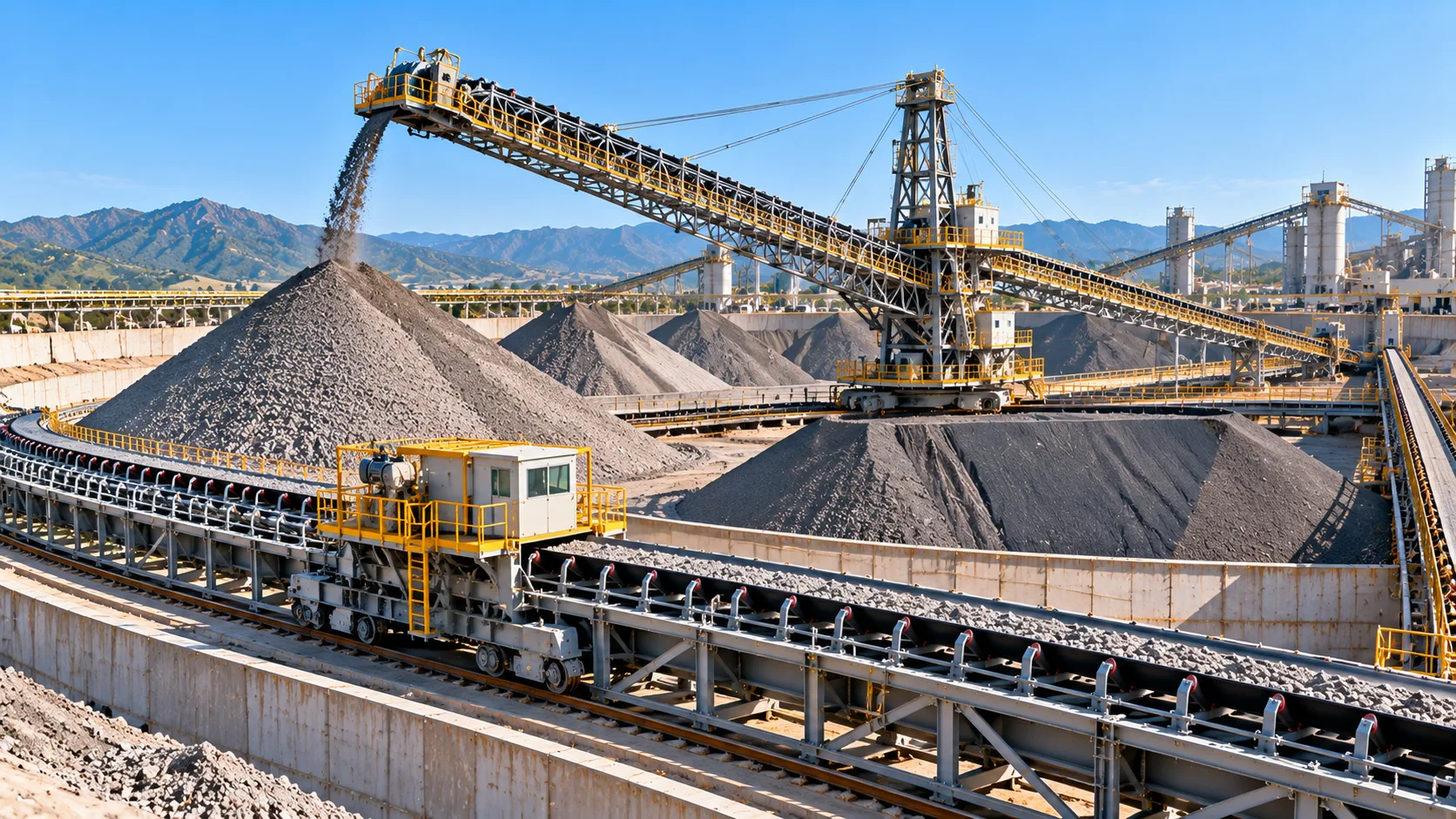
Automated luffing stacker boom conveyors, motorized tripper cars, and reversible shuttle conveyors providing precise chevron and windrow blending in circular or longitudinal stockyards.
- Stacking Boom: Reversible belt travel with hydraulic luffing range control.
- Belt Construction: Multi-ply EP500 polyester-nylon with anti-static compound.
- Process Control: Stockpile laser profiling with automated DCS track sequencing.

Kiln Cooler Hot Clinker Off-Take
Specialized thermal transport systems engineered to convey red-hot abrasive clinker nodules at 120°C to 180°C (with thermal spikes exceeding 200°C) from grate coolers into clinker silos.
- Belt Compound: Heat-resistant EPDM rubber with steel mesh anti-tear insert.
- Idler System: Forward-inclined heat-dissipation rollers with synthetic grease.
- Containment: Ceramic-lined hood with convection cooling ventilation dampers and high-temperature cyclone dust collectors.
Raw Meal & Slag Grinding Feed Lines
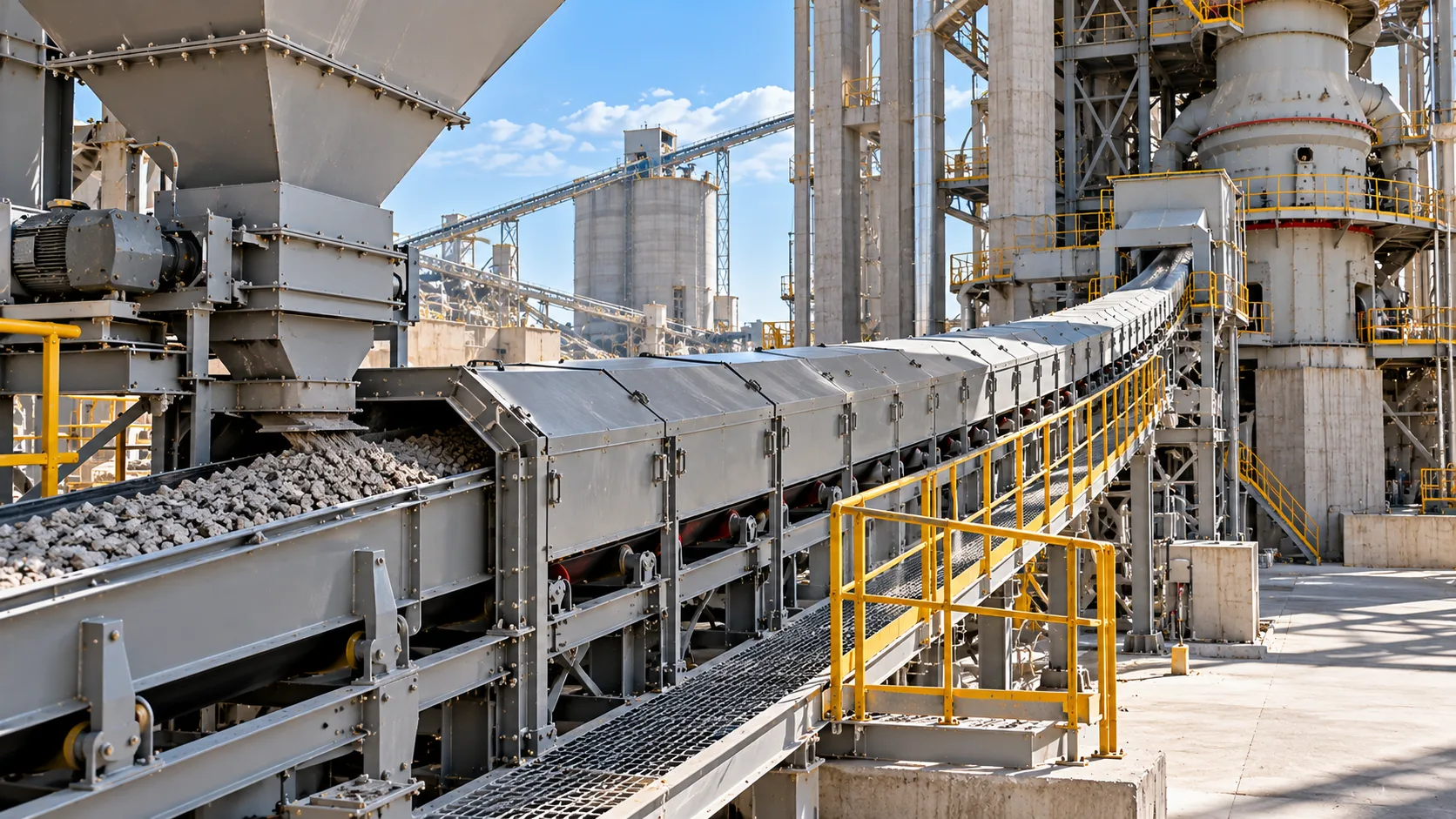
Enclosed, micro-negative pressure belt feeders and transit conveyors supplying vertical roller mills and ball mills with steady volumetric flow, eliminating fugitive dust emissions.
- Sealing System: Dual-lip polyurethane skirtboard with passive dust suppression and venting to baghouse dust collectors.
- Drive Control: Closed-loop vector VFD system for responsive proportioning.
- Equipment Protection: High-gradient suspended electromagnetic cross-belt separator.

Bulk Dispatch & Marine Shiploading
High-efficiency telescopic, luffing, and slewing conveyor boom systems providing fast, environmentally compliant loading into ocean vessels, river barges, and bulk rail hoppers.
- Boom Kinematics: Hydraulic luffing and slewing structure with shuttle extension.
- Discharge Chute: Cascading anti-dust telescopic bellows with sonar level control.
- Corrosion Protection: ISO 12944 C5-M marine epoxy coating with stainless fasteners.

Mining Beneficiation & Dry Tailings
Curved long-span overland conveyor flights engineered to transport high-density mineral ores, dry tailings filter cake, and aggregates across varied elevations with minimal transfer stations.
- Drive Topology: Multi-pulley head and tail synchronized variable frequency drives.
- Take-Up Unit: Automated hydraulic winch system responding to transient starts.
- Safety Interlock: Continuous embedded sensor loop for real-time rip detection.
Operating Across 200+ Modern Cement Lines Worldwide
From 2,500 t/d regional production lines to large-scale 10,000 t/d dry-process cement clinker complexes, DARKO Cement Machinery delivers robust, CEMA and DIN compliant belt conveying solutions tailored for demanding plant environments.
Belt Conveyor vs Chain Conveyor & Alternative Handling Systems
Selecting the appropriate continuous bulk material handling equipment demands a rigorous balance between capital investment, drive mechanical efficiency, material envelope limits, and lifecycle operating costs. For cement plants, aggregate quarries, and mineral processing facilities, industrial belt conveyors deliver decisive mechanical and economic advantages over en-masse drag chain conveyors, vertical bucket elevators, industrial screw conveyors, and pneumatic air gravity slides across high-tonnage and extended-distance routes.
| System Architecture | Throughput Range | Max Conveying Span | Lump Size Tolerance | Specific Energy Consumption | Primary Application Zone |
|---|---|---|---|---|---|
| Heavy-Duty Belt Conveyor | 300 to 6,000+ TPH | 15+ km (Overland Flights) | ≤ 350 mm (Run-of-Mine) | Lowest (0.015–0.035 kWh/t·km) | Primary quarry crushing to stockyards, clinker transfer, bulk shiploading |
| En-Masse Drag Chain Conveyor | 100 to 1,200 TPH | ≤ 60 m | ≤ 50 mm | Moderate (0.08–0.15 kWh/t·km) | Kiln-hood hot clinker recycling, enclosed dust-tight short transfers |
| Continuous Bucket Elevator | 50 to 1,500 TPH | ≤ 65 m (Pure Vertical Lift) | ≤ 80 mm | High (Gravity potential demand) | Storage silo vertical feeding, preheater tower material circulation |
| Industrial Screw Conveyor | 10 to 400 TPH | ≤ 30 m | ≤ 25 mm | High (Continuous sliding friction) | Hopper discharge beneath baghouse dust collectors, regulated additive volumetric dosing |
| Air Gravity Conveying Slide | 50 to 1,000 TPH | ≤ 100 m (Declined slope >6°) | Fine Dry Powders Only (<0.2 mm) | Low to Moderate (Blower power) | Fluidized raw meal, pulverized fly ash, and finished cement transport |
Conveying Distance and Geometric Envelope Limits
Horizontal range and route geometry establish the primary engineering boundaries during system selection. While bucket elevators dominate pure vertical lifts up to 65 meters, their horizontal transfer capability is zero. Conversely, screw conveyors and en-masse drag chain conveyors become economically and mechanically unviable beyond 30 to 60 meters due to severe flight abrasion, internal chain tension limits, and structural casing deflection under heavy loads.
Industrial troughed and overland belt conveyors deliver unmatched versatility, spanning single flights from 50 meters to over 15 kilometers. By incorporating horizontal curves and vertical incline transitions up to 18 degrees (or up to 90 degrees with corrugated sidewall configurations), belt conveyors seamlessly trace natural terrain contours, eliminating the structural expense and dust emission risks of multiple intermediate transfer towers often requiring auxiliary dust collection equipment.
Material Granulometry and Abrasiveness Adaptability
Bulk material lump size and abrasiveness strictly dictate equipment longevity. Air gravity slides are exclusively engineered for fluidizable, dry, sub-millimeter powders; introducing uncrushed limestone or hot clinker nodules destroys the aeration membrane instantly. Similarly, highly abrasive aggregates cause rapid flight degradation and barrel wear in industrial screw conveyors within weeks of continuous duty.
Heavy-duty belt conveyors accommodate the broadest granulometry spectrum in industrial material handling. From blasted run-of-mine limestone blocks up to 350 mm to hot abrasive clinker nodules, reinforced multi-ply EP and steel-cord conveyor belts absorb heavy kinetic loading shocks across engineered impact beds without casing gouging, binding, or catastrophic mechanical jams.
Lifecycle Operational Expenditure (OPEX) Trade-Off
Comparing continuous bulk material handling equipment requires a holistic evaluation of specific drive power consumption, scheduled component replacement intervals, and unplanned downtime costs over a standard 10-to-20-year operating horizon.
Belt conveyors operate entirely on low rolling friction across precision idler bearings, cutting specific electrical energy per ton-kilometer to a fraction of the sliding drag friction inherent in chain conveyors and high-pressure pneumatic blower loops.
Precision-machined idler rollers featuring double-sided, multi-lip labyrinth seals (IP65) prevent abrasive clinker and limestone dust ingress, eliminating the continuous lubrication schedules and link replacements required by en-masse chains.
Unlike drag chain systems where chain elongation accelerates bottom trough wear and causes sudden structural failure, belt conveyor wear is localized to replaceable top covers and tungsten-carbide cleaner blades with clear visual wear indicators.
Engineering Feasibility Studies & Equipment Selection Support
As a global manufacturer of full-spectrum bulk conveying equipment, DARKO Cement Machinery delivers unbiased comparative engineering studies. Our technical team evaluates material abrasiveness, bulk density, hourly mass flow rates, and plant terrain layouts—including integration with pulse jet dust collectors for dust-free transfer chutes—to recommend the most cost-effective mechanical handling configuration.
- Dynamic CEMA/ISO standard belt tension and power calculations
- Comprehensive CAPEX vs. OPEX lifecycle payback modeling
- High-temperature clinker heat dissipation and rubber belt selection
- Turnkey overland alignment and transfer chute DEM flow simulation
Environmental Containment, Dust Control, and Smart Belt Conveyor Safety Systems
Modern cement production plants, limestone quarries, and high-capacity bulk terminals demand continuous material conveying that satisfies stringent particulate emission limits while safeguarding operating personnel. DARKO Cement Machinery engineers heavy-duty enclosed belt conveyor solutions, modular transfer point dust suppression chutes integrated with heavy-duty pulse jet dust collectors, and an integrated matrix of electrical safety switches compliant with OSHA, MSHA, and CE machinery safety directives.
Dust Suppression & Structural Enclosures
Airborne clinker dust, silica fines, and raw meal spillage cause accelerated mechanical wear, structural fouling, and regulatory non-compliance. Our custom conveyor systems pair seamlessly with industrial dust collection equipment to isolate bulk streams through engineered aerodynamic transfer chutes and modular environmental galleries.
Fully Enclosed Galleries & Corrugated Rain Hoods
Heavy-duty corrugated galvanized steel and reinforced composite hood covers shield conveyed bulk materials from crosswinds, rain, and snow. Dual-sided, self-locking inspection hinges allow rapid idler servicing without dismantling hoods. For long-distance overland lines, fully enclosed structural steel truss galleries provide an isolated micro-environment that completely eliminates cross-contamination and weather downtime.
- Galvanized Steel Covers: 22-gauge corrugated panels with weather-tight overlapping seals.
- Maintenance Access: Full 180-degree ergonomic swing-up sections with dual positive-locking latches.
Dual-Sealing Transfer Chutes & Passive Micro-Fogging
Transfer transition chutes feature internal rock boxes and curved deflector plates that center the material flow, equalizing load velocity with belt speed. Where high air-displacement rates occur, chutes interface with auxiliary baghouse dust collectors or utilize passive expansion stilling chambers to settle fines back onto the main cargo bed without excessive energy consumption.
- Skirting Architecture: Dual-contact 70-Shore-A polyurethane primary and secondary sealing barriers.
- Wear Liners: Bolt-on high-chromium white iron and alumina ceramic mosaic wear tiles.
Smart Sensors & Interlocking Safety Matrix
High-tonnage continuous belt conveyors generate massive mechanical forces. DARKO integrates a failsafe electrical and instrumentation suite that continuously monitors drive dynamics, carcass alignment, structural temperature, and perimeter safety zones.
Emergency Pull-Wire & Belt Misalignment Switches
Bi-directional safety pull-cord switches are mounted along accessible maintenance walkways at 30-meter intervals, providing instant emergency shut-off capability. Heavy-duty two-stage belt conveyor safety switches detect tracking drift early, triggering a plant SCADA alarm at a 10-degree deviation and commanding an automated drive trip at 15 degrees before belt edge fraying or structure collision can occur.
- Pull Switches: Rugged IP67 cast-aluminum housings equipped with mechanical manual reset flags.
- Tracking Sensors: Heavy-duty stainless steel actuation rollers built for abrasive operating conditions.
Speed Slip Encoders & Rip Detection Scanners
Non-contact speed monitors track driven pulley rotation against non-driven idlers, shutting down motors instantly if belt slip exceeds preset thresholds. Beneath critical transfer chutes, high-frequency inductive transponder loops and optical laser conveyor belt tear detector systems identify carcass punctures and halt high-speed drive lines within milliseconds, preventing catastrophic longitudinal slitting.
- Tear Detection: Embedded carcass vulcanized antenna coils paired with rapid microprocessor scanners.
- Digital Telemetry: Native Profinet, Modbus TCP, and Ethernet/IP integration modules for DCS networks.
Safety Interlock and Environmental Monitoring Specifications
Every conveyor engineered by DARKO Cement Machinery adheres to international safety thresholds and emissions standards. The table below details our standard multi-stage sensor architectures, response criteria, and interlocking logic for cement manufacturing and heavy bulk operations.
| Subsystem | Detection Mechanism | Response Threshold | Control Action | Regulatory Standard |
|---|---|---|---|---|
| Perimeter E-Stop | Bi-directional tensioned wire rope | Manual pull actuation (>40 N) | Instant main motor trip | OSHA 1926.555 / EN 620 |
| Belt Drift Control | Two-stage mechanical roller switch | Stage 1: 10° | Stage 2: 15° | Alarm DCS → Motor cutoff | MSHA 30 CFR § 56.14109 |
| Drive Pulley Slip | Non-contact inductive pulse sensor | 10% speed differential | Controlled VFD deceleration | ISO 5048 / DIN 22101 |
| Longitudinal Rip Guard | Embedded RF sensor loops + laser grid | Broken RF circuit continuity | Emergency stop <0.8 sec | CEMA Engineering Standards |
| Bearing Temperature | Integrated PT100 RTD sensors | 85°C continuous temperature | Telemetry alarm & lube alert | ISO 10816 Vibration Standard |
| Chute Dust Containment | Negative pressure unpowered baffles | <5 mg/m³ fugitive dust index | Continuous passive settling | EPA Method 9 Dust Compliance |
Unified Central Control Architecture for Heavy Conveyor Lines
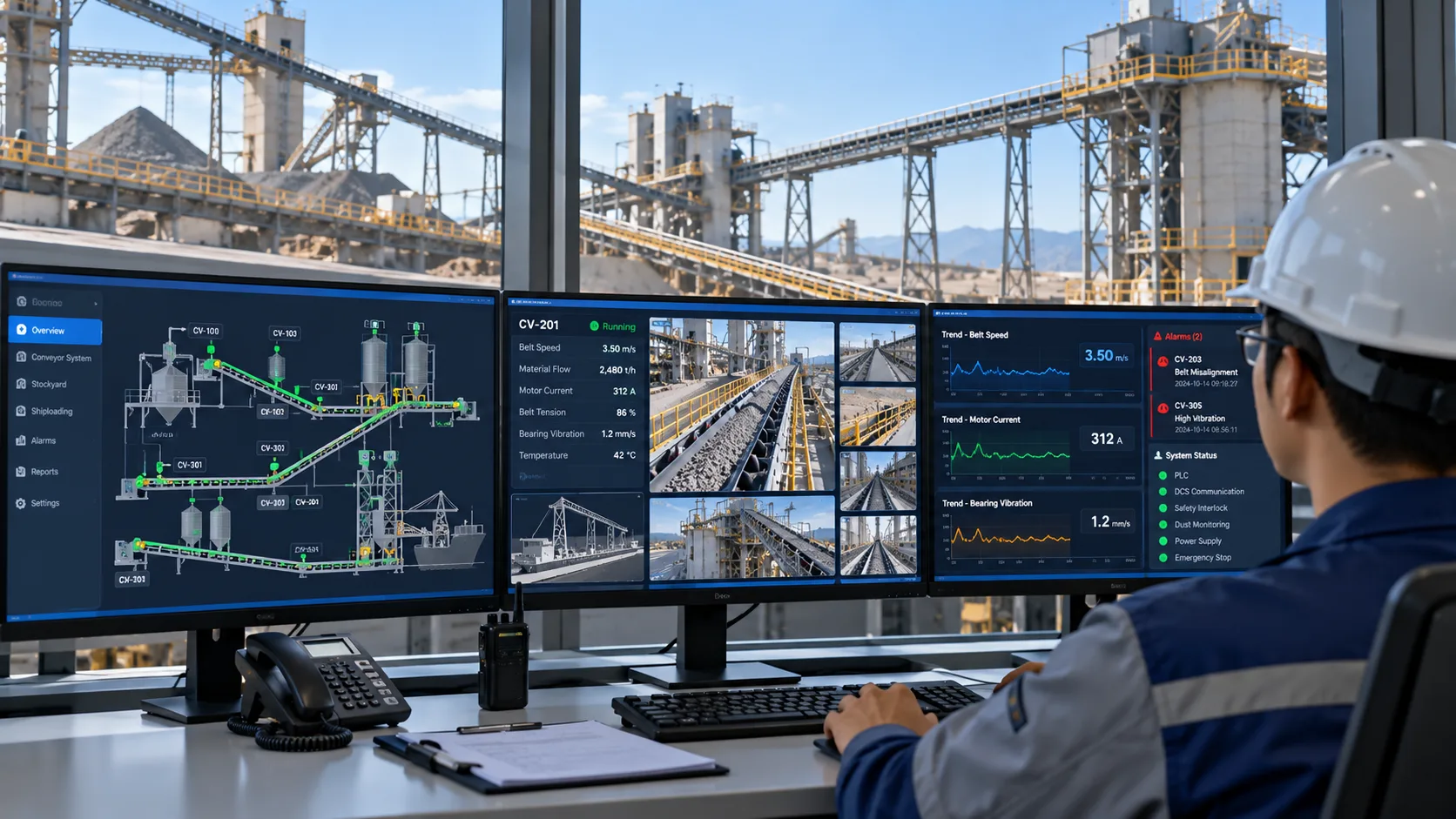
All safety switches, speed monitors, bearing vibration sensors, and dust containment transmitters engineered by DARKO integrate directly into modern plantwide DCS and SCADA networks. Our pre-programmed PLC safety routines deliver sequential starting, anti-pileup chute interlocking, dynamic emergency ramp-down, and predictive maintenance telemetry.
Heavy-Duty Conveyor Fabrication Standards & QA Protocols
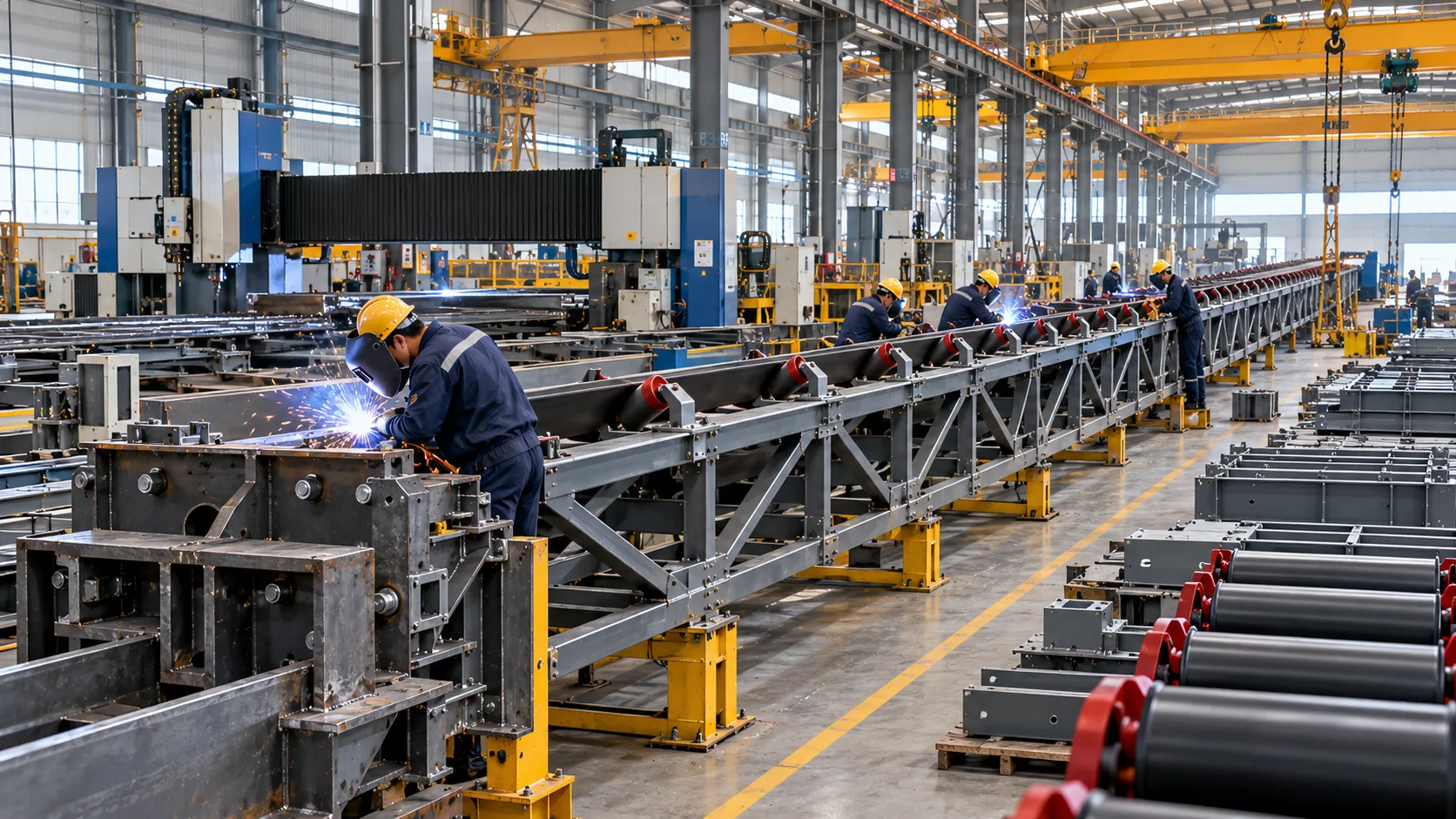
DARKO operates a 50,000+ m² specialized production center engineered for high-capacity bulk material handling equipment, maintaining strict machining tolerances to guarantee zero alignment deviation during site erection.
Equipped with high-precision CNC plasma cutters, submerged arc welders, and heavy-duty frame rolling stations.
Automated steel shot blasting followed by a three-coat industrial epoxy barrier system for extreme outdoor durability.
Every drive, take-up, and bend pulley undergoes ISO G2.5 balance verification and ultrasonic weld inspection.
Full conformity with EU machinery safety standards and ATEX explosion-proof ratings for combustible dust lines and integrated dust collection equipment.
Automated Plate Profiling
Multi-torch CNC plasma and laser systems cut structural trusses and transfer chutes compatible with automated pulse jet dust collectors with sub-millimeter repeatable tolerances.
Submerged Arc Welding
Full-penetration longitudinal welds on stringers and heavy take-up masts eliminate stress risers under continuous shock loads.
ISO G2.5 Pulley Balancing
Engineered turbine-welded end discs and shafts receive precision dynamic balancing to protect pillow blocks from premature fatigue.
Idler Runout & Seal Audits
Batch testing validates radial runout within 0.5 mm alongside water-submersion tests for IP65 multi-labyrinth seal integrity.
Worldwide Field Services & Commissioning
Our factory-trained mechanical and control engineers deploy directly to project sites globally, overseeing turnkey installation, optical alignment, and hot commissioning.
- ✓ Hot vulcanized and cold chemical rubber belt splicing up to ST6300 ratings
- ✓ Laser tracker verification of head, tail, and drive pulley centerline coplanarity
- ✓ Stepped 72-hour continuous no-load and full-capacity performance trial runs
- ✓ Integrated plant DCS interlocking, pull-cord checks, and zero-speed calibration
Conveyor Manufacturing Standards
Every fabrication lot complies strictly with CEMA standards and international manufacturing codes, designed to interface seamlessly with industrial baghouse dust collectors to maintain peak MTBF under aggressive quarry conditions.
International Quality & Safety Certifications
Select any credential below to review verified audit scopes, standards, and regulatory bodies.
Belt Conveyor Engineering FAQ & Field Troubleshooting Guide
Continuous bulk material conveying across quarry extraction, clinker handling, and finish grinding puts heavy mechanical demands on equipment. Abrasive wear, thermal degradation, structural settlement, and dynamic tension shifts can compromise conveyor performance. This engineering manual provides systematic diagnostic procedures, root-cause analyses, and field-proven maintenance guidelines for industrial belt conveyor systems and heavy-duty chain conveyors.
Root-Cause Analysis: Longitudinal belt wander on overland and plant-wide conveyor runs is driven by asymmetric loading profiles or frame misalignment. Common mechanical triggers include:
- Off-Center Chute Trajectory: Material hitting the belt off the geometric center induces continuous lateral thrust.
- Out-of-Square Idler Sets: Carrying or return idler brackets shifted out of perpendicular alignment relative to the stringer centerline.
- Pulley Shell Buildup: Abrasive fines or clay packing on bend and snub pulleys distort the effective cylindrical profile.
- Splice Crookedness: Belt ends cut and vulcanized out of square produce a cyclic lateral deflection with every belt rotation.
Engineering Remediation: Re-align internal chute deflector plates to center the falling material stream. Install forward-tilted self-aligning trainer idlers along transition zones and return runs (spaced every 30 meters). Mount tungsten carbide primary belt cleaners and motorized return-pulley scrapers to eliminate material carryback. DARKO pre-assembles modular truss sections with CNC laser alignment to ensure frame squareness within ±1.0 mm during plant installation.
Thermal Degradation Mechanism: Hot clinker discharging from grate coolers typically operates between 120°C and 180°C, with uncalcined nodules frequently surging above 220°C. Standard SBR rubber covers lose plasticizers under sustained heat, leading to carcass embrittlement, transverse micro-cracking, hardness escalation (Shore A exceeding 85), and eventual cover delamination.
Engineered Mitigation Protocols:
- High-Grade EPDM Compound: Specify sulfur-cured or peroxide-cured EPDM covers engineered for continuous 180°C duty and transient peaks up to 250°C.
- Glass-Fiber Barrier Plies: Embed high-tensile glass-fiber or aramid breaker plies between the top cover and the fabric carcass to halt heat penetration into the tension members.
- Cooling Chute Integration: Introduce induced-draft cross-ventilation inside loading hoods and configure deep-trough idler geometries with wide belt-to-structure clearances to maximize convective cooling.
Preventive Maintenance Support
DARKO provides project-specific Preventive Maintenance Manuals, CEMA-compliant dynamic simulation reports, and DCS telemetry diagnostic protocols with every belt conveyor engineering package.
Request an Engineering Evaluation
Send us your conveyor layout drawings, material lump size profile, or transfer point challenge for integrated systems and bulk loading equipment for a technical review by our bulk material handling engineers.