
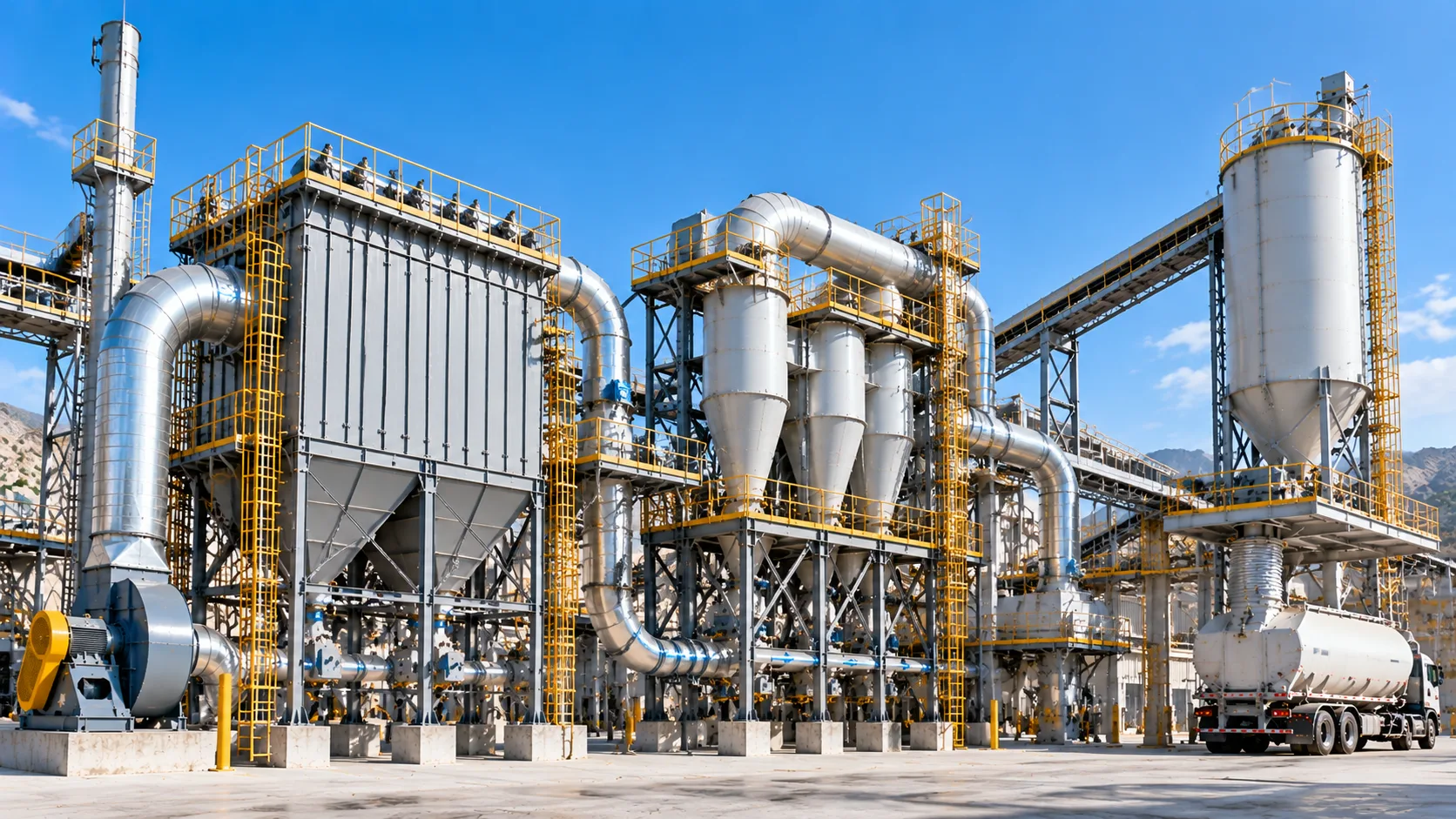
Full-Process Dust Generation Points & Engineering Capture Strategy
Achieving ultra-low emission compliance across an integrated cement manufacturing facility demands point-specific aerodynamic isolation, balanced system static pressure, and targeted filtration media. DARKO Cement Machinery engineers turn-key cement plant dust collection equipment customized to the distinct thermal profiles, abrasive loads, and particle dynamics of each production stage—recirculating captured particulates directly into active material streams to eliminate material waste and maximize plant-wide operational uptime.
Limestone Crushing & Belt Conveying
Primary jaw and secondary impact crushers generate sharp positive-pressure surges and heavy abrasive dust clouds upon rock fracturing. Insufficient capture velocity at transfer chutes and screen decks accelerates conveyor belt wear and creates severe fugitive dust migration across quarry transfer routes.
Raw Meal Vertical Roller Mill & Ball Mill
Raw grinding circuits combine extreme dust loading with hot process exhaust (80°C–120°C) and substantial moisture content. Inadequate aerodynamic design leads to dew-point condensation, severe filter bag blinding, uneven gas distribution, and premature fan impeller erosion.
Preheater Tower & Clinker Kiln Tail
The kiln tail presents the plant's most demanding thermodynamic and corrosive conditions. Flue gas streams carry sub-micron particulate, sulfur dioxide, volatile alkali chlorides, and elevated moisture levels, posing major risks of thermal degradation and structural acid corrosion.
Clinker Cooler Grate & Discharge
High-velocity air quenching of incandescent clinker generates turbulent, severely abrasive particulate streams. Direct introduction of coarse clinker fines into standard dust collectors causes severe duct scour, hopper wall perforations, and rapid fabric degradation.
Cement Grinding & Air Slide Conveying
Finished grinding circuits discharge ultra-fine cement particles with high specific surface areas and electrostatic surface charges. Sub-micron dust easily bleeds through standard woven textiles, while charged dust cakes resist conventional low-energy purge cleaning.
Clinker & Cement Storage Silo Tops
Pneumatic elevator transfers and aeration fluidization create continuous air volume displacement inside high-capacity storage silos. Without reliable negative-pressure venting, silo headspaces overpressurize, releasing severe dust clouds through emergency pressure relief valves.
Bulk Truck Loading Spouts & Automated Packing Stations
High-throughput bulk tanker filling and rotary packaging lines require effective dust extraction at discharge points. DARKO integrates concentric double-wall telescopic loading spouts with dedicated exhaust filtration systems to capture airborne dust and reduce fugitive emissions during continuous bulk dispatch operations.
Enclosed telescopic spouts and synchronized extraction help minimize airborne dust during truck, railcar, and vessel loading.
Process Stage Engineering & Operational Matrix
Standardized aerodynamic and thermodynamic parameters across core cement manufacturing extraction nodes.
| Process Section | Operating Temp | Inlet Dust Load | Recommended Filter Media | In-Line Material Return |
|---|---|---|---|---|
| Limestone Crushing | Ambient | 30 – 80 g/Nm³ | 550 g/m² Polyester Needle Felt | Direct Conveyor Drop |
| Raw Meal Mill (VRM) | 80°C – 120°C | 600 – 1,200 g/Nm³ | Hydrophobic/Oleophobic Polyester | Air Slide to Homogenizing Silo |
| Kiln Tail Preheater | 200°C – 260°C | 40 – 100 g/Nm³ | Woven Fiberglass + ePTFE Membrane | Screw Conveyor to Raw Feed |
| Clinker Cooler Grate | 140°C – 220°C | 30 – 60 g/Nm³ | Aramid / Polyimide (P84) Membrane | Deep Pan Clinker Conveyor |
| Cement Grinding Mill | 90°C – 115°C | 400 – 1,000 g/Nm³ | Antistatic Polyester + ePTFE | Product Air Slide to Silo |
| Silo Top Venting | Ambient – 80°C | 10 – 50 g/Nm³ | Pleated Polyester Cartridge / Bags | Direct Gravitational Drop |
| Bulk Loading Spout | Ambient – 60°C | 20 – 60 g/Nm³ | Polyester Needle Felt Inserts | Recycled to Dispatch Bin |
Dual Economic & Environmental Yield Guarantee
DARKO Cement Machinery designs every pickup hood, duct run, and pulse jet baghouse as an active production asset rather than a passive compliance burden. By integrating precision rotary airlocks with fully enclosed air slide and screw conveying loops across all 7 process points, our systems return up to 15–40 metric tons per day of usable raw meal and salable cement back into your process stream while guaranteeing continuous <5–10 mg/Nm³ stack emission performance.
Engineered Dust Collector Equipment Matrix for Cement Operations
Selecting the proper cement plant dust collection equipment demands rigorous matching among process gas chemistry, grain loading, operating temperature, and gas-to-cloth ratios. Built with DARKO’s reinforced structural steel framing and precision valve sealing, our pulse jet collectors and cyclonic separators ensure zero casing air in-leakage and uniform differential pressure across high-volume clinker and grinding circuits.
Pulse Jet Baghouse Dust Collector (Offline Compartment Isolation)
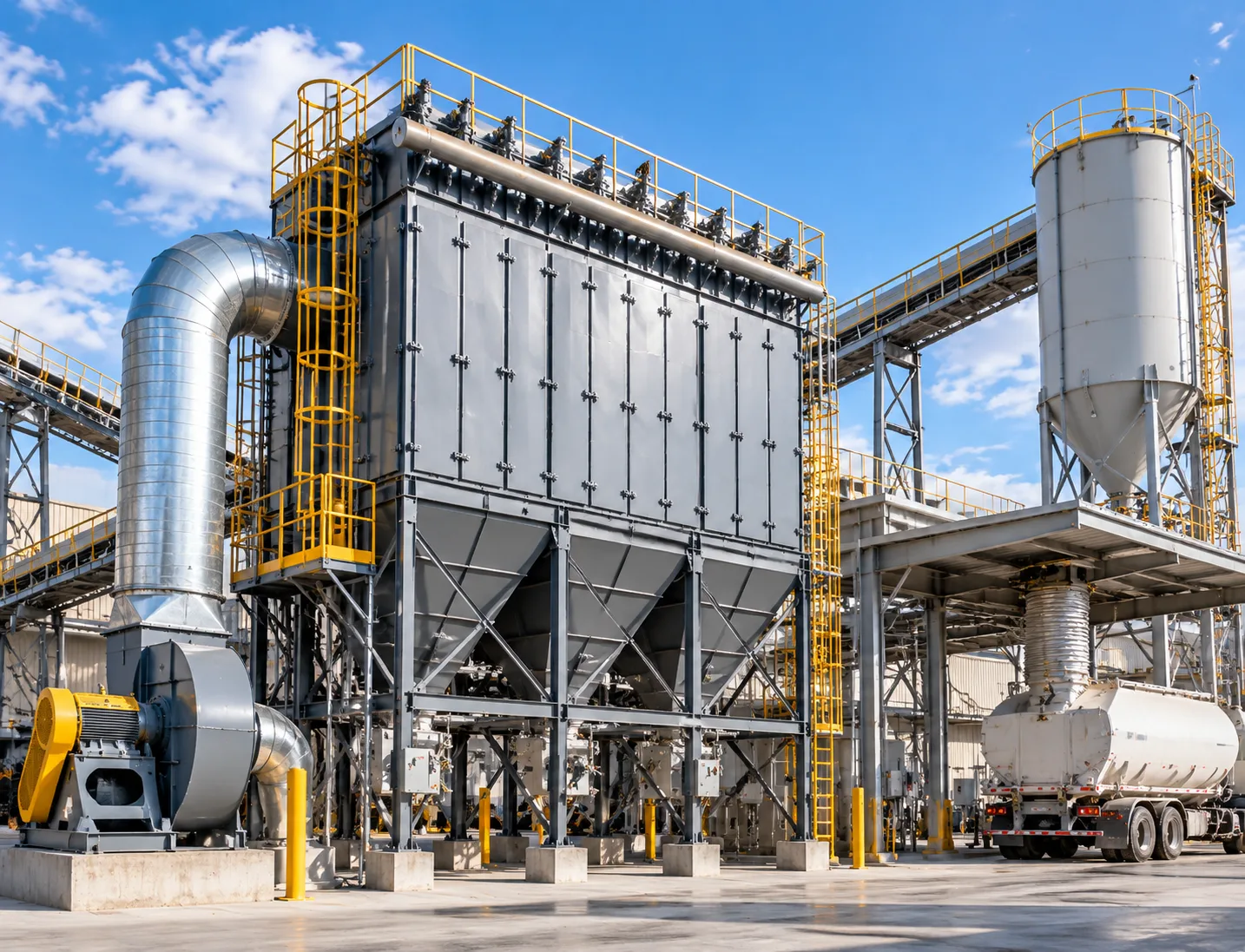
Purpose-built for main kiln tail exhausts, preheaters, clinker coolers, and primary ball mill ventilation circuits. The offline pulse jet architecture of these engineered baghouse dust collectors pneumatically isolates each individual compartment during high-pressure reverse air purging. This prevents particulate re-entrainment and maintains ultra-low differential pressure across high-volume gas streams exceeding hundreds of thousands of cubic meters per hour.
Key Technical Parameters
Operational Advantages
- ✓ Zero In-Flight Re-entrainment: Fast-acting poppet damper valves isolate chambers completely, allowing dislodged dust cakes to settle undisturbed into the discharge hopper.
- ✓ Acid & Condensation Protection: Heavy mineral wool insulation and electric hopper heating keep gas temperatures safely above acid dew points, preventing bag blinding.
- ✓ Online Chamber Maintenance: Modular walk-in clean-air plenums allow selective isolation for filter bag inspection and replacement without halting clinker production.
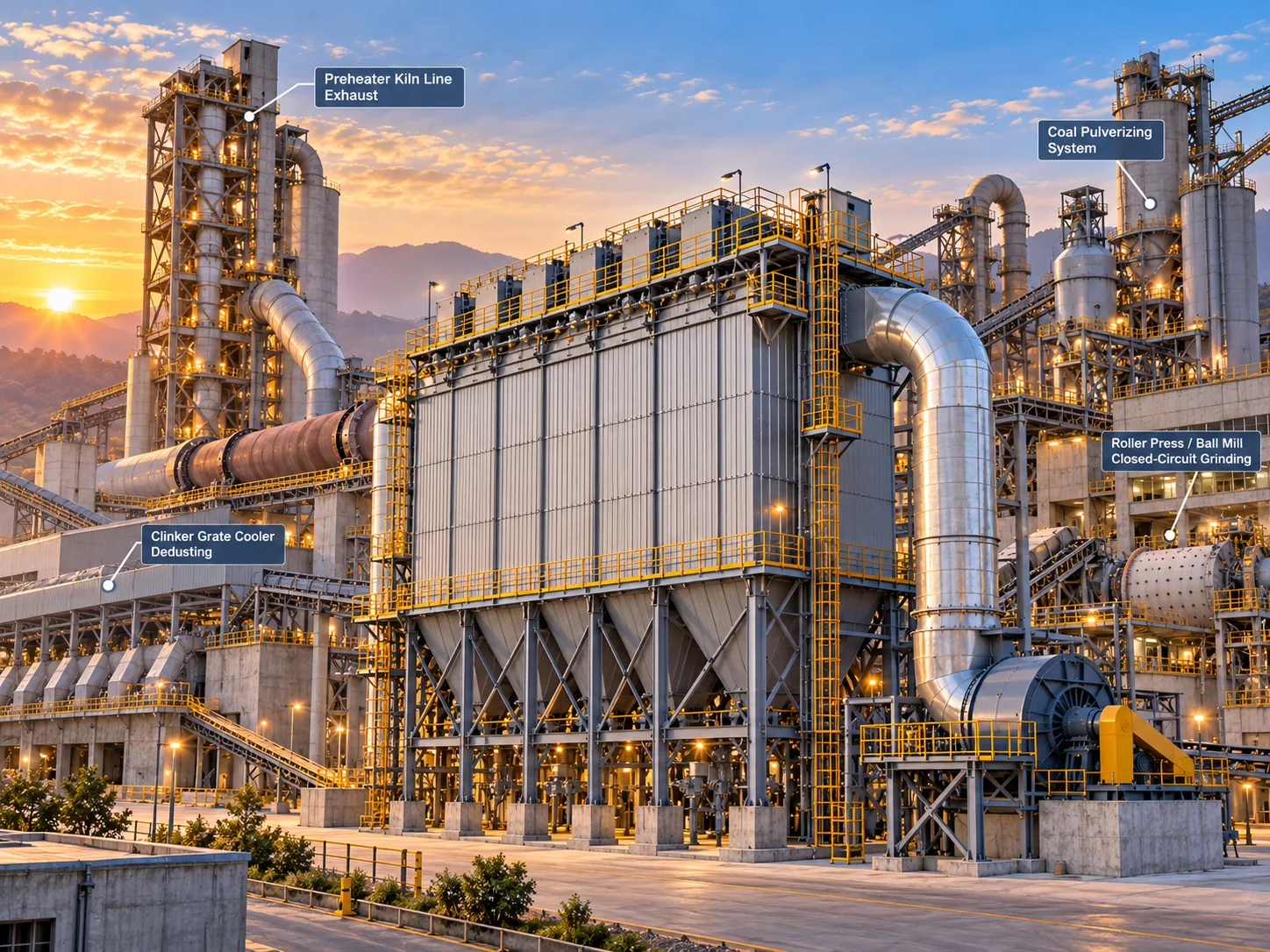
Preheater Kiln Line Exhaust, Clinker Grate Cooler Dedusting, Coal Pulverizing Systems, and High-Capacity Roller Press / Ball Mill Closed Circuits.
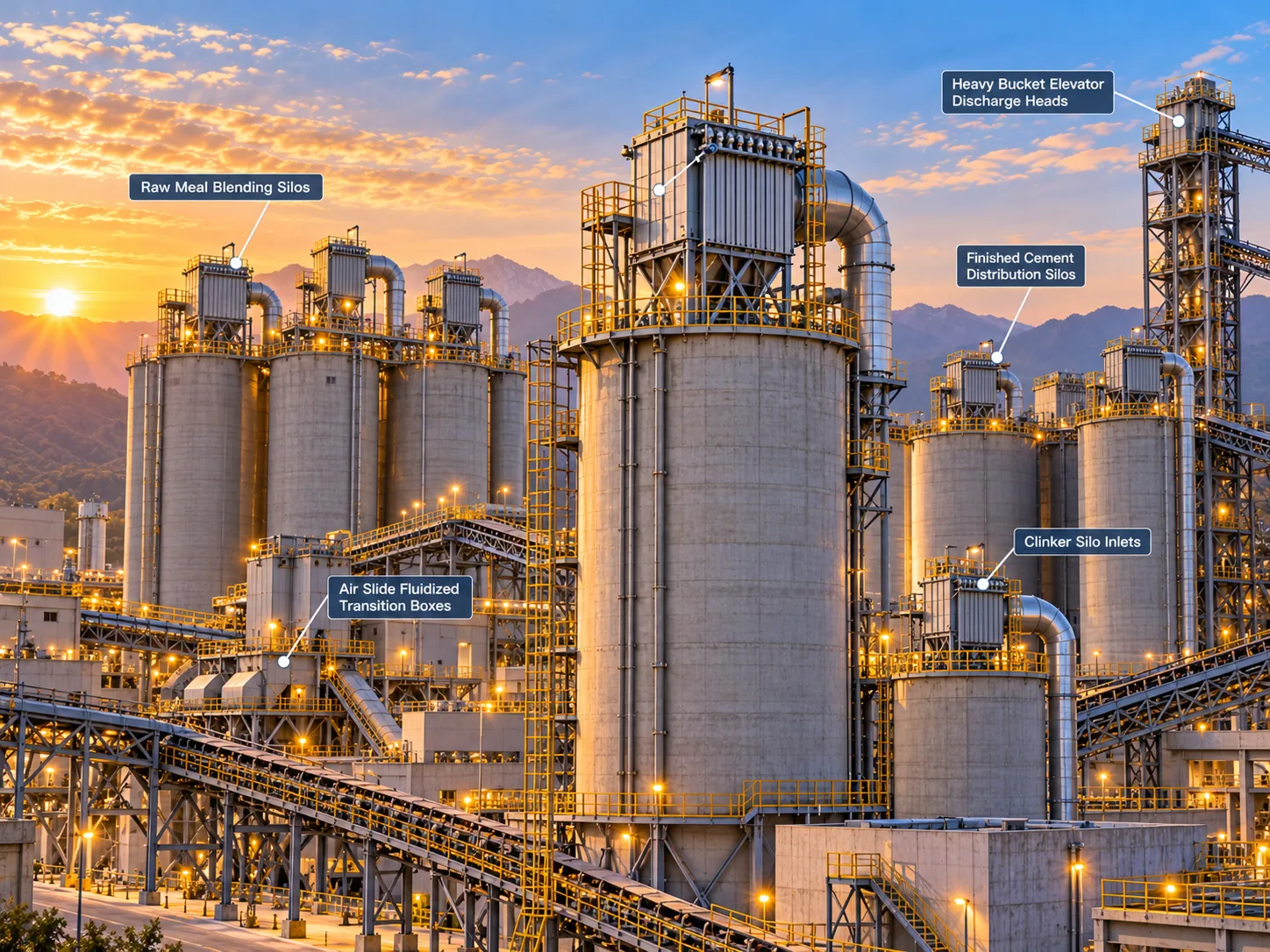
Engineered Performance Metrics: Engineered for <10 mg/Nm³ Emissions
DARKO Cement Machinery delivers high-efficiency dust collection equipment and industrial filtration systems with guaranteed ultra-low particulate limits, protecting continuous clinker production and plant-wide regulatory compliance.
Calibrated at 0.8–1.2 m/min for cement grinding mills and 0.6–1.0 m/min for preheater kiln tails to minimize differential pressure and extend filter bag life.
Equipped with PTFE and woven fiberglass membrane media to withstand sudden flue gas spikes, acid dew points, and chemical corrosion in clinker production.
High-flow, low-pressure pulse valves engineered for pulse jet dust collectors reduce compressed air consumption by 35% while providing thorough dust cake release across deep pleated filter cages.
Continuous seal-welded casing with dual-gasket access doors stops ambient air intake, preventing condensation, corrosion, and blinding across our industrial baghouse dust collectors.
Tailored to Exceed International Emission Mandates
DARKO engineers each cement dedusting package to satisfy targeted regional air quality standards, including ultra-low emission thresholds (<10 mg/Nm³), the EU Industrial Emissions Directive (IED), and US EPA NSPS Subpart F requirements.
Complete System Synergy: Dust Discharge, Air Sealing & Closed-Loop Recovery
A cement plant dust collection equipment system achieves continuous compliance and low differential pressure only when collection hoppers, pressure-isolation valves, and pneumatic conveying circuits operate in complete mechanical harmony. In high-capacity cement processing, up to 70% of premature filter blinding and hopper bridging occurrences stem from false air ingress through ill-fitting discharge valves. When atmospheric air infiltrates a negative-pressure hopper, localized upward drafts re-entrain heavy dust fines back onto the filtration matrix.
DARKO Cement Machinery designs and fabricates every subsystem in-house to guarantee flawless mechanical synchronization. By combining precision-machined rotary airlock dust discharge assemblies, air slide conveying systems, and heavy-gauge filter cages, we eliminate leakage points across the entire dust-handling path. Leveraging our own rotary airlocks and conveying equipment, DARKO eliminates system-wide air leakage at the source, returning valuable calcined meal and finished cement seamlessly into active production circuits without generating secondary fugitive dust.
Integrated Engineering Safeguards
- 99% Gas-Path Sealing: Positive pressure barriers prevent ambient moisture and air ingress across collection hoppers.
- Closed-Loop Product Return: Sealed conveying streams return collected micro-fines directly to process bins without dust escape.
- Single-Manufacturer Integration: Unified structural flanges, matched drive ratios, and synchronized PLC instrumentation.
Rotary Airlock & Double Flap Discharge Valves
Operating under continuous negative pressures exceeding -8,000 Pa, kiln-tail preheaters and finish grinding ball mills require ultra-tight gas-isolation valves. DARKO heavy-duty rotary airlocks feature adjustable Hardox or tungsten-carbide blade tips, outboard spherical roller bearings, and pressurized shaft packing glands to withstand severe abrasive dust and hot gas exposure.
Maintains 99% airtight isolation under deep system vacuum, preventing hopper re-entrainment and thermal shock.
Motor-driven or cam-actuated dual-chamber sealing for high-temperature, highly abrasive clinker and raw meal discharge.
Air Slide & Heavy-Duty Screw Conveyors
Recovered raw meal and finished cement powders represent direct plant yield. Our fully enclosed conveying systems bolt directly to baghouse dust collectors hopper flanges, utilizing low-angle fluidization channels or heavy-flighted screw feeders to transport hot, aerated fines continuously back into production without blockages or dust leakage.
High-permeability woven polyester aeration pads deliver low-energy, gravity-assisted transport for ultra-fine cement powders.
Continuous heavy-pitch flights with abrasion-resistant hardfacing and split-sleeve hanger bearings for smooth meal evacuation.
Wear-Resistant Filter Bags & Rigid Precision Cages
High-velocity pulse jets and heavy dust loads can cause mechanical fatigue along bag seams and bottoms in pulse jet dust collectors. DARKO supplies precision-welded 16-to-24 wire cages paired with ePTFE-membrane needle felts, incorporating reinforced double-layer wear cuffs and aerodynamic venturis to distribute reverse pulse energy uniformly across the entire filter length.
Reinforced wear bottoms and rigid galvanized cages prevent abrasive bag-to-cage friction during high-frequency pulse cycles.
Machined venturi throats direct low-pressure, high-volume pulses at 0.4–0.6 MPa, ensuring thorough cake release down the entire 6-meter bag span.
Engineered Countermeasures for Challenging Cement Plant Working Conditions
Operating an industrial cement plant dust collection equipment system demands resilient engineering capable of overcoming severe thermal cycling, acid dew point moisture condensation, intense particulate abrasion, and electrostatic fine-dust accumulation. Standard commercial fabric filters routinely experience catastrophic failures when subjected to clinker kiln exhaust fluctuations or high-velocity raw meal transport, leading to frequent filter bag blinding, structural housing abrasion, high differential pressure spikes, and unscheduled kiln halts.
DARKO Cement Machinery engineers process-matched dedusting solutions built specifically to conquer extreme thermal, mechanical, and chemical challenges. Combining advanced computational fluid dynamics (CFD) gas distribution, metallurgical wear protection, and specialized membrane filtration media, DARKO guarantees continuous dust capture and dependable ultra-low emissions below 10 mg/Nm³ across raw grinding, pyroprocessing, and finish milling circuits worldwide.
High Moisture & Acidic Kiln Flue Gas
Operating Challenge
Exhaust gas from clinker kiln preheaters carries high moisture volumes (8% to 14% H₂O) alongside volatile sulfur compounds, chlorides, and nitrogen oxides. Temperature dips below the acid dew point (130°C to 150°C) during startup or raw meal feed shifts trigger aggressive acid condensation, causing severe filter bag caking, sheet metal corrosion, and uncontrolled system differential pressures exceeding 2,000 Pa.
DARKO Countermeasure Package
- • Composite Thermal Insulation: 100 mm high-density rock wool with dual-layer pre-painted aluminum cladding eliminates thermal bridges and shell cold spots.
- • Electric Trace-Heated Hoppers: Self-regulating heating cable circuits ensure dust hopper valley angles remain safely 25°C above acid dew points.
- • Gradient PTFE Membrane Media: Acid-resistant needle felt with expanded PTFE membrane delivers hydrophobic dust release and prevents caking.
- • Protective Internal Coatings: High-temperature phenolic epoxy lining insulates tubesheets and clean-air chambers from chemical corrosion.
Performance Validation
Abrasive Raw Meal & High-Velocity Clinker Dust
Operating Challenge
Crushed limestone, hard quartz silica, and clinker fines (Mohs hardness 6 to 7) entering dust collectors at velocities exceeding 18 m/s rapidly scour raw metal inlet channels, hopper transition cones, and the lower sections of filter bags. Unchecked abrasive wear causes housing perforations, ambient air ingress, damaged bag cages, and sudden particulate breakthrough.
DARKO Countermeasure Package
- • High-Alumina Ceramic Liners: Wear-resistant 92% Al₂O₃ ceramic tiles protect high-velocity inlet impact zones and lower hopper troughs.
- • Pre-Settling Dropout Chamber: Integral aerodynamic expansion plenum drops over 65% of coarse abrasive particles directly into the discharge hopper.
- • CFD Airflow Distribution Baffles: Perforated flow-equalizing vanes distribute incoming gas evenly, keeping interstitial velocity under 1.1 m/min.
- • Reinforced Bag Bottom Cuffs: 150 mm heavy-duty dual-layer woven scrim collar cuffs protect against bottom-cage mechanical friction and abrasion.
Performance Validation
Static Charge & Ultra-Fine Grinding Powder
Operating Challenge
Ultra-fine cement particles generated in ball mills and vertical roller mills (Blaine fineness >380 m²/kg) build intense electrostatic charges during high-speed air classification. This highly adhesive dust clings tenaciously to standard filter fabric, resists standard pulse-jet cycles, and poses critical static-sparking deflagration risks in coal-grinding or dual-fuel plant environments.
DARKO Countermeasure Package
- • Stainless Steel Antistatic Scrim: Epitropic stainless steel or conductive carbon filaments woven into filter media safely dissipate static charges to ground.
- • Continuous Grounding Network: Certified bonding across filter cages, venturis, tubesheets, and casing ground lugs prevents spark accumulation.
- • Intelligent Adaptive Pulse Cleaning: PLC-driven differential pressure pulsing automatically adjusts cycle frequency based on real-time dust cake build-up.
- • Hopper Fluidization Aeration: Aerated discharge cones and precision rotary airlocks eliminate hopper ratholing, bridging, and material packing.
Performance Validation
Severe Cement Working Conditions: Technical Comparison Matrix
Compare standard commercial dust collector vulnerabilities with DARKO's heavy-duty industrial cement dust collection engineering designed for maximum uptime and ultra-low emission compliance under extreme operational loads.
| Engineering Parameter | Standard Commercial Collector | DARKO Reinforced Cement System | Operational Impact |
|---|---|---|---|
| Thermal Insulation System | 50 mm fiberglass batt; uninsulated access doors | 100 mm dense mineral wool with thermal-break double-seal doors | Prevents cold bridging and eliminates internal acidic moisture condensation |
| Inlet Abrasion Defense | Standard carbon steel (Q235) single deflection plate | 92% alumina ceramic tile lining with integral dropout settling chamber | Absorbs high-energy particle impact, protecting filter cages and bottom sleeves |
| Filter Media Specification | Standard woven fiberglass or untreated polyester needle felt | Hydrophobic PTFE membrane laminated needle felt with antistatic grid | Maintains particulate collection efficiency >99.99% under 260°C operating peaks |
| Pulse Cleaning Control | Fixed-interval analog timer board with constant pulsing | Smart differential pressure (ΔP) adaptive PLC pulsing algorithm | Cuts compressed air consumption by 35% and extends filter bag life past 4 years |
| Hopper Dust Discharge | Shallow unheated pyramid hoppers prone to bridging | 60° steep valley angle + trace heating + precision rotary airlock valve | Ensures continuous ash evacuation with zero air infiltration into the hopper |
Overcoming Filter Blinding and Unplanned Kiln Shutdowns
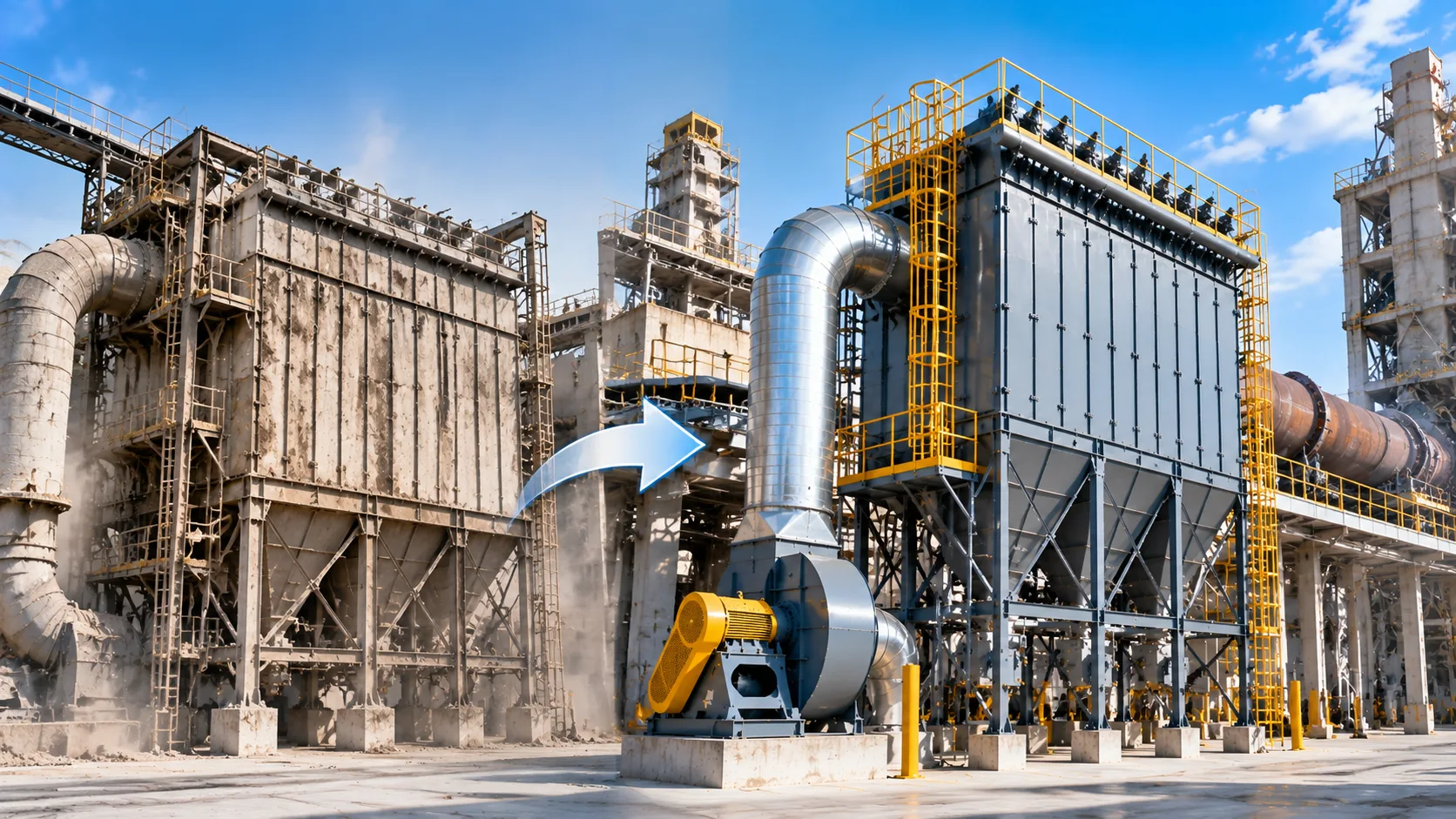
Unscheduled cement plant downtime caused by moisture-induced filter bag blinding, holed casings, or jammed hopper discharges can cost operators tens of thousands of dollars per hour in lost clinker production. DARKO Cement Machinery specializes in upgrading and retrofitting aging electrostatic precipitators (ESP) and underperforming baghouse dust collectors across crushing lines, raw grinding circuits, rotary kiln tails, and packaging stations.
DARKO's advanced thermal insulation and abrasive-resistant engineering prevent unscheduled shutdowns caused by filter blinding, deploying specialized pulse-jet dust collectors tailored for demanding process streams. Our experienced field engineers assess plant-specific gas chemistries, moisture dew points, and particulate velocity dynamics to deliver turnkey retrofit packages engineered for fast turnaround during scheduled maintenance outages.
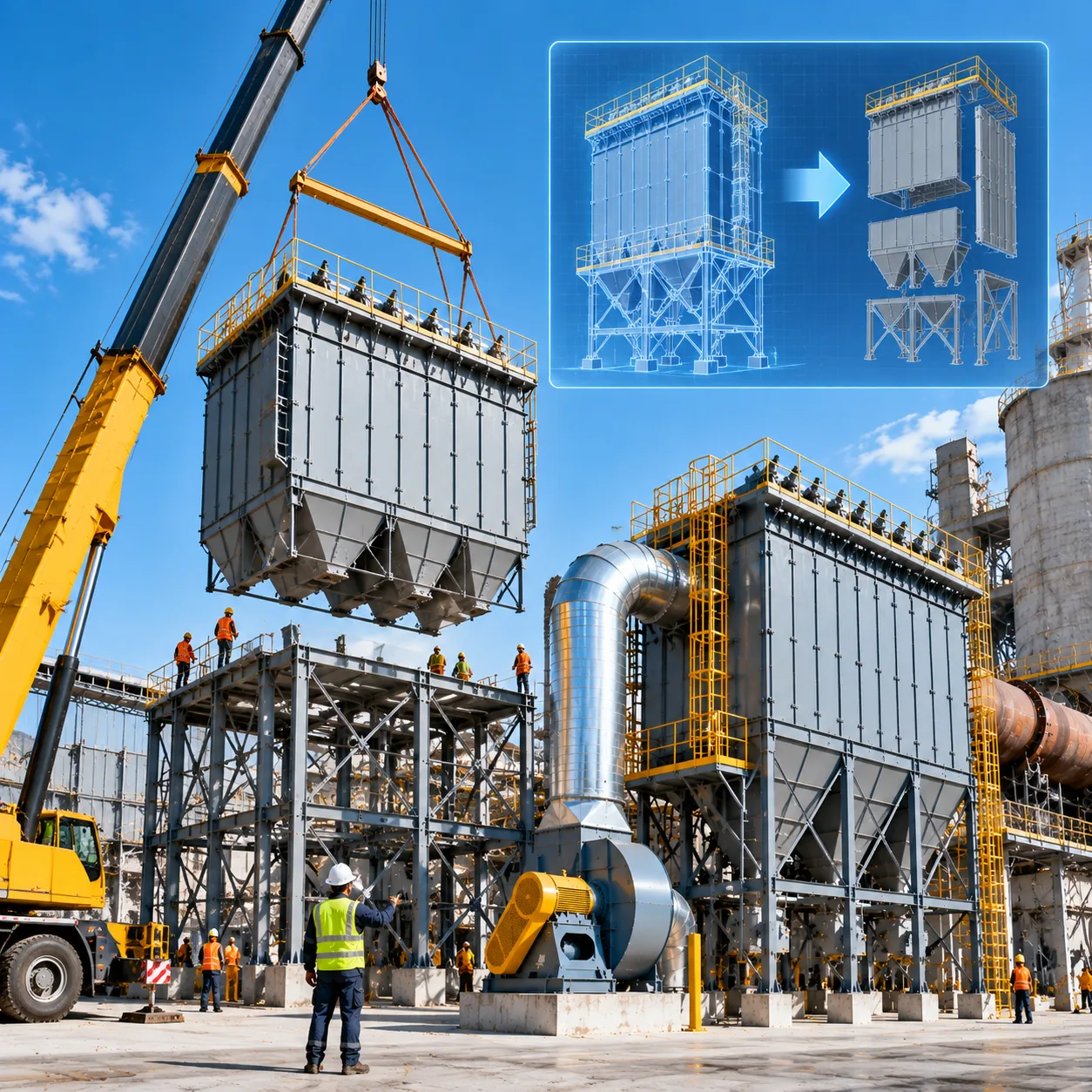
From CFD Simulation to Commissioning: Our 5-Stage Turnkey Execution
DARKO Cement Machinery ensures seamless on-schedule deployment with rigorous project management from computational fluid modeling to full plant handover.
On-Site Measurement & Field Survey
Precise baseline gathering to define operating envelopes, gas chemistry, and structural interfaces.
Deliverables:
- ✓ Spatial 3D laser scanning
- ✓ Flue gas composition & moisture audit
- ✓ Dust load & particle size analysis
CFD Fluid Dynamics Modeling
Advanced computational flow simulation to eliminate dead zones, high-pressure drops, and localized bag abrasion.
Deliverables:
- ✓ Optimized duct design CFD profile
- ✓ Hopper airflow equalization report
- ✓ Wear pattern & velocity mapping
Precision Manufacturing & Pre-Assembly
Heavy-duty factory fabrication with automated robotic welding and modular test assembly.
Deliverables:
- ✓ CNC laser plate cutting & robotic welds
- ✓ Factory modular trial pre-assembly
- ✓ Shell air tightness & pressure testing
Installation & Ductwork Erection
Fast-track turnkey installation of heavy-duty baghouse dust collectors supervised on-site by senior structural and mechanical engineers.
Deliverables:
- ✓ Modular crane lift sequencing
- ✓ Turnkey ductwork & valve integration
- ✓ Comprehensive structural QA sign-off
Commissioning & Emission Audit
Cold and hot process testing for high-efficiency pulse jet dust collectors, automated pulse tuning, and certified third-party emission validation.
Deliverables:
- ✓ Cold & hot commissioning protocol
- ✓ PLC differential pressure loop tuning
- ✓ Certified <10 mg/Nm³ handover audit
Engineered for Strict Plant Overhaul Schedules
Retrofitting industrial dust collection equipment and cement dedusting systems demands flawless execution within scheduled kiln shutdown windows. By leveraging precision 3D modeling and pre-tested modular sections, DARKO reduces site installation cycles by up to 40%, protecting your production uptime.
100%
Overhaul Schedule Adherence
< 5-10 mg/Nm³
Guaranteed Emission Handover
Proven in Action: Worldwide Cement Plant Dedusting Projects
Trusted by cement manufacturers worldwide, DARKO plants deploy high-efficiency dust-collection equipment to consistently outperform strict environmental compliance targets through verified engineering retrofits.
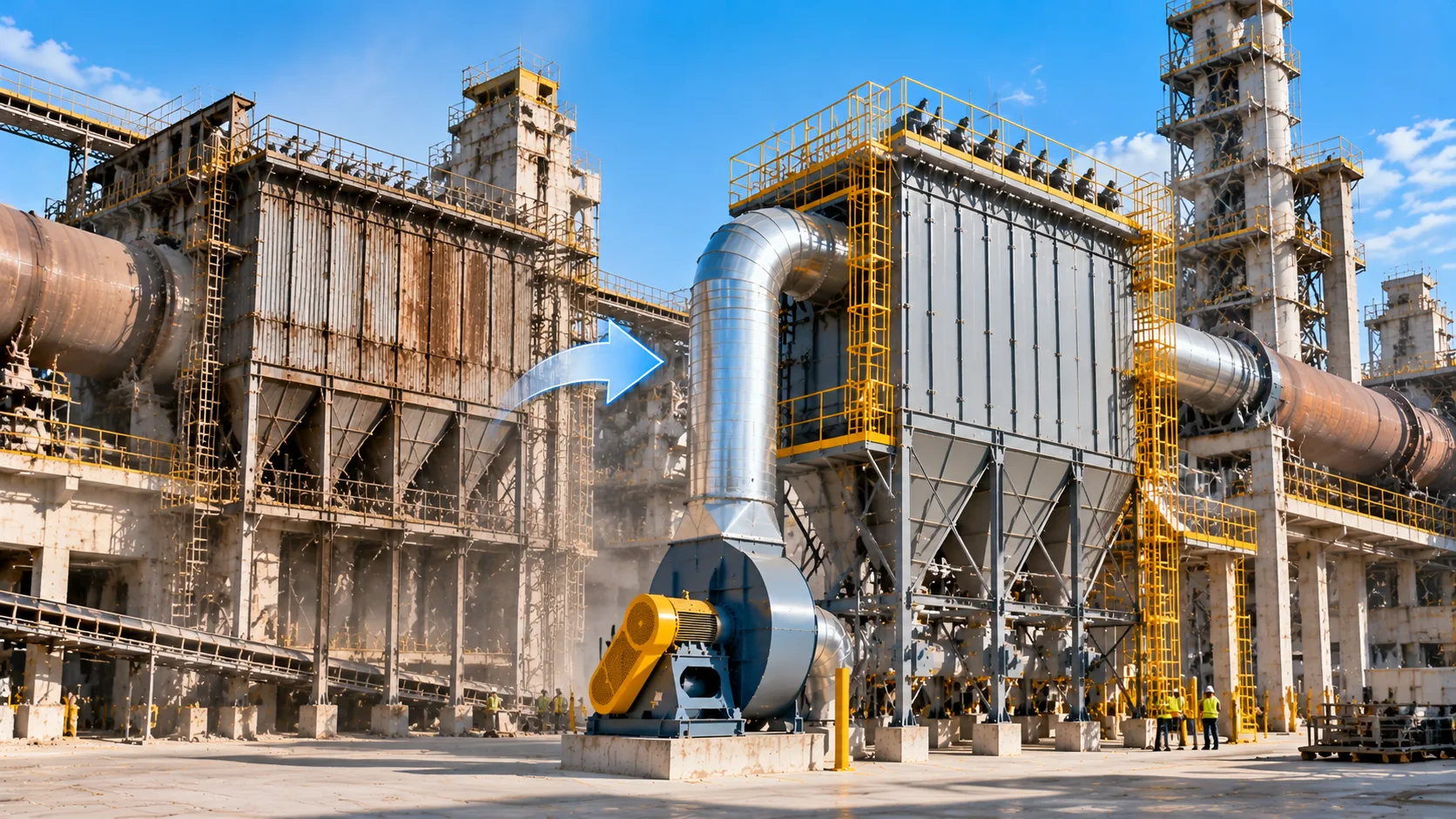 Southeast Asia
5,000 TPD Clinker Line Kiln Tail Retrofit
Replaced obsolete electrostatic precipitators with offline baghouse-dust-collectors inside existing structural envelopes, stabilizing kiln draft and clearing ISO emission benchmarks.
 Middle East
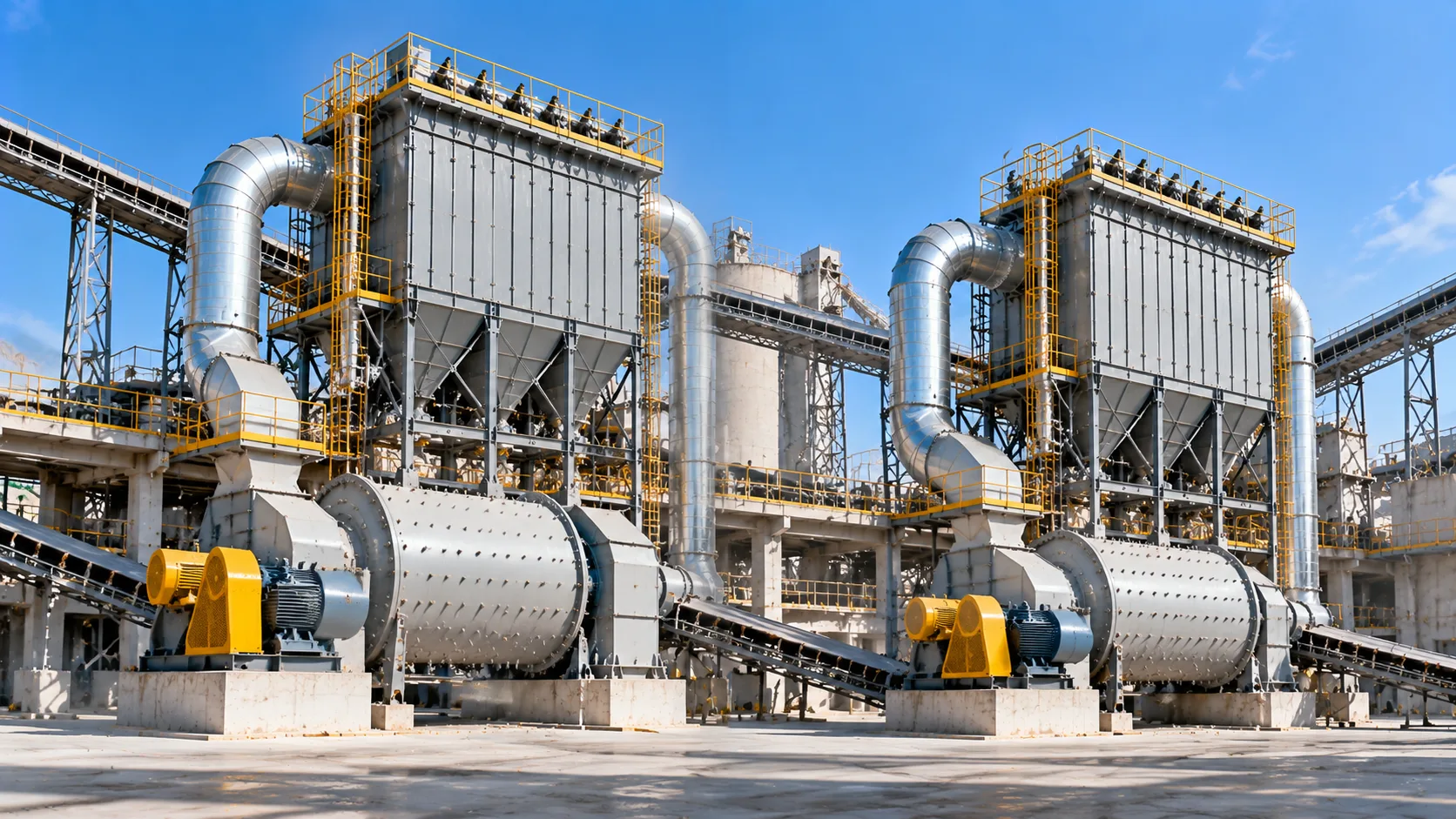
Dual Cement Ball Mills Dedusting Upgrade
Installed heavy-gauge pulse-jet-dust-collectors engineered for hot, highly abrasive finished cement dust, directly recycling salable fines back into dynamic air-swept circuits.
 South America
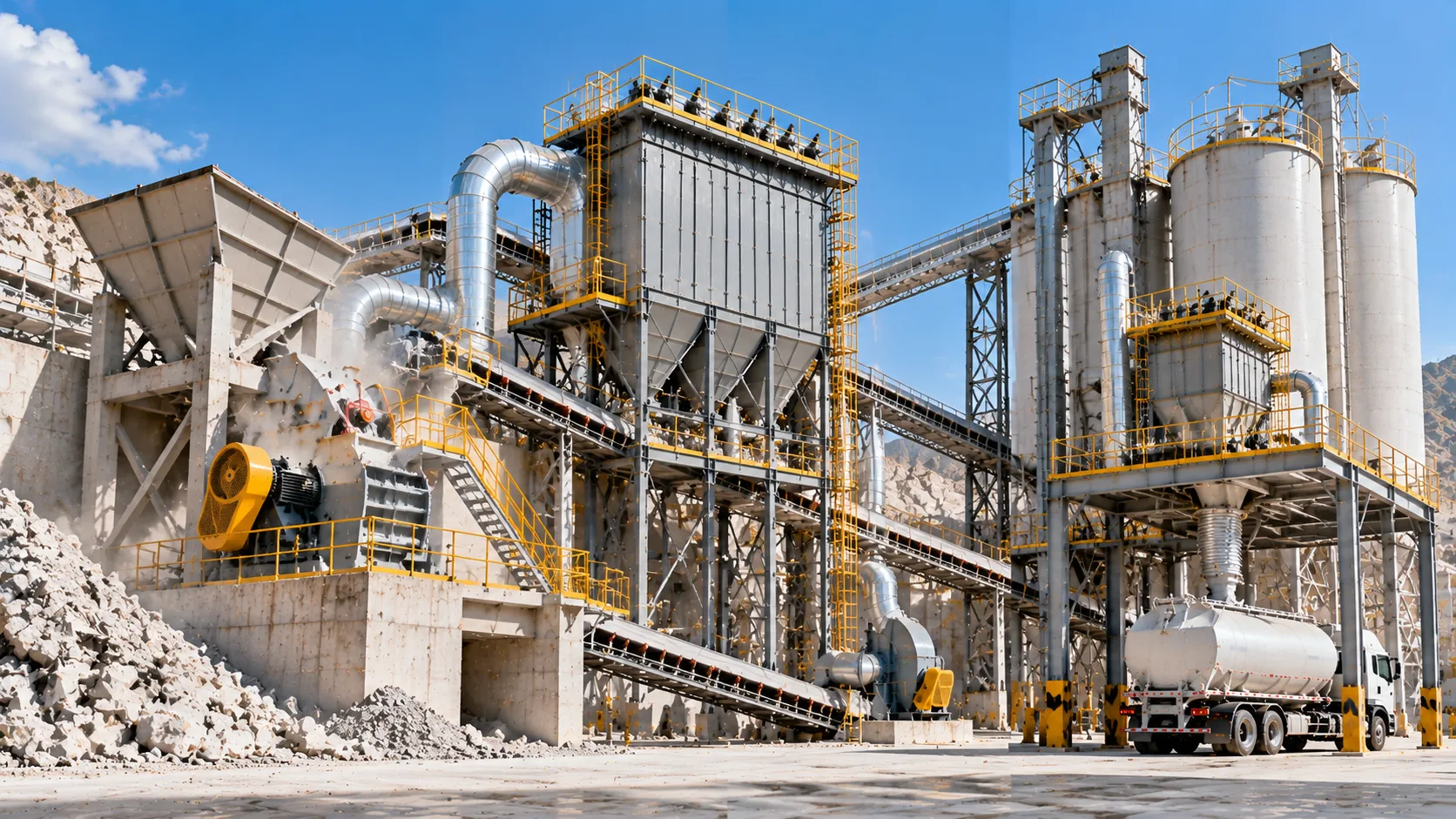
Limestone Crushing & Silo Dispatch System
Turnkey dust suppression overhaul across primary crushing stations, transfer chute junctions, and bulk road-tanker loadout spouts, resolving historical fugitive dust fines.
Need a customized dedusting audit for your kiln or mill?
DARKO Cement Machinery engineering specialists evaluate airflow profiles, gas temperatures, and emission targets to design compliant filtration systems.
Frequently Asked Questions: Cement Plant Dust Collection Engineering
Maintaining continuous emission compliance below 10 mg/Nm³ while protecting clinker output requires systematic engineering control over baghouse differential pressure, pneumatic cleaning, and thermal dew points. Review technical guidance on ESP retrofits, moisture blinding prevention, and process dedusting sizing across cement manufacturing circuits.
Converting an obsolete kiln or cooler electrostatic precipitator into high-efficiency baghouse dust collectors typically reduces capital expenditure by 40% to 55% compared to installing an entirely new baghouse. Total cost efficiencies derive from reusing existing civil support foundations, casing outer envelopes, dust discharge hoppers, and duct runs.
Turnaround shutdown schedules: Mechanical conversion is engineered specifically around annual kiln overhaul shutdowns, completing within an 18- to 25-day critical path. Internal emitting wires, collector plates, and rigid frames are stripped out, followed by the installation of modular tube sheets, clean-air plenum covers, pulse header manifolds, and high-temp PTFE or fiberglass membrane filter bags.
ID fan and pressure adjustments: Because fabric filtration operates across higher system resistance (typically 1,000 Pa to 1,300 Pa versus 250 Pa to 400 Pa in an ESP), DARKO engineers run aerodynamic modeling on the induced draft (ID) fan. In most installations, re-wheeling the impeller or reconfiguring variable frequency drives (VFD) meets volume and static head requirements without demanding a replacement fan casing or foundation rebuild.
Field Diagnostic Reference Guide
Essential baseline operating metrics for plant managers and reliability engineers evaluating cement dedusting line performance.
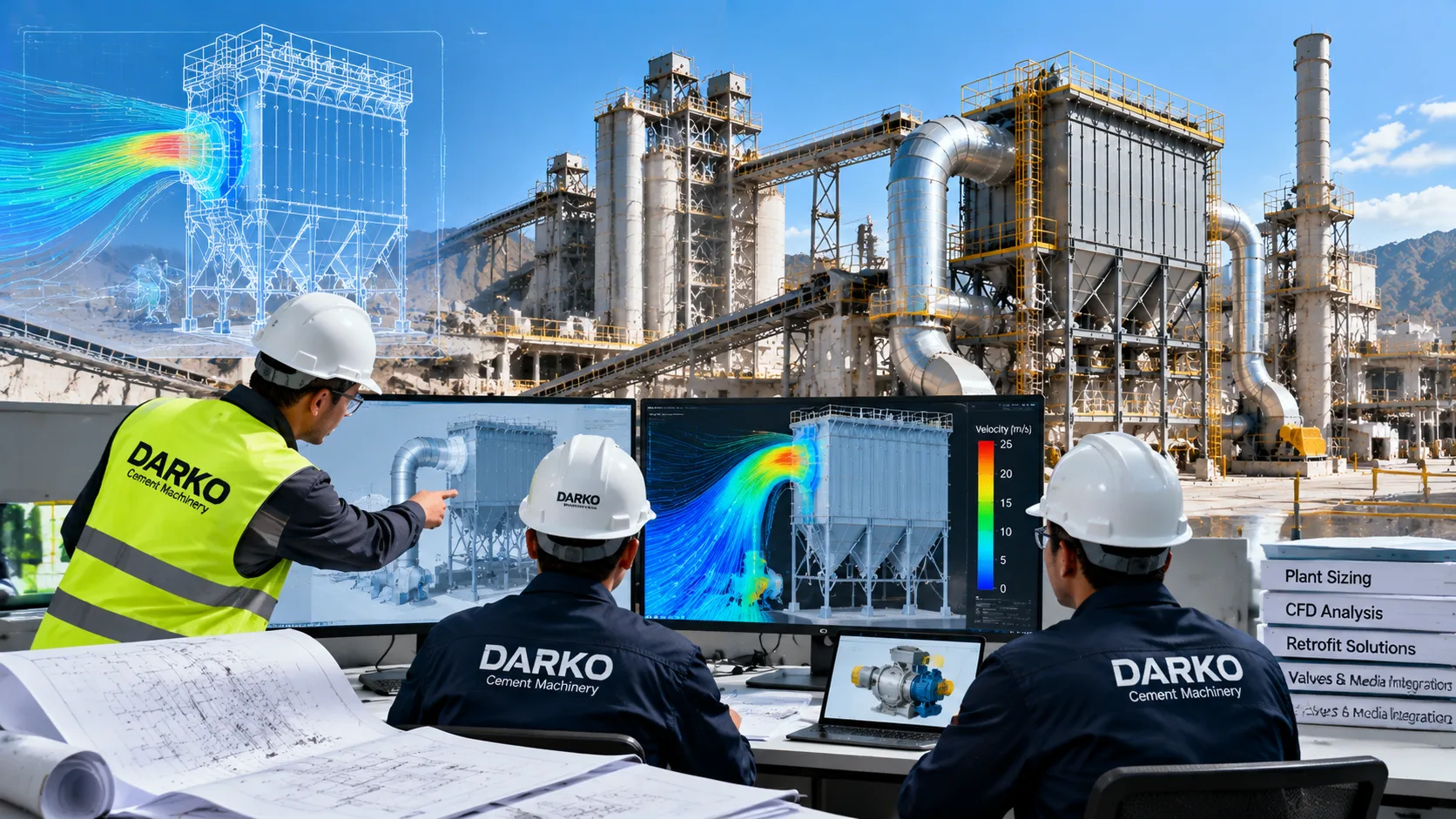
Need Immediate Plant Sizing or CFD Audits?
DARKO Cement Machinery delivers turn-key retrofits, CFD airflow modeling, and precision valve and media integration for industrial dust collection equipment worldwide.
Can't find your specific operating challenge?
From high-moisture slag grinding to complex kiln tail air-to-cloth upgrades, every cement line demands site-specific aerodynamic sizing. DARKO engineers provide 24/7 technical troubleshooting support for all industrial dust control installations.
Find the Right Dust Collection Solution for Your Cement Plant
Whether you are planning a new installation, upgrading an existing filtration system, or sourcing replacement components, DARKO Cement Machinery can help you evaluate your requirements and identify a suitable solution.
Application-Specific Guidance
Discuss your operating conditions, dust characteristics, and equipment selection with our team.
Equipment & System Optimization
Explore suitable filtration systems, filter media, conveying equipment, and retrofit options.
Direct Project Communication
Start with a brief description of your project. Detailed technical information can be discussed later.
Explore Our Equipment
Let's Discuss Your Project
Tell us what you need. Our team will help you identify a suitable solution for your application.