
Ship Loader Configurations: Engineering Types for Dry Bulk Jetties
Matching ship loader geometry to wharf infrastructure is critical to minimizing civil foundation costs, expediting vessel turnaround, and managing local tidal extremes. DARKO Cement Machinery engineers four primary structural arrangements tailored to dry bulk terminals handling cement, clinker, fly ash, aggregates, and mineral ores worldwide, fully compatible with advanced dust collection equipment.

Mobile Rail-Mounted Ship Loaders
Long-travel gantry systems traversing continuous runway rails along the entire wharf face. Engineered to service multiple holds on Handymax, Supramax, and Panamax carriers without moving the moored vessel.
- • Travel Stroke: 80 m to 800+ m along linear quay tracks
- • Boom Mechanism: Telescopic shuttle boom with hydraulic luffing
- • Wharf Footprint: Requires full-length runway beams & crane rails
- • Vessel Sizing: 20,000 to 100,000+ DWT ocean bulkers

Stationary Pivot Slewing Loaders
Fixed single-foundation loaders operating via heavy-duty slewing bearings and luffing booms. Ideal for compact marine structures, dedicated coastal berths, and terminals relying on vessel winching.
- • Travel Stroke: Static center pin; rotational slew coverage
- • Boom Mechanism: ±110° slew range with luffing & shuttle boom
- • Wharf Footprint: Single central dolphin or concrete mooring caisson
- • Vessel Sizing: 3,000 to 45,000 DWT coastal vessels

Radial Quadrant Ship Loaders
Curved-track loading systems combining a rear pivot point with a motorized front gantry riding an arcuate rail beam. Delivers broad hatch access with substantially lower civil costs than linear rails.
- • Travel Stroke: 60° to 120° curved quadrant radial track arc
- • Boom Mechanism: Telescopic shuttle boom with luffing cylinder
- • Wharf Footprint: Shore pivot support plus curved marine pile deck
- • Vessel Sizing: 10,000 to 70,000 DWT bulk carriers

Inland Barge Loading Systems
Purpose-built bulk loading gantries designed specifically for inland distribution terminals and river ports subjected to extreme water fluctuations, commonly outfitted with cyclone dust collectors for rapid and clean material transfer.
- • Travel Stroke: Compact linear stroke or stationary tower
- • Boom Mechanism: Extended -25° to +30° high-amplitude luffing
- • Wharf Footprint: Reinforced riverbank pier or floating pontoon
- • Vessel Sizing: 1,000 to 12,000 DWT river and coastal barges
Structural Typology & Terminal Suitability Matrix
Evaluating structural kinematics against existing quay load capacities allows terminal operators and EPC contractors to maximize loading rates without triggering expensive jetty structural retrofits.
| Loader Typology | Civil Infrastructure Needs | Hatch Working Coverage | Vessel Shifting Requirement | Rated Capacity Range |
|---|---|---|---|---|
| Rail-Mounted Traveling Loader | Continuous linear runway crane beams | Full berth length across all cargo holds | No ship shifting required | 1,000 to 3,000 TPH |
| Stationary Pivot Slewing Loader | Single central dolphin or caisson foundation | Circular sector reach around central pivot | Winching required for multi-hold ships | 500 to 1,800 TPH |
| Radial Quadrant Ship Loader | Pivot dolphin combined with curved arc beam | Broad sector reach via luffing-shuttle boom | Rarely required; holds spanned by boom | 800 to 2,500 TPH |
| Dedicated Barge Loading System | Compact riverbank breasting dolphins or pontoons | High vertical adjustment for wide river stages | Barge repositioning or dual-head setup | 300 to 1,500 TPH |
Custom Structural Sizing for Greenfield Terminals and Existing Jetties
From agile barge loading units to mega-vessel rail-mounted systems, DARKO manufactures custom structural configurations tailored to specific jetty layouts. Our port engineering specialists conduct finite element structural analyses, storm load verifications, and wheel load evaluations to ensure seamless alignment with your wharf piling constraints.
Request a Terminal Structural Assessment
Submit your jetty structural drawings, vessel deadweight tonnage specifications, and material characteristics to receive detailed kinematic layouts and wheel loading calculations within 48 hours.
Materials Handled and Industrial Applications
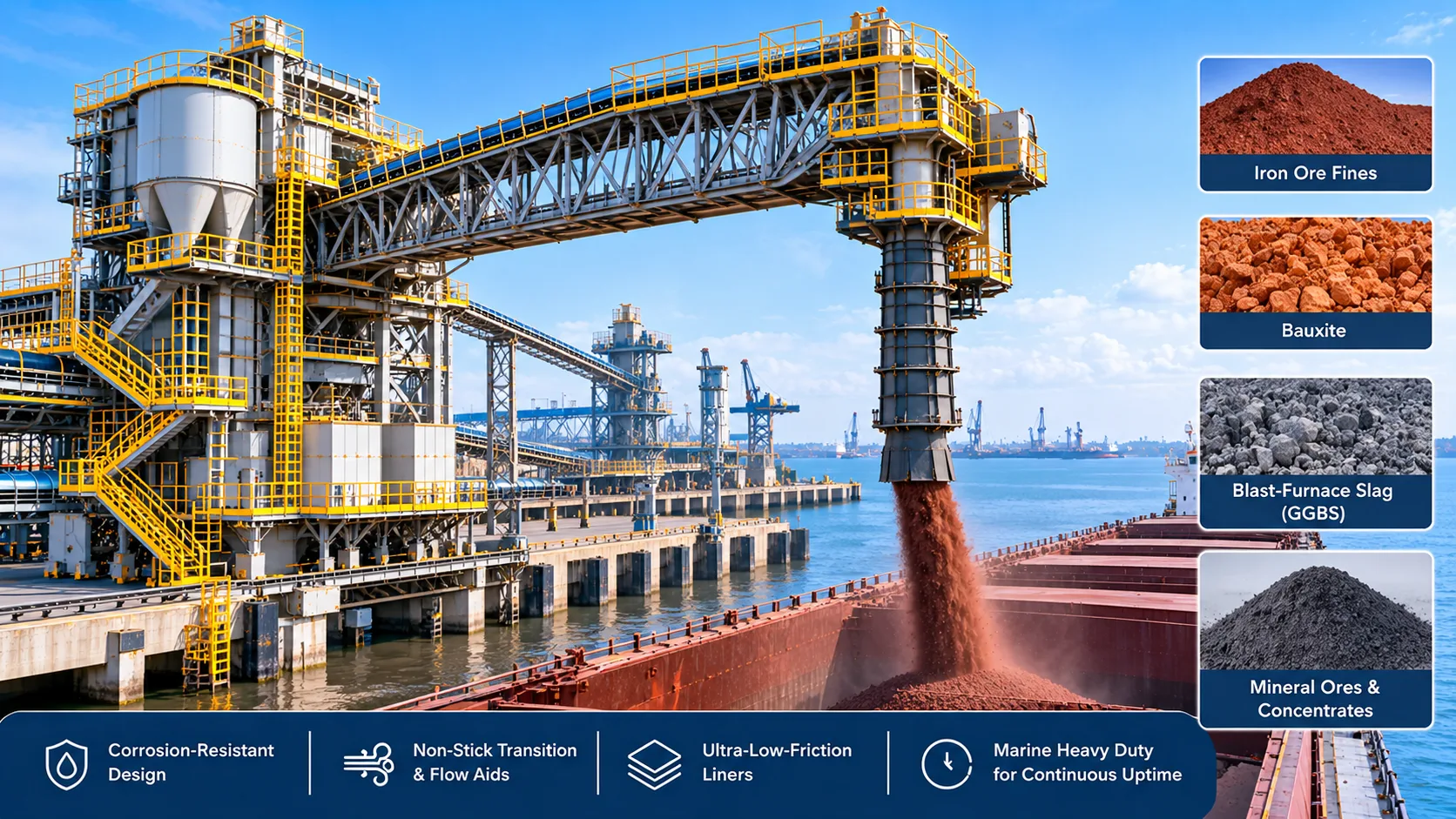
Dry bulk terminals manage vastly divergent cargo profiles, ranging from fluid, aeration-prone fine powders to high-impact abrasive lumps and moisture-laden mineral concentrates. DARKO Cement Machinery engineers dedicated ship loading systems with material-calibrated conveying geometries, heavy wear protection packages, and integrated dust collection equipment to maximize loading rates while eliminating terminal spillage and cargo degradation.
Cement, Slag Powder, and Fly Ash
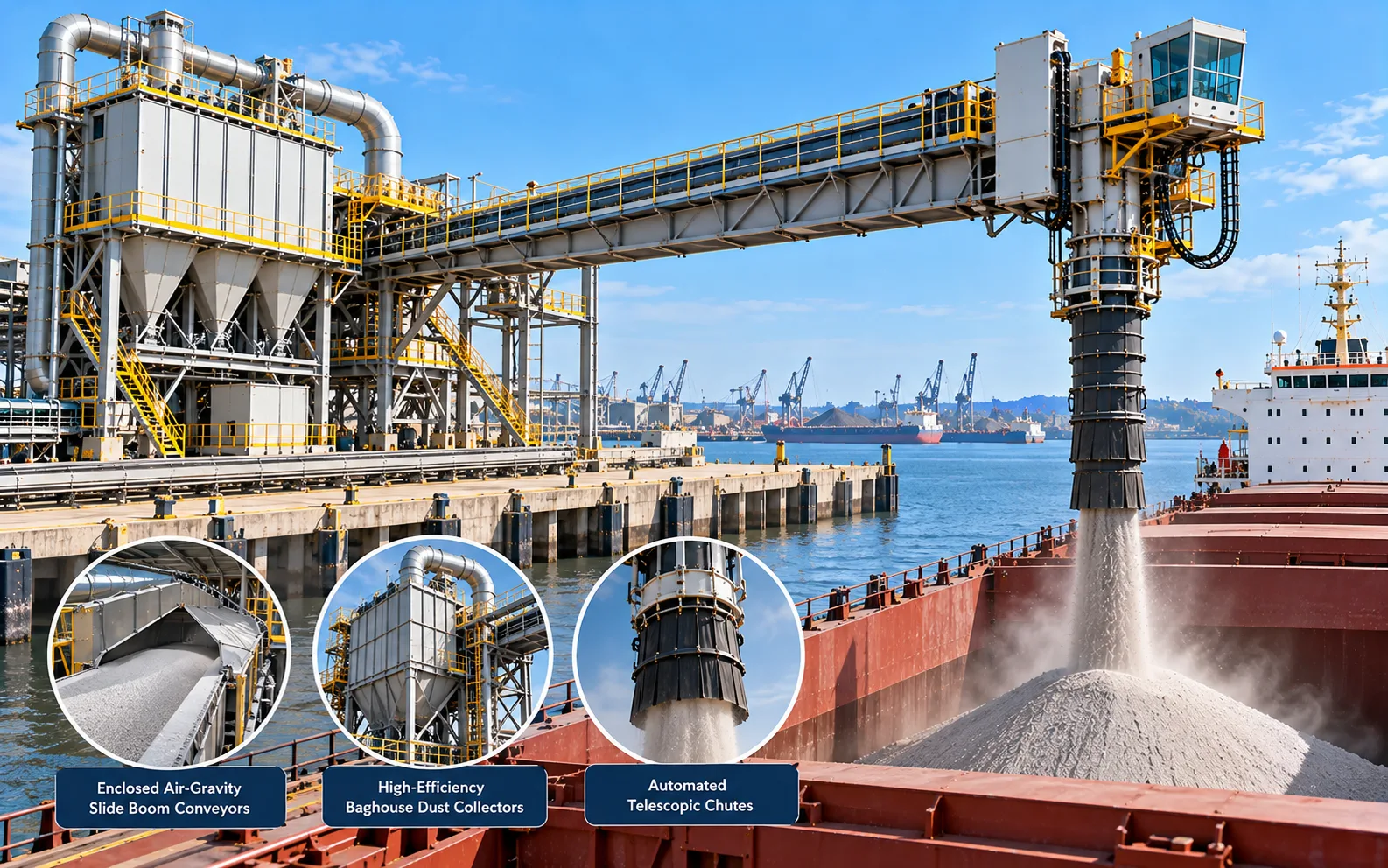
Pneumatic powders like Ordinary Portland Cement (OPC), ground slag, and fly ash fluidize easily, causing rapid dust generation and cargo loss if uncontrolled. DARKO delivers enclosed air-gravity slide boom conveyors, negative-pressure transfer points connected to high-efficiency baghouse dust collectors, and automated telescopic chutes that discharge smoothly below the hatch line without airborne dispersion.
Enclosed Air Slide Conveying
Pneumatically fluidized trough conveyors eliminate mechanical friction, reducing power draw while transporting powders smoothly with zero mechanical wear.
Boom-Mounted Pulse Dust Collectors
Integrated reverse pulse-jet dust collectors maintain continuous negative suction at the chute head, feeding captured fines straight back into the cargo hold.
Double-Bellows Telescopic Spouts
Inner steel loading cones channel material velocity while the outer heavy-duty bellow evacuates displaced air through an automated dust filtration duct.
Fluidizing Cleanout Aeration Pads
Strategically placed micro-porous aeration membranes prevent product build-up and compaction in dead corners, enabling rapid purge between grades.

Closed-Loop Dust Control and Eco-Friendly Port Loading Systems
Modern marine bulk terminals require stringent airborne particulate containment without compromising high-speed ship loading rates. DARKO Cement Machinery engineers advanced eco friendly bulk loading solutions featuring integrated dust collection equipment, multi-stage negative-pressure air balancing, airtight transfer containment, and smart telescopic chutes to secure verified dust-free operations across all jetty environments.
Boom System Interactive Anatomy
Select an engineering hotspot below to examine our multi-stage dust suppression architecture operating along the ship loader boom.
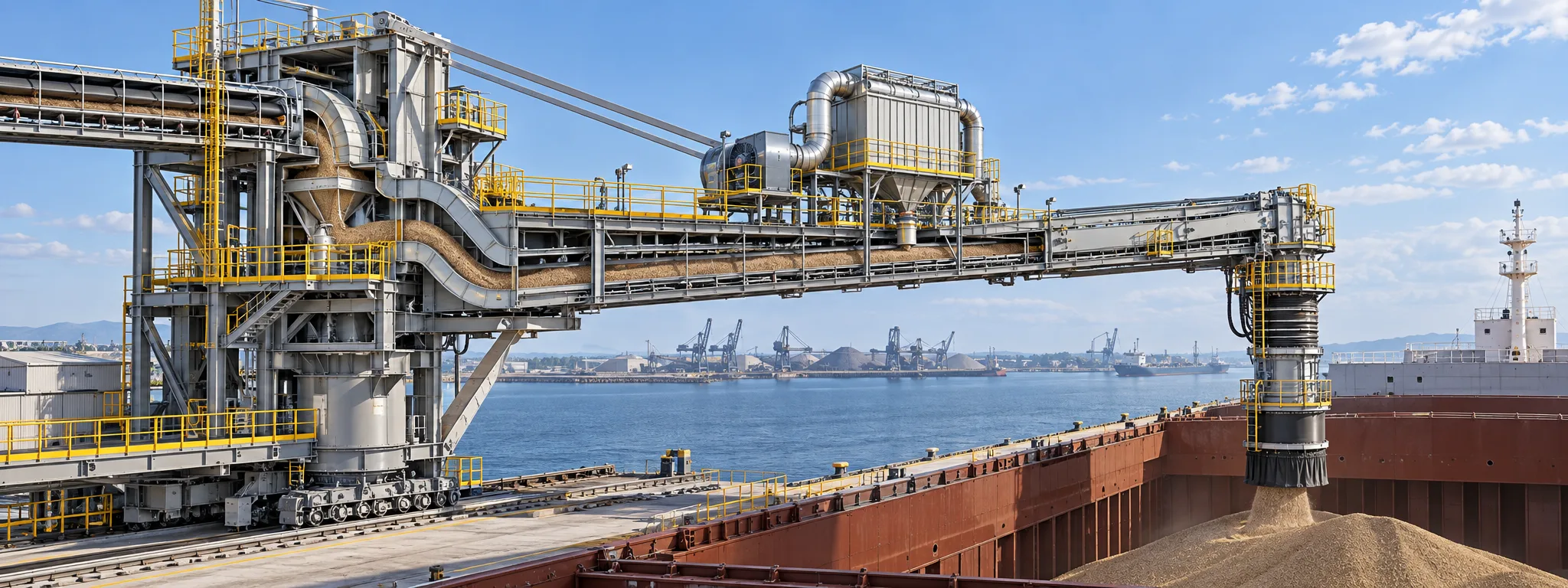
Verified stack emission: < 10 mg/Nm³ during continuous peak loading of dry cement, pulverized fly ash, granulated slag, and abrasive clinker.
Enclosed Material Feed and Transfer Tower
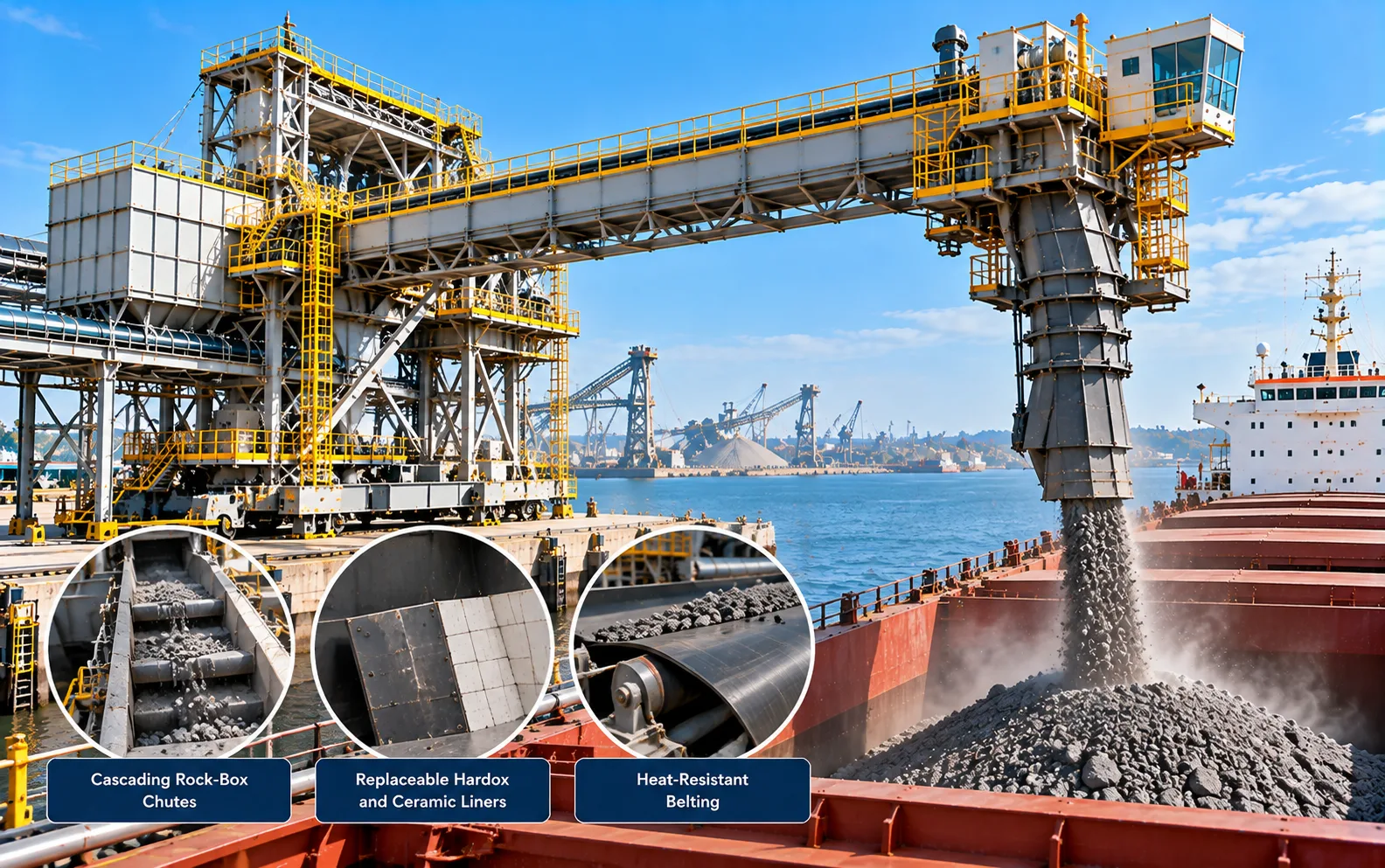
Total dust abatement starts well before the bulk stream enters the ship hold. On every dust free ship loader built by DARKO, transfer junction points and boom feed conveyors are housed inside aerodynamic, fully sealed enclosure hoods. Engineered rock-box profiles and curved impact chutes decelerate falling stream velocity, equalizing internal air pressure and neutralizing particle entrainment directly at feed transitions.
- Air-tight transfer skirts: Zero fugitive powder leakage
- Curved chute geometry: Mitigates particle impact breakage
- Dual-lip skirt sealing: Continuous positive air barrier
- Quick-release hatches: Tool-free maintenance access
Telescopic Chute with Adaptive Anti-Wind Dust Skirt
Controlling freefall trajectory inside deep vessel holds is critical to stopping terminal dust plumes. This telescopic chute ship loader utilizes interlocking abrasion-resistant conical cascades surrounded by a heavy-duty flexible outer bellows. Continuous ultrasonic pile tracking automatically elevates the chute as the hold fills, keeping the flexible anti-wind skirt sealed firmly against the material mound throughout loading and trimming.
- Inner wear cones: Hardox 450 and ceramic tile lining
- Ultrasonic level tracking: Automated vertical positioning
- Heavy bellow sleeve: Antistatic polyurethane fabric
- Rotating trimming head: Uniform, void-free hold filling
Integrated Boom-Mounted Pulse-Jet Bag Filter
Eliminating long, high-maintenance shoreside duct runs, DARKO integrates compact pulse jet dust collectors directly onto the structural loading boom. Operating with the capture efficiency of heavy-duty baghouse dust collectors, high-efficiency reverse fans extract displaced air from the discharge chute annulus under steady negative pressure. The captured fine powder is regularly pulsed off the filter bags and dropped straight back into the main cargo stream, delivering 100% material retention with zero product loss.
- Filtration efficiency: 99.9% on micro-particulate fines
- In-stream recycling: Zero cargo loss and zero waste handling
- Pulse cleaning: Automated differential-pressure cycles
- Explosion mitigation: Full ATEX and NFPA compliance
Green Terminal System Compliance Benchmarks
Our marine bulk loading equipment meets and exceeds the world's strictest port authority environmental impact and occupational safety mandates.
Continuous stack emission thresholds certified under EPA standards and European clean port air-quality regulations.
Certified antistatic filter elements, explosion relief venting, and intrinsically safe electrical drive controls.
Direct fines recirculation preserves up to 45 tons of sellable cement or mineral cargo per vessel loading campaign.
Acoustic attenuation enclosures and variable frequency fan drives engineered for low-carbon harbor operations.
Dry Bulk Ship Loader Technical Specifications & Sizing Parameters
Engineered to withstand harsh marine environments, DARKO bulk ship loaders integrate seamlessly with comprehensive bulk-conveying-equipment networks and are designed in strict compliance with FEM and ISO marine design rules. Review baseline engineering data below to accelerate equipment sizing, jetty civil checks, and EPC technical qualification.
Standard Engineering Parameter Specifications
Comprehensive benchmark criteria for marine dry bulk terminal equipment
| System Dimension | Standard Engineering Specification | Operational Capability & Application Details |
|---|---|---|
| Rated Loading Capacity | 500 – 3,000 TPH | Continuous rated mass flow customizable for cement powder, clinker, fly ash, slag, bauxite, and mineral ores fed via terminal air-slide conveyors or dockside belt lines. |
| Applicable Vessel Range | 3,000 DWT to 100,000 DWT | Configured for inland river barges, coasters, Handysize, Handymax, Supramax, and full-breadth Panamax bulk carriers. |
| Boom Kinematics | Luffing: -15° to +20° Slewing: ±110° Shuttle Stroke: 15 – 35 m | Multi-axis articulated positioning guarantees complete hold trimming across tidal shifts, reducing vessel warping downtime. |
| Control Architecture | Automated Industrial PLC Cabinet | Operated via ergonomic wireless belly-box remote, local operator cabin controls, or centralized terminal SCADA / DCS integration. |
| Power Feeding System | Motorized Cable Reel or Conductor Bar | High-reliability medium/low-voltage power feeding engineered with magnetic-coupler reeling drums or enclosed safety busbars. |
| Corrosion Protection | ISO 12944 C5-M Marine Coating | Multi-tier zinc-rich epoxy primer and polyurethane topcoat system designed for high salinity and coastal industrial atmospheres. |
Need Custom Ship Loader Engineering for Your Terminal?
From rail gauge alignment and boom operating envelopes to berth clearances and structural load requirements, DARKO engineers can help evaluate your terminal layout and develop customized ship loading equipment configurations. Project-specific drawings and technical documentation are available upon request.
Integrated Dry Bulk Terminal Systems from Silo Storage to Ship Hold
DARKO delivers complete material flow integration with advanced bulk conveying equipment, pairing pneumatic air slides and heavy conveyors directly with front-line marine ship loaders. Our end-to-end engineering eliminates bottlenecks across reclamation, overland transit, and high-rate vessel loading.
Silo Extraction & Reclaiming
Reliable terminal performance begins with steady discharge. We engineer specialized bottom extraction systems for cement silos, clinker domes, and mineral storage halls.
- ✓ Heavy-Duty Air Slide Conveyors: Low-energy fluidization conveying for powders like raw meal, cement, and fly ash.
- ✓ Precision Dosing Gates: Modulating flow-control pin gates and sector valves to prevent surge loading.
- ✓ Pneumatic Aeration Pads: Zone-controlled aeration grids that eliminate rat-holing and purge dead inventory.
Overland & Jetty Conveying
Long-distance transport systems bridge landside storage yards and coastal jetty berths with continuous, dust-tight material streams.
- ✓ Enclosed Pipe Conveyors: Tight horizontal and vertical curves with complete spillage and moisture protection.
- ✓ Covered Trough Galleries: High-throughput modular jetty galleries fitted with integrated maintenance walkways.
- ✓ Steep-Angle Pocket Belts: Compact vertical transfers that minimize the civil footprint on narrow quayside decks.
Tripper Car & Feeding Systems
Quayside elevated conveyor tripper cars feed seamlessly into mobile ship loader intake hoppers across the entire working length of the berth.
- ✓ Synchronized Trippers: Automated rail-tracking drives that match ship loader gantry travel dynamically.
- ✓ Sealed Chute Interfaces: Flexible bellows and skirt seals preventing fugitive dust during continuous handoffs.
- ✓ Engineered Impact Cradles: Heavy-duty shock-absorbing transfer beds that protect belts from high-tonnage impact.
Intelligent Trimming & Control
Smart terminal automation ensures uniform cargo hold filling, optimal vessel trim, and active structural protection during marine operations.
- ✓ 3D Cargo Profiling: Millimeter-wave radar surface scanning for real-time hold mapping and level tracking.
- ✓ 360° Trimming Spoons: Variable-speed rotating kickers ensuring high stowage density under hatch coamings.
- ✓ Anti-Collision Interlocks: Multi-zone LiDAR and radar arrays that protect boom structures and ship superstructures.
Lifecycle EPC Project Delivery
From initial geotechnical and berth kinematic evaluations to hot commissioning, our multidisciplinary engineering team manages every project milestone to guarantee operational uptime, strict environmental compliance, and rated throughput targets.
Unified Control Architecture: Integrated PLC and SCADA platforms connect silo reclaim gates, overland belts, trippers, and ship loaders into a single synchronized material handling network.
Detailed jetty structural assessments, tidal range profiling, vessel mooring envelope analysis, and material rheology testing.
Finite element structural simulations, dynamic typhoon wind load verifications, and discrete element modeling (DEM) for transfer chutes.
100% factory trial fit-up, non-destructive weld examination (NDT), hydraulic loop pressure testing, and automated panel cold staging.
On-site heavy lift management, precision rail alignment, integrated dry run tests, and full-tonnage load acceptance commissioning.
Turnkey System Technical Matrix
Engineering specifications and operational parameters for integrated dry bulk terminal handling systems.
| Subsystem Component | Engineering Specification | Primary Function | Integration Benefit |
|---|---|---|---|
| Air Slide Fluidization Units | Incline: 6° to 8°; Throughput: Up to 1,500 TPH | Enclosed pneumatic fine powder transfer | Zero moving parts, minimal maintenance, low power draw |
| Overland Pipe Conveyors | Belt Width: 800–1,800 mm; Speed: 2.5–4.5 m/s | Fully enclosed cross-terminal transit | 100% dust containment along jetty approach trestles |
| Quayside Tripper Cars | Travel Speed: 0.1–0.3 m/s; Rail Clamp Locks | Flexible off-belt feeding to mobile loaders | Continuous cargo feed without main conveyor shutdown |
| Smart Anti-Collision Radar | Operating Range: 0.2–50 m; Frequency: 77 GHz | Proximity monitoring along vessel superstructures | Prevents boom impact during vessel surge and tidal shift |
Precision Marine Manufacturing & Global Delivery Standards
Operating modern fabrication and testing facilities, DARKO applies rigorous quality controls to structural fabrication, mechanical assemblies, and drive systems for marine bulk handling projects.
International Codes & Accreditations
Project quality plans can incorporate applicable ISO management standards, structural welding requirements, and relevant CE conformity assessments according to the equipment scope and destination market. Documentation and certification requirements are reviewed during project engineering.
Shop Pre-Assembly & QA Testing
Depending on project specifications, quality checks may include dimensional inspection, trial fitting, non-destructive weld testing, and factory acceptance testing of drives, dust collection interfaces, and hydraulic equipment before dispatch.
Marine Project Delivery Support
DARKO supports engineering coordination, shipment planning, installation guidance, and commissioning arrangements for coastal ports and inland bulk handling terminals. The service scope is tailored to each project and local site requirements.

Industrial-Grade Quality Assurance & Risk Mitigation
DARKO uses staged quality checks to identify fabrication and integration issues before shipment. Material traceability, weld inspection, equipment alignment, and verification of dust collection interfaces help reduce commissioning risks and support smoother site installation.
Ship Loader Procurement & Technical Engineering FAQ
Selecting the ideal marine bulk loading configuration demands careful evaluation of jetty civil capacity, vessel sizing envelopes, strict environmental standards, and total lifecycle costs. Explore key technical answers compiled by our marine terminal engineers to streamline your equipment selection, retrofitting plans, and Capex modeling.
The choice between rail-mounted traveling ship loaders and stationary slewing or radial units centers on berth length, multi-hatch access requirements, civil foundation capacities, and total capital expenditure. While both architectures achieve throughputs up to 3,000 TPH, their layout integration and operational ergonomics address different port environments.
Rail-Mounted Traveling Loaders
- Coverage: Glides along quay rails to reach all vessel holds without ship repositioning or warping.
- Berth Profile: Suited for dedicated long quays servicing Handysize, Supramax, and Panamax vessels.
- Infrastructure: Demands higher continuous foundation load-bearing capacity for gantry bogie lines.
- Turnaround: Maximizes vessel turnaround efficiency across high-throughput commercial bulk hubs.
Stationary & Radial Slewing Loaders
- Coverage: Utilizes telescopic boom luffing, shuttling, and slewing, frequently paired with winch warping.
- Berth Profile: Ideal for compact finger piers, dolphin mooring setups, and inland river barge docks.
- Infrastructure: Lowers civil investment with concentrated structural piling on a single central pivot.
- Turnaround: Perfect for captive export berths, barge redistribution depots, and footprint-restricted terminals.
DARKO application engineers evaluate jetty structural drawings and local tidal conditions to recommend optimal loading configurations before production starts, balancing civil engineering investment against target berthing cycles.