Vertical Roller Mill Working Principle & Integrated Material Dynamics
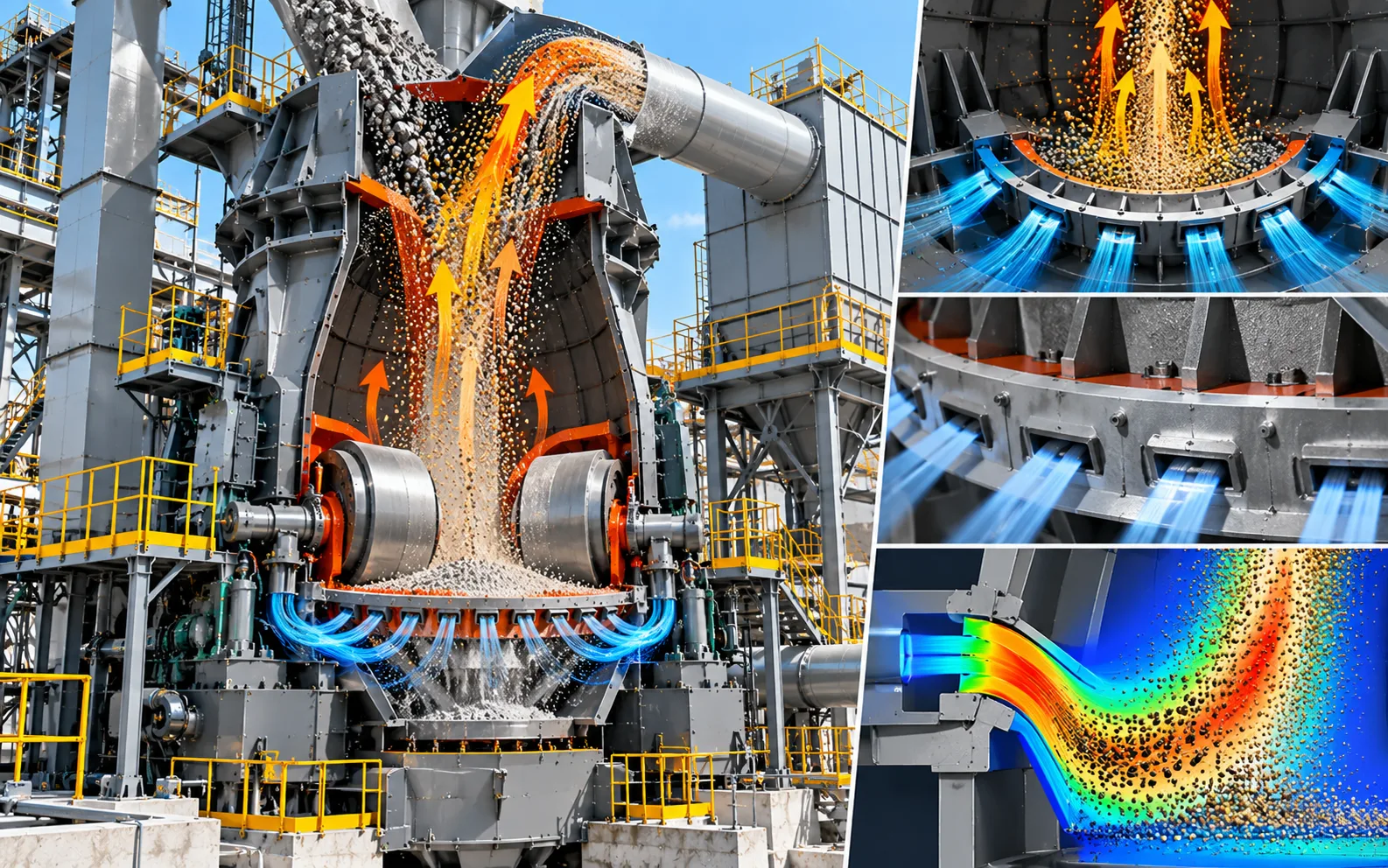
Modern vertical roller mills streamline cement raw meal, clinker, slag, and coal processing by combining inter-particle bed grinding, flash thermal drying, high-efficiency dynamic air classification, and pneumatic transport to yield uniform finished products within a single closed-circuit, negative-pressure milling chamber.
Hydraulic Material Bed Grinding
Raw feed enters the rotating table center and distributes outward by centrifugal acceleration. Heavy-duty hydraulic cylinders exert continuous compressive force through the conical rollers, pulverizing particles via bed shearing without metal-to-metal contact.
Flash Thermal Gas Drying
Hot kiln exhaust gases enter through the circumferential nozzle ring at velocities of 40 to 70 m/s. Instantaneous convective heat exchange evaporates surface moisture up to 20% in suspension, eliminating the need for standalone rotary dryers.
Dynamic Air Classification
The integrated variable-speed dynamic rotor separates pulverized material against upward gas drag. Oversized particles drop back to the grinding table for re-grinding, while qualified fine particles pass immediately to prevent over-grinding.
Negative-Pressure Pneumatic Conveying
Qualified fine product is pneumatically discharged through the top classifier under continuous system draft. The closed-loop negative-pressure circuit conveys material directly into high-efficiency pulse-jet dust collectors with zero fugitive dust emission.
Continuous Material Circulation and Energy Efficiency Mechanics
The superior thermal and electrical efficiency of vertical roller mills stems from continuous inter-particle bed grinding. Rather than relying on repetitive ball impact and tumbling friction, the VRM system compresses a dense, regulated material bed between conical wear rollers and an inclined horizontal grinding table.
Nitrogen-charged hydraulic accumulators absorb dynamic shock loads caused by feed size variations or tramp iron. An active oil-film gap and segmented high-chromium wear liners ensure stable operations with baseline mill vibration maintained below 1.5 mm/s.
High-temperature gases (250°C to 350°C) introduced through the peripheral vane ring deliver rapid convective heat exchange to suspended particles. This fast flash drying handles moist feed materials such as natural clays, moist limestone, and blast furnace slag without auxiliary fuel combustion.
The top-mounted variable-speed dynamic cage classifier isolates on-spec particles in 2 to 4 minutes of residence time. Quick extraction of finished product sharpens particle size distribution, prevents over-grinding, and minimizes parasitic fan power consumption.
Engineered by DARKO Cement Machinery alongside integrated dust collection equipment, optimized guide vane geometry and aerodynamic mill body sizing lower circuit pressure resistance by up to 15%, translating into 30% to 50% net electricity savings compared to conventional ball mill grinding systems.
Internal Kinetic Parameters by Operational Zone
Engineering benchmarks and functional mechanics within the closed-circuit vertical grinding housing.
| Operational Zone | Primary Physical Action | Operating Parameter | Direct Process Benefit |
|---|---|---|---|
| Table Center to Roller Path | Centrifugal bed dispersal and retention | Table speed: 20–35 RPM | Uniform material bed thickness (30–80 mm) |
| Hydraulic Roller Nip Zone | High-pressure inter-particle shear | Specific pressure: 5–12 MPa | 30%–50% power reduction vs. tumbling media |
| Peripheral Vane Nozzle Ring | Gas-solid suspension and flash drying | Nozzle gas velocity: 40–70 m/s | Reliable handling of feed moisture up to 20% |
| Dynamic Rotor Classifier | Centrifugal aerodynamic particle separation | VFD speed control: 50–250 RPM | Online Blaine fineness adjustment in < 3 minutes |
| Discharge Plenum Outlet | Continuous negative-pressure pneumatic draft | Draft suction: -3.5 to -6.5 kPa | 100% dust containment; zero fugitive emissions |
Application-Specific Vertical Roller Mill Series Across the Cement Lifecycle
Grinding efficiency in industrial mineral processing requires mechanical kinetics tailored directly to feed material characteristics. As a specialist in heavy-duty cement grinding equipment, DARKO builds dedicated vertical roller mills engineered with optimized roller-track geometry, adjustable hydraulic line pressures, and variable-speed grinding tables. Whether processing abrasive silica-rich raw meal, unground clinker nodules, high-moisture granulated blast furnace slag, or combustible solid fuels, our VRM series ensures stable grinding bed formation, superior thermal drying efficiency, and pinpoint particle size distribution control.
HRM Series Raw Material Vertical Roller Mills
Engineered specifically for raw meal homogenization, the HRM Series effortlessly pulverizes heterogeneous mixtures of limestone, clay, marl, shale, and iron ore corrective materials. Featuring high-velocity sweeping gas ports, this system utilizes kiln preheater exhaust gases at temperatures up to 350°C, evaporating raw feed moisture levels up to 15% without requiring an external hot gas generator.
Instant suspension flash drying
Dynamic rotor blade classification
35% reduction versus ball mill circuits
Direct secondary crusher feed intake
- Hydraulic Pressure Tuning: Proportional load servo controls maintain a uniform material bed even during abrupt fluctuations in limestone hardness.
- Integrated Mechanical Recirculation: Heavy oversize grit discharges through the bottom nozzle ring into an external bucket elevator, minimizing pneumatic fan power consumption.
HRM Technical Range Matrix
Engineering Sizing Guide: Matching Table Diameter to Plant Production Goals
Selecting the ideal vertical roller mill requires aligning target hourly output, feed material grindability (Bond Work Index / Hardgrove Grindability Index), feed moisture levels, and final Blaine fineness. DARKO mill table diameters range from 1.5 meters for auxiliary coal circuits up to 5.6 meters for large raw meal lines supporting 10,000 TPD clinker kilns.
Material Grindability Audit
Laboratory testing determines the Bond Ball Mill Work Index (BWi) and Hardgrove Grindability Index (HGI) to establish specific grinding power requirements.
Thermal Balance & Airflow Modeling
Moisture evaporation modeling balances hot gas flow rates, kiln ducting, and nozzle ring velocities to prevent grinding bed collapse and excessive pressure drop.
Drive & Table Diameter Selection
Grinding table area, roller geometry, hydraulic loading force, and motor power ratings are matched to ensure consistent hourly throughput under variable quarry conditions.
| Series & Model | Application | Table Diam. (m) | Capacity (t/h) | Product Fineness | Main Motor (kW) | Specific Power (kWh/t) |
|---|---|---|---|---|---|---|
| HRM-2800 | Raw Meal Preparation | 2.8 | 80–110 | 80 μm Residue < 12% | 1,120 | 14.5–16.5 |
| HRM-4800 | Raw Meal Preparation | 4.8 | 350–400 | 80 μm Residue < 10% | 3,800 | 14.0–15.5 |
| CLM-3800 | Clinker & Blended Cement | 3.8 | 110–135 | 3,600 cm²/g Blaine | 2,800 | 27.0–30.0 |
| CLM-4600 | Clinker & Blended Cement | 4.6 | 180–220 | 3,700 cm²/g Blaine | 4,500 | 26.5–29.5 |
| SLM-3600 | Slag & GGBS Fine Grinding | 3.6 | 70–85 | 4,300 cm²/g Blaine | 2,600 | 39.0–43.0 |
| SLM-5000 | Slag & GGBS Fine Grinding | 5.0 | 140–165 | 4,500 cm²/g Blaine | 4,800 | 38.0–42.0 |
| MC-2200 | Pulverized Coal / Petcoke | 2.2 | 25–35 | 200 Mesh Residue < 3% | 400 | 17.0–20.0 |
| MC-3200 | Pulverized Coal / Petcoke | 55–70 | 200 Mesh Residue < 2% | 900 | 16.5–19.0 |
Need a Custom VRM Sizing & Power Consumption Assessment?
Tell us about your raw materials, required capacity, and grinding targets. DARKO can help you evaluate suitable vertical roller mill configurations, estimated power requirements, and system integration options.
Why Modern Cement Plants Transition to Vertical Roller Mill Grinding Technology
Modern cement manufacturing, slag beneficiation, and industrial mineral processing facilities face tightening emission caps, surging power tariffs, and aggressive decarbonization goals. Vertical roller mills engineered by DARKO Cement Machinery replace obsolete tumbling ball mills by shifting comminution physics from inefficient impact crushing to high-pressure inter-particle bed compression. This fundamental mechanical transformation delivers substantial power reductions, compact civil layouts, unmatched drying capacity, and accelerated payback on capital investments.
30% to 50% Power Consumption Reduction
Conventional ball mills waste significant mechanical energy through grinding media attrition, frictional heat, and excessive over-grinding. Vertical roller mills compress a continuous material bed using calibrated hydraulic loading, ensuring targeted comminution with minimal parasitic power loss.
- ✓ Raw Material Grinding: Specific energy consumption drops to 14 to 18 kWh/t versus 24 to 28 kWh/t in ball mill circuits.
- ✓ Clinker Grinding: Consumes only 26 to 32 kWh/t while optimizing final cement particle size distribution.
- ✓ Rapid CAPEX Payback: Generates substantial OPEX savings that offset initial capital investment within 12 to 18 operating months.
50% Reduced Footprint & Civil Costs
By vertically integrating crushing, grinding, flash drying, dynamic separation, and pneumatic elevation into a single unified casing, DARKO vertical roller mills eliminate separate separator buildings, bucket elevator circuits, and auxiliary ductwork.
- ✓ Integrated 4-in-1 Architecture: Consolidates grinding, thermal drying, dynamic classification, and transport.
- ✓ Reduced Foundation Costs: Saves 40% to 55% in reinforced concrete foundations and structural steel fabrication.
- ✓ Brownfield Adaptability: Fits seamlessly into compact footprint envelopes during ball mill modernization projects.
High Feed Moisture Flash Drying
High-temperature exhaust gases enter directly through the lower nozzle ring to establish instant counter-current convective heat transfer with suspended fine particles, drying high-moisture raw feed materials concurrently with active comminution.
- ✓ Exceptional Moisture Tolerance: Directly processes moist limestone, clay, and wet granulated slag with up to 15% to 20% moisture.
- ✓ Kiln Waste Heat Utilization: Utilizes 250°C to 350°C kiln preheater exhaust without supplemental fossil fuel firing.
- ✓ Zero Pre-Dryer CAPEX: Eliminates standalone rotary drying drums, auxiliary hot gas generators, and complex transfer chutes while discharging to downstream cyclone dust collectors.
Precise Particle Size & Blaine Control
Material retention time within a vertical roller mill is restricted to just 2 to 4 minutes, compared to 15 to 30 minutes in a ball mill. Operators can adjust the top-mounted dynamic classifier in real time to reach required Blaine fineness across cement and slag grades.
- ✓ Rapid Recipe Transition: 2 to 4 minute retention permits quick grade changeovers without off-spec product accumulation.
- ✓ Dynamic Cage Classifier: High-efficiency dynamic-static rotor provides stepless VFD regulation for narrow particle distribution.
- ✓ High Fineness Capability: Delivers stable Blaine specific surface area control from 3,500 up to 5,000 cm²/g for slag and OPC.
Acoustic & Dust Containment
Operating entirely under continuous negative pressure and integrated alongside heavy-duty dust collection equipment, the vertical roller mill system guarantees zero fugitive dust leakage across all grinding, classifying, and ducting zones. Hydro-pneumatic cushioning eliminates steel-on-steel impact noise.
- ✓ Quiet Industrial Operation: Generates noise levels under 85 dB(A) at 1 meter, compared to over 105 dB(A) for ball mills.
- ✓ Total Dust Containment: Negative-pressure operation keeps fugitive emissions below 10 mg/Nm³ in conjunction with high-efficiency baghouse dust collectors.
- ✓ Safer Plant Environment: Meets stringent OSHA and international environmental compliance standards with low housekeeping labor.
Closed-Loop DCS Automation
DARKO vertical roller mills incorporate multi-point sensor telemetry integrated directly into centralized DCS networks. Automated feedback loops continuously adjust hydraulic loading pressure, feed rates, and gas volume to maintain optimal grinding stability.
- ✓ Vibration Suppression: Hydraulic servo accumulators dynamically dampen bed fluctuations, keeping mechanical vibration below 1.5 mm/s.
- ✓ Predictive Condition Monitoring: Continuous telemetry tracks bearing thermal profiles, differential pressure, and liner wear rates.
- ✓ Unattended Operation: Closed-loop algorithms stabilize throughput, prevent mill trip conditions, and maximize uptime.
Quantified Energy Payback & Plant Modernization Impact
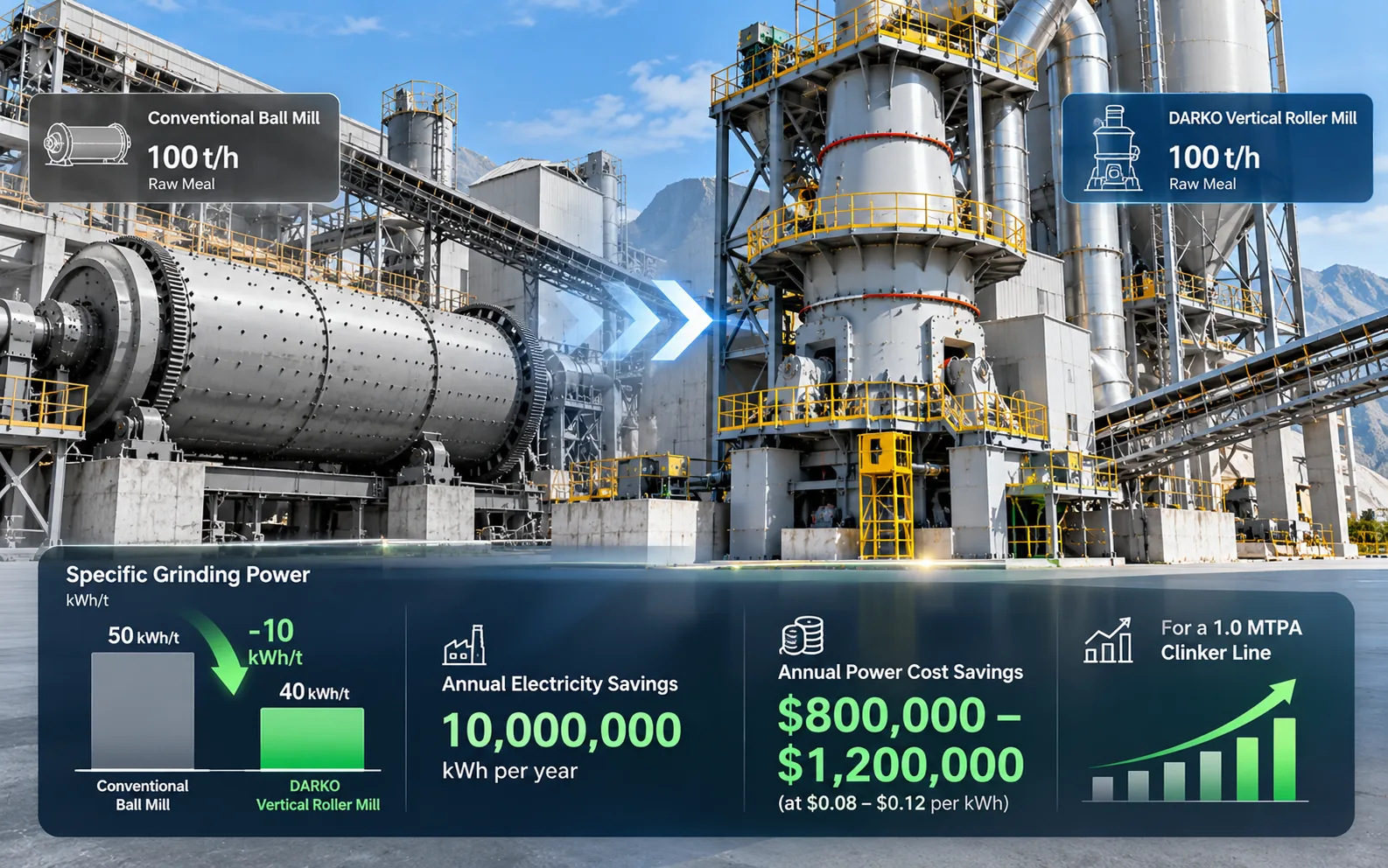
Replacing a conventional 100 t/h raw meal ball mill circuit with an energy-efficient DARKO vertical roller mill generates measurable operational cash flows. Reducing specific grinding power by 10 kWh per ton on a 1.0 MTPA clinker line saves approximately 10,000,000 kWh annually. At standard industrial power rates of $0.08 to $0.12 per kWh, direct annual power bill savings exceed $800,000 to $1,200,000.
* Estimates based on typical industrial electricity rates of $0.08 - $0.12/kWh across 7,000 baseline annual operating hours.
Vertical Roller Mill vs. Traditional Ball Mill: Technical & Economic Evaluation
Selecting the appropriate comminution technology determines baseline electrical demand, operating flexibility, and capital payback for decades. While cement ball mills dominated 20th-century cement plants, modern dry-process lines and brownfield modernization projects increasingly rely on vertical roller mills (VRM) to eliminate high thermal losses, curtail grinding media consumption, and lower specific energy consumption by 30% to 50%.
Specific Electrical Energy Reduction
Bed compression directly shears particles, eliminating kinetic energy wasted by tumbling steel charge.
Integrated Flash Thermal Drying
Sweeps kiln preheater exhaust gas straight through the nozzle ring to dry damp materials in situ.
Vertical 4-in-1 Process Integration
Combines crushing, drying, grinding, and classifying in a single compact structural footprint.
Dynamic Classifier Rotor Response
Brief mill retention time enables rapid Blaine fineness grade shifts without off-spec material batches.
Vertical Roller Mill vs. Ball Mill: Engineering & Operational Matrix
Side-by-side performance comparison of DARKO vertical roller mill installations against legacy closed-circuit ball mills across production capacity, energy consumption, and lifecycle maintenance.
| Evaluation Parameter | DARKO Vertical Roller Mill (VRM) | Conventional Ball Mill Circuit |
|---|---|---|
| Specific Power Consumption (Raw Meal) | 14 to 18 kWh/t (Direct bed compression) | 22 to 28 kWh/t (Kinetic impact losses) |
| Specific Power Consumption (Cement Clinker) | 26 to 32 kWh/t (Optimized particle bed) | 38 to 48 kWh/t (Severe thermal friction) |
| Specific Power Consumption (GGBS Slag) | 38 to 45 kWh/t (>4,200 cm²/g Blaine) | 65 to 80 kWh/t (Accelerated media attrition) |
| Maximum Allowable Feed Moisture | Up to 15% - 20% (Integrated flash drying) | Max 2% - 3% (Requires separate rotary dryer) |
| System Footprint and Layout | Compact vertical structure; saves 40% - 50% land area | Expansive horizontal bay requiring heavy foundation pads |
| Operational Noise and Vibration | < 85 dB(A) (Sealed housing, continuous oil dampening) | 105 dB(A) (Loud steel charge impact on shell liners) |
| Material Retention and Quality Response | 2 to 4 minutes; near-instant Blaine adjustment | 15 to 30 minutes; sluggish feedback stabilization |
| Wear Media Consumption and Maintenance | Segmented alloy liners with automated on-site hardfacing | Frequent ball charging, grading, and manual shell relining |
| Turnkey Civil Construction Time | 20% to 30% faster installation via pre-assembled modules | Prolonged curing cycles for massive trunnion bearing pedestals |
Comminution Physics & Thermal Drying Efficiency
Horizontal ball mills rely on uncontrolled gravitational cascade and random collision. Only 6% to 9% of the mechanical energy input creates new surface area, while the remaining energy dissipates as heat, structural noise, and liner wear. High moisture materials quickly clog grinding diaphragms and damp the impact zone.
DARKO vertical roller mills substitute chaotic ball collisions with controlled material bed grinding. Hydraulic cylinders exert regulated compressive force through profiled roller tires onto a rotating table. Simultaneously, kiln exhaust gas entering the lower nozzle ring flash-dries feed moisture up to 20% in suspension, carrying classified finished product directly to the baghouse.
- ✓ Cuts finished cement grinding electricity by 10 to 16 kWh per metric ton.
- ✓ Eliminates separate gas-fired dryers for wet slag, pozzolana, and limestone additives.
Process Agility & Closed-Loop Fineness Control
Because a standard ball mill retains 30 to 60 tons of circulating material, responding to quality fluctuations or switching between OPC and high-early-strength Portland composite grades creates substantial operational lag. Operators must absorb 30 to 45 minutes of transition delay and divert significant off-spec tonnage to balance silos.
In contrast, a DARKO VRM maintains an active grinding bed residence time of only 2 to 4 minutes. An integral dynamic cage-rotor classifier adjusts finished fineness (3,200 to 5,000 cm²/g Blaine) within minutes simply by adjusting variable-speed motor frequency through DCS presets, yielding consistent particle size distributions and predictable hydration rates.
- ✓ Real-time DCS adjustment of hydraulic loading pressure, mill draft, and rotor speed.
- ✓ Steeper particle size distribution curves ensure reproducible setting times and high 28-day compressive strength.
Turnkey Ball Mill Replacement & Plant Revamping Packages
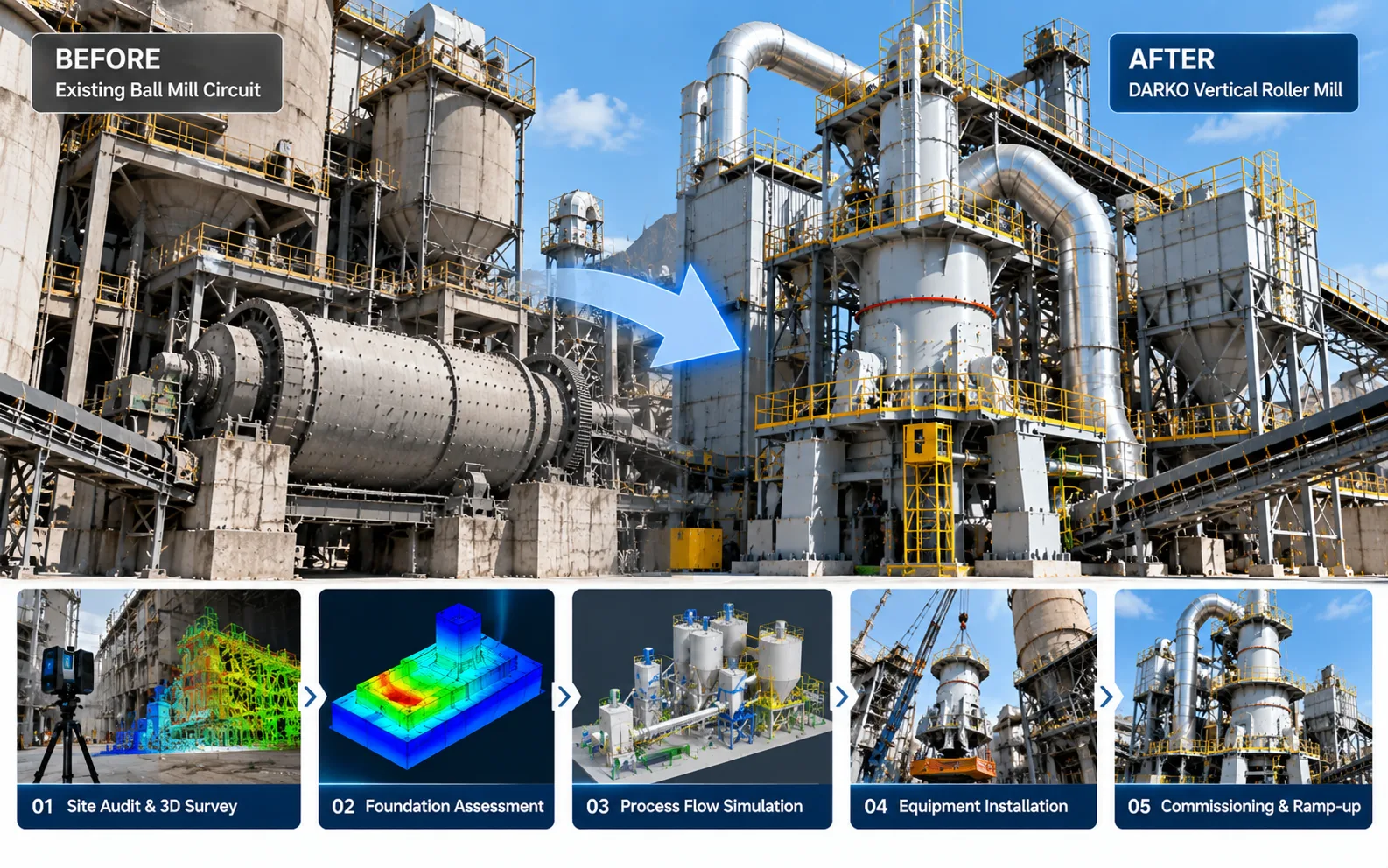
For operating cement facilities constrained by rising kilowatt-hour tariffs and strict local emissions caps, converting older ball mill circuits into modern vertical roller mill systems delivers swift economic returns. DARKO provides turnkey brownfield modernization programs engineered to reuse existing feed bins, weigh feeders, product silos, and high-voltage electrical infrastructure.
Our engineering team conducts comprehensive site audits, foundation resonance assessments, and process flow simulations. By dropping an engineered VRM into existing mill buildings or adjacent plots, plant owners can double clinker grinding capacity while reducing plant-wide electrical intensity.
Wear Metallurgy, Media Handling & Maintenance Protocols
Unplanned downtime and wear part replacement represent the largest operational expenditures across grinding circuits. Compare how mechanical architectures influence maintenance overhead:
Automated Hardfacing
DARKO high-chromium alloy roller tires and table liner segments can be rebuilt in place using automated welding systems, extending wear life across 2 to 3 operational campaigns.
Hydraulic Swing-Out System
Grinding roller assemblies pivot outside the mill housing via integrated hydraulic swing-out cylinders, enabling ground-level inspection and quick segment swaps in under 12 to 24 hours.
Elimination of Ball Charging
Eliminates continuous steel ball top-ups, hazardous confined-space entry for ball sorting, and frequent shell liner bolt retorquing required by conventional ball mills.
DARKO Cement Machinery delivers proven ball mill replacement solutions and advanced cement grinding equipment engineered for maximum uptime.
Engineered for Heavy Duty OperationsHeavy-Duty Mechanical Components: Extended Wear Life and Fast Maintenance
The operational availability and overall lifecycle cost of a vertical roller mill depend directly on the structural reliability and metallurgy of its primary wear components. DARKO Cement Machinery builds each core subassembly to withstand severe compressive grinding pressures, thermal shocks, and continuous abrasive contact. Our integrated hydraulic swing-out maintenance mechanisms, high-chromium alloy casting formulations, and closed-loop dynamic dampening minimize unscheduled plant stoppages while ensuring predictable, manageable servicing intervals.
Advanced Metallurgy and Dynamic Load Management
In high-throughput vertical roller mill circuits, grinding rollers and table segments face continuous multi-megapascal compressive loads alongside extreme abrasive gouging from raw limestone, clinker nodules, and granulated blast furnace slag. Our component architecture unites high surface hardness with deep structural fracture toughness, preventing catastrophic spalling, delamination, or fatigue cracking when uncrushable tramp metal enters the grinding zone.
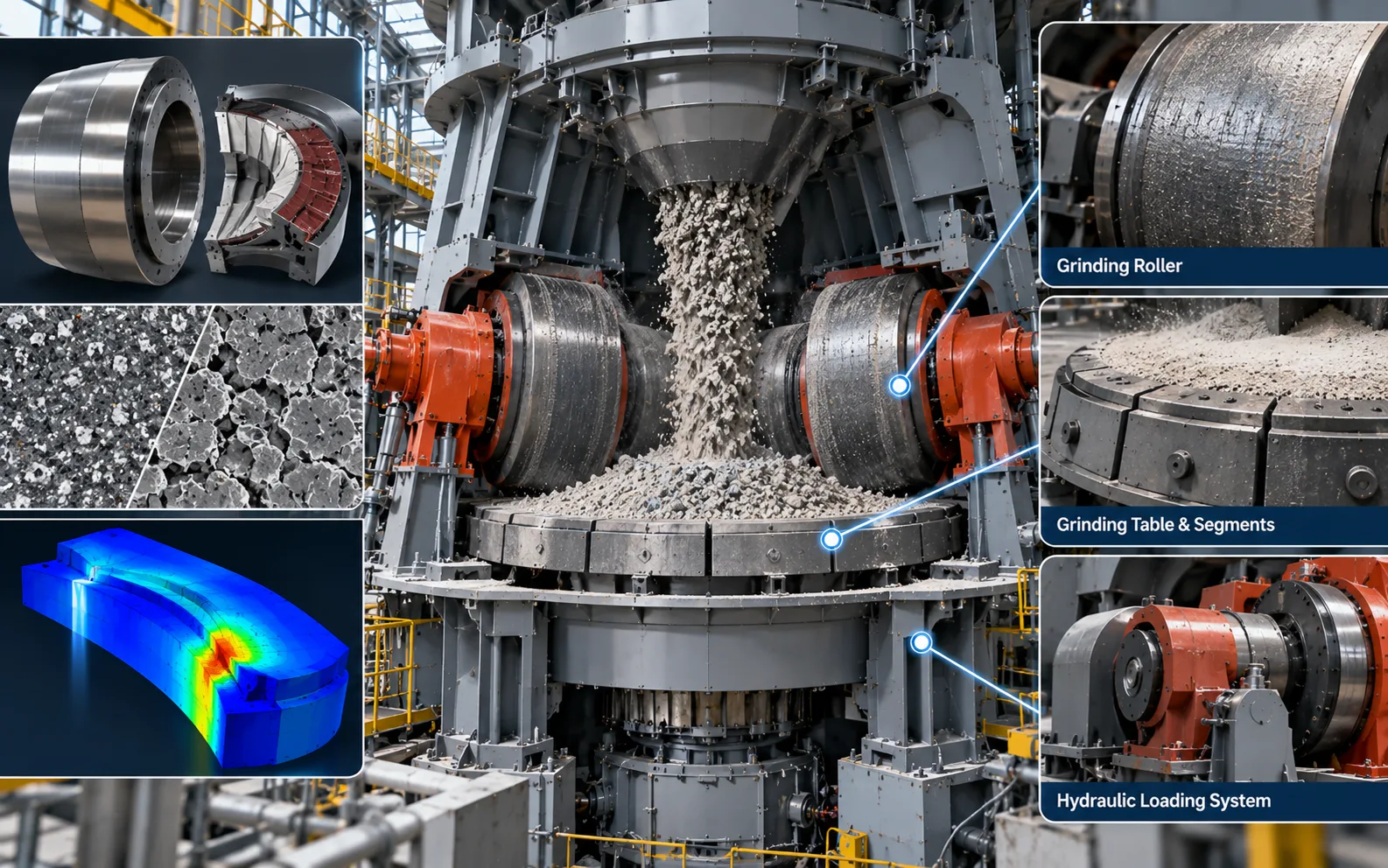
High-Chromium Alloy Grinding Roller Assemblies
Engineered with high-chromium alloyed white cast iron (HRC 60–65) or dual-metal compound centrifugal castings, our roller tire geometries resist severe three-body abrasive wear. Heavy-duty self-aligning spherical roller bearings operate within continuous circulating oil circuits equipped with high-efficiency multi-stage micro-filtration and dual-contact mechanical seals that block abrasive particulate ingress under extreme negative-pressure conditions.
- Hydraulic Swing-Out System: Rollers swivel fully outside the mill housing for fast hardfacing repairs or tire swaps without disassembling classifier ducts connected to baghouse dust collectors.
- Reversible Roller Tires: Symmetrical profile geometry allows 180-degree tire rotation to balance profile wear patterns and double usable wear life.
Segmented Wear-Resistant Grinding Table Liners
The rotating grinding table incorporates an engineered concave track profile designed to stabilize material retention and form an even, continuously renewed grinding bed. The race is split into precision-cast trapezoidal segments fastened with high-tensile wedge clamping assemblies, isolating thermal expansion stresses and allowing selective individual segment replacement.
- Stable Material Bed Formation: Optimized table curvature channels material smoothly beneath the roller tracks without premature edge spillage.
- Quick Wedge Replacement: High-wear liner segments can be unlocked and replaced during planned maintenance shifts using standard overhead hoists.
Dynamic Hydraulic Loading and Accumulator Dampening
Controlled compressive force is applied directly to the roller rocker arms through heavy-duty, double-acting hydraulic cylinders. The closed-circuit hydraulic station incorporates pre-charged nitrogen bladder accumulators that cushion high-frequency impact spikes caused by uncrushable foreign objects, isolating dynamic shock loads from the mill shell and concrete foundation.
- Proportional Servo Load Control: Hydraulic pressure continuously modulates according to feed moisture, grindability, and main motor load to ensure optimal throughput for finished material handling and bulk loading equipment.
- Zero Metal-to-Metal Protection: Adjustable mechanical limit stops preserve a precise safety gap between rollers and table during no-load starts.
Heavy-Duty Planetary Bevel Gearbox
The main drive employs a multi-stage bevel-planetary reduction gearbox designed to transfer massive torque while supporting total vertical grinding reaction forces. An integrated circular thrust housing uses hydrostatic tilting-pad bearings with a dedicated high-pressure jacking oil system, eliminating boundary friction on startup and ensuring reliable bearing support during continuous 24/7 milling.
- Direct Load Routing: Heavy cast steel housings direct compressive grinding thrust straight downward into reinforced foundation piers.
- DCS Condition Monitoring: Multi-point RTD temperature sensors, oil quality monitors, and vibration transmitters interface directly with plant DCS.
Component Metallurgy and Performance Specifications
Review standard metallurgical specifications, expected operational lifespans, and field maintenance procedures for core vertical roller mill subassemblies.
| Subassembly Component | Material Grade & Specification | Hardness Rating | Estimated Wear Lifespan | Maintenance & Servicing Mode |
|---|---|---|---|---|
| Grinding Roller Tires | High-Cr Mo-Ni Alloyed Cast Iron / Composite Hardfacing | HRC 60 – 65 | 8,000 – 15,000 Operating Hours | Hydraulic swing-out with automated on-site hardfacing |
| Table Liner Segments | High-Chromium Hypereutectic White Cast Iron | HRC 58 – 63 | 10,000 – 18,000 Operating Hours | Trapezoidal segmented wedge release and crane lift-out |
| Rocker Arm Pivot Pins | 42CrMo High-Tensile Forged Alloy Steel | HB 280 – 320 | 50,000 Operating Hours | Automated centralized grease purge lubrication |
| Nozzle Ring Air Vanes | Hardox 450 / 16Mn Composite Armored Plates | HBW 450 | 12,000 – 20,000 Operating Hours | Bolt-on replaceable aerodynamic guide vanes |
| Planetary Thrust Bearings | Babbitt White Metal on Hydrostatic Tilting Pads | ISO VG 320 / 460 | 80,000 Operating Hours | High-pressure hydrostatic jacking oil pump inspection |
In-House Foundry Casting, Heat Treatment, and NDT Verification
DARKO operates heavy foundry casting and precision heat-treatment workshops dedicated to mineral grinding components. Every roller shell and table segment undergoes 100% ultrasonic non-destructive testing (NDT), magnetic particle crack inspection, and controlled multi-stage stress-relief tempering cycles. This metallurgical rigor eliminates internal casting voids and micro-porosity, guaranteeing zero-spalling durability under maximum grinding pressure.
Complete Cement Grinding Plant Auxiliary Equipment Integration
DARKO Cement Machinery delivers fully synchronized auxiliary equipment products engineered for airtight process control, ultra-low stack emissions, and dependable powder conveying across complete vertical roller mill circuits.
Harmonizing Aerodynamic Balance and High-Volume Material Handling
A grinding circuit operates only as efficiently as its auxiliary systems. Unchecked false air ingress, material bottlenecking, or unstable air classification degrades cement Blaine fineness while driving up main system fan power consumption.
DARKO engineers each auxiliary module—from high-integrity rotary airlocks to dedicated dust collection equipment and fluidized air slides—to precisely match vertical roller mill flow dynamics, ensuring continuous operation without pressure drops or dust leakage.
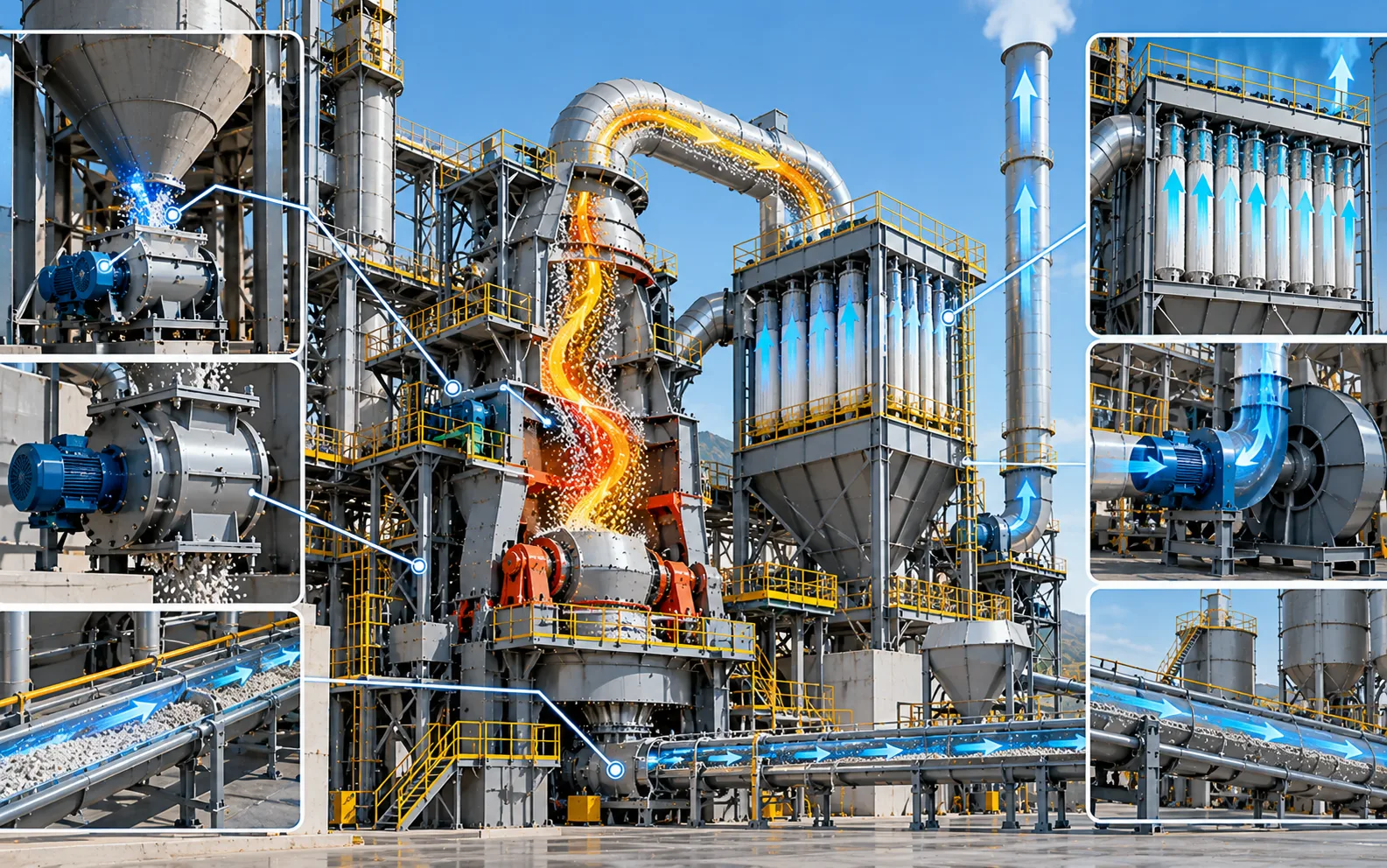
Engineered Auxiliary Modules for High-Capacity Grinding Plants
Heavy-duty process machinery designed for seamless linkage, continuous 24/7 reliability, and minimal maintenance downtime.
Dedicated VRM Bag Filter Collectors
Full-negative-pressure baghouse dust collectors engineered to handle high-moisture mill exhaust, providing ultra-clean filtration and particulate capture below 10 mg/Nm³.
- Hydrophobic & PTFE membrane filter bags
- Smart differential pressure pulsing control
Air Slides & Central Chain Elevators
Enclosed air gravity conveyors transfer fine cement with near-zero energy consumption, feeding reinforced central chain bucket elevators for vertical transport into storage silos.
- High-permeability woven fluidization fabric
- Wear-resistant alloy bucket chains
Heavy-Duty Rotary Air Lock Valves
Precision-machined rotary feeders and double flap valves seal raw feed and reject chutes, eliminating parasitic false air infiltration to stabilize the internal mill airflow pattern.
- Hardfaced adjustable rotor tip blades
- Air-purged outboard bearing seals
Homogenizing Silos & Bulk Loaders
Large-capacity cement storage silos with multi-zone bottom aeration ensure uniform blending and smooth discharge, paired with dustless telescopic chutes for rapid truck loading.
- Zone-fluidized aeration cone discharge
- Integrated dust aspiration loading spouts
Auxiliary Equipment Performance Standards
Technical specifications benchmarked across DARKO turnkey cement grinding installations.
| Subsystem Unit | Standard Operational Scope | Critical Technical Parameter | Plant Benefit |
|---|---|---|---|
| VRM Exhaust Bag Filter | Gas volume: 50,000 – 650,000 m³/h | Outlet dust: < 10 mg/Nm³ | Complies with strictest global emissions standards |
| Air Gravity Conveyor | Throughput: 50 – 800 t/h | Slope angle: 4° to 8° decline | Low-power, low-friction micro-powder conveyance |
| Rotary Air Lock Feeder | Inlet bore: 300 mm – 1,000 mm | Machined rotor gap: ≤ 0.15 mm | Preserves mill negative pressure and aerodynamic balance |
| Telescopic Bulk Spout | Loading rate: 150 – 350 t/h | Dual-tube dust-evacuation design | High-speed, dust-free automated dispatch loading |
Single-Source Engineering for Complete Grinding Circuits
From initial plant layout and equipment selection to dust collection, material conveying, and commissioning, DARKO supports integrated cement grinding projects with coordinated engineering and equipment solutions.
Turnkey Grinding Installations and Verified Operating Data
DARKO Cement Machinery engineers and commissions vertical roller mill systems and turnkey dust collection equipment for heavy industrial operations across more than 30 countries. Our turnkey installations deliver documented power savings, precise Blaine fineness control, and uninterrupted plant availability under demanding continuous-duty cycles.
Countries operating DARKO vertical roller mill installations.
Stable grinding capacity on 5,000 TPD clinker production lines.
Specific power reduction verified against closed-circuit ball mills.
Logged consecutive operating hours without unplanned downtime.
Featured Turnkey Engineering Projects
Engineered vertical roller mill systems matched to abrasive raw materials, clinker hardness, and regional market specs.
HRM 4800 Raw Meal Grinding System
Complete raw grinding and drying station paired with specialized pulse jet dust collectors delivered on an accelerated schedule to supply a high-capacity cement manufacturing line.
SLM 3600 GGBS Slag Grinding Plant
Turnkey ground granulated blast-furnace slag plant engineered for high-abrasion resistance, ultra-fine binder production, and high-efficiency baghouse dust collectors.
CLM 4200 Clinker Grinding Station
Complete standalone cement grinding station producing high-grade Portland cement with zero unscheduled stops in Year 1.
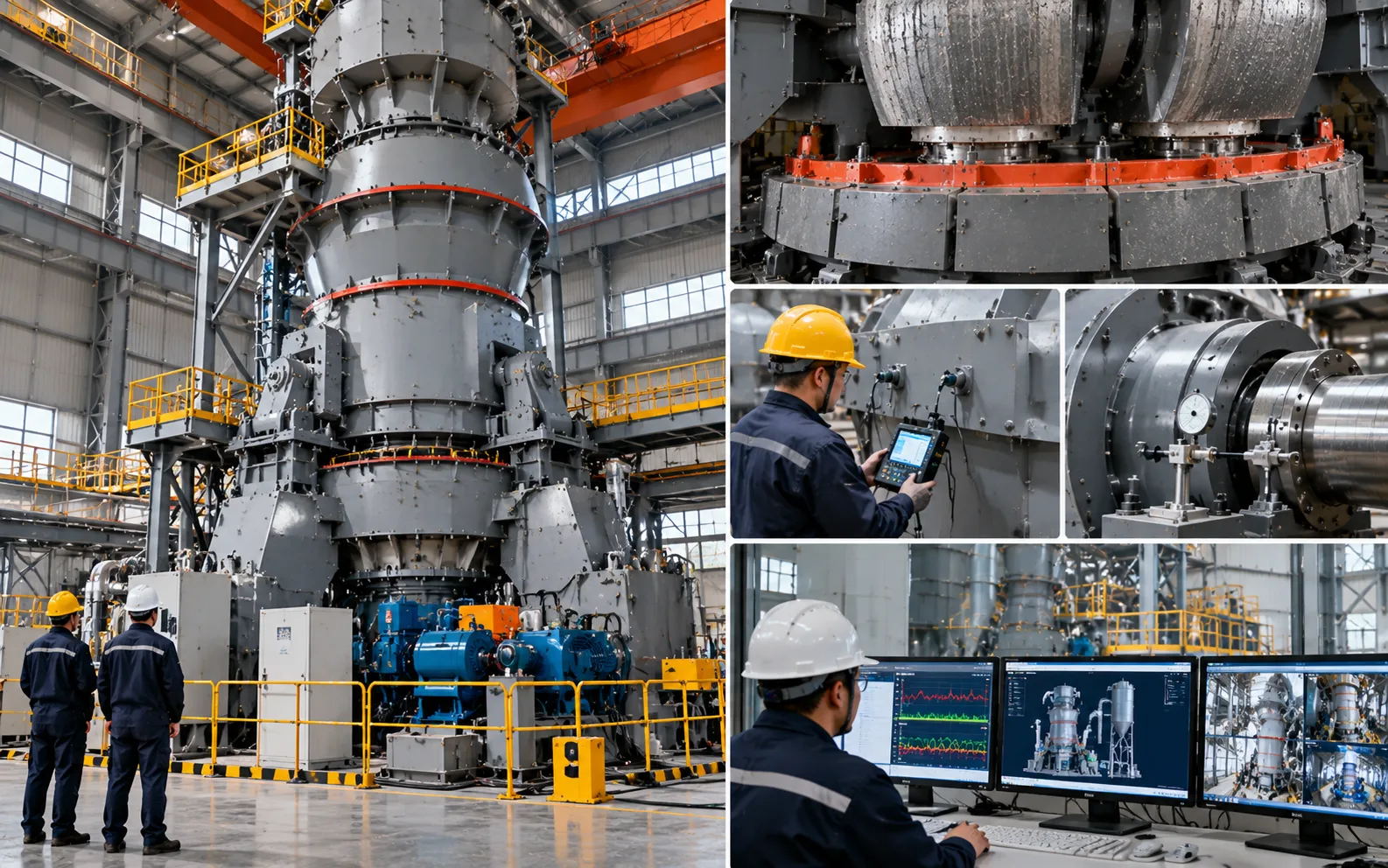
Factory Testing & Commissioning Acceptance Criteria
Every DARKO mill assembly undergoes rigorous dynamic testing and mechanical shop assembly prior to dispatch, ensuring immediate field stability and rapid ramp-up to rated output.
| Operating Parameter | Standard Industry Metric | DARKO Commissioned Performance |
|---|---|---|
| Grinding Bed Vibration Severity | < 2.5 mm/s RMS | ≤ 1.5 mm/s RMS |
| Acoustic Noise Level at 1 Meter | < 90 dB(A) | ≤ 83 dB(A) |
| System False Air Ingress Rate | < 8.0% to 10.0% | ≤ 4.5% |
| Grinding Tire Service Life (Raw/Slag) | 6,000 to 8,000 Hours | 10,000 to 15,000 Hours |
Manufacturing Quality and Safety Certifications
Every pressure vessel, planetary gear drive, and structural weldment adheres to recognized international machinery standards.
ISO 9001:2015
Certified quality assurance governing casting metallurgy, machining tolerances, assembly, and test-run protocols.
CE Machinery Directive
Full conformity with European Directive 2006/42/EC, EMC standards, and safety circuit interlock requirements.
ASME Section VIII
Hydraulic nitrogen accumulators, pressure vessels, and lube oil reservoirs fabricated to ASME code criteria.
ISO 1940-1 Grade G2.5
Precision dynamic balancing of mill tables, grinding rollers, and dynamic classifier cage rotors to minimize bearing wear.
Need Technical Data & Grinding System Sizing?
Share your feed material properties, target capacity, and grinding requirements with DARKO. Our engineering team can help evaluate equipment configurations, power demand, and plant modernization options.
Frequently Asked Questions on Vertical Roller Mill Operations
Technical answers and sizing guidance addressing operational economics, wear part metallurgy, flash drying capabilities, Blaine fineness control, and mill vibration mitigation.
Core Operating Highlights
DARKO Cement Machinery engineers every vertical roller mill with continuous DCS telemetry, proactive hydropneumatic stabilization, and premium wear-resistant assemblies to deliver uninterrupted plant uptime.
Our technical support team provides 24/7 DCS remote performance diagnostics, plant modernization assessments, and laboratory Bond Work Index grindability evaluations.
While the initial machinery investment for a vertical roller mill (VRM) can be slightly higher than a standalone ball mill, the total turnkey installation cost remains comparable because the VRM eliminates standalone pre-drying units, complex recirculation bucket elevators, separate dynamic separator structures, and extensive civil foundations. The operational savings deliver definitive financial advantages:
- Raw Material Grinding: Raw meal VRM systems consume only 14 to 18 kWh/t compared to 24 to 28 kWh/t in traditional ball mills, yielding direct electrical energy savings of 30% to 40%.
- Clinker and Slag Grinding: Producing ordinary Portland cement or GGBS with a VRM saves 10 to 15 kWh per ton over standard open-circuit ball mill arrangements.
- Investment Amortization: For an industrial grinding plant operating at 1,000,000 tons per year, cumulative power cost savings alone typically recoup the differential capital investment within 12 to 18 months.
DARKO optimizes internal gas flow dynamics and grinding roller geometry to minimize specific power draw across variable kiln production outputs.
Request a Grinding System Proposal
Tell us about your project. Our team will review your requirements and discuss suitable equipment and system options.
How DARKO Can Help
From equipment selection to plant integration, we support your grinding project at every stage.
- Equipment selection based on material and capacity requirements
- System planning for grinding, conveying, and dust collection
- Technical discussion and a project-specific quotation
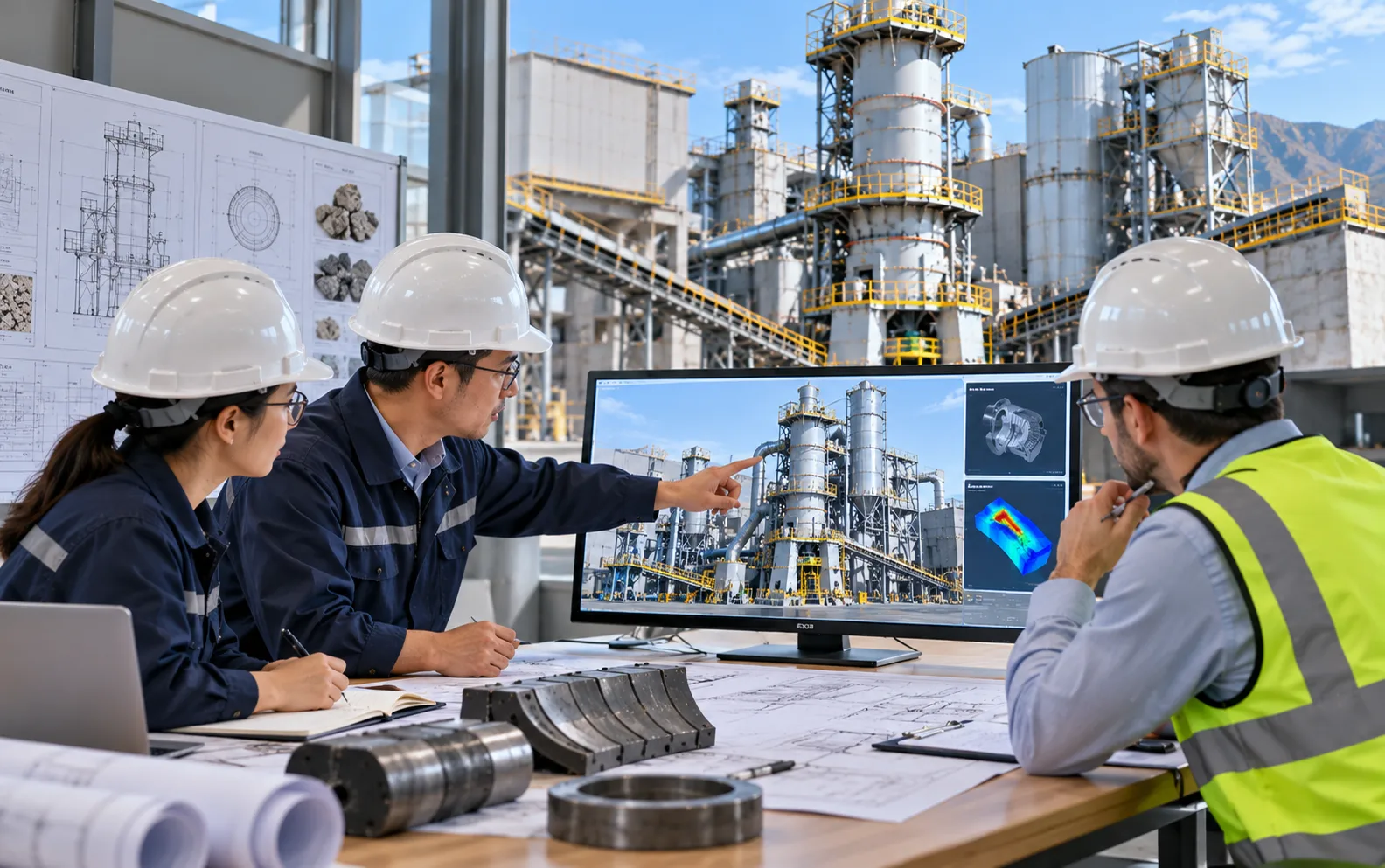
Tell Us About Your Project
Only your contact details are required. Technical details can be discussed later.