
Six Core Engineering Criteria for Bulk Loading Spout Selection
Specifying an industrial telescopic loading spout requires evaluating physical loading boundaries rather than relying solely on nominal catalog ratings. Gravity mass flow rates, material abrasive indices, carrier intake geometry, and negative pressure ventilation dynamics must balance across every loading cycle. Mismatched components cause blown outer bellows, severe dust emissions, accelerated cone wall thinning, and unplanned terminal downtime.
At DARKO Cement Machinery, our application engineering follows a field-proven principle: bulk material characteristics dictate inner wear cone metallurgy, while operating cycles, bay heights, and vehicle profiles govern telescopic drive geometry. Use the six core evaluation criteria below to properly size and configure your bulk loadout system.
Receiving Vehicle and Vessel Interface
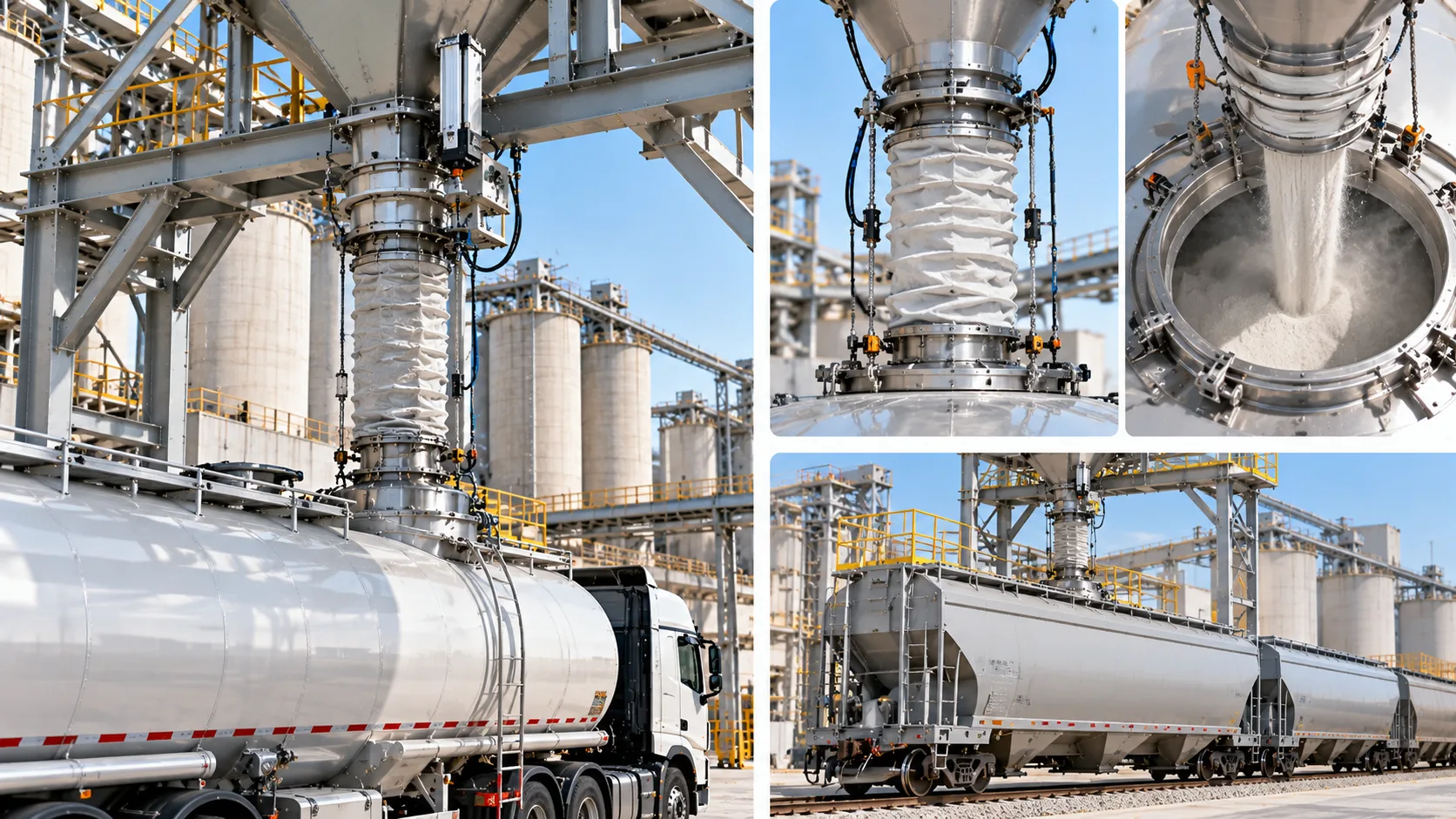
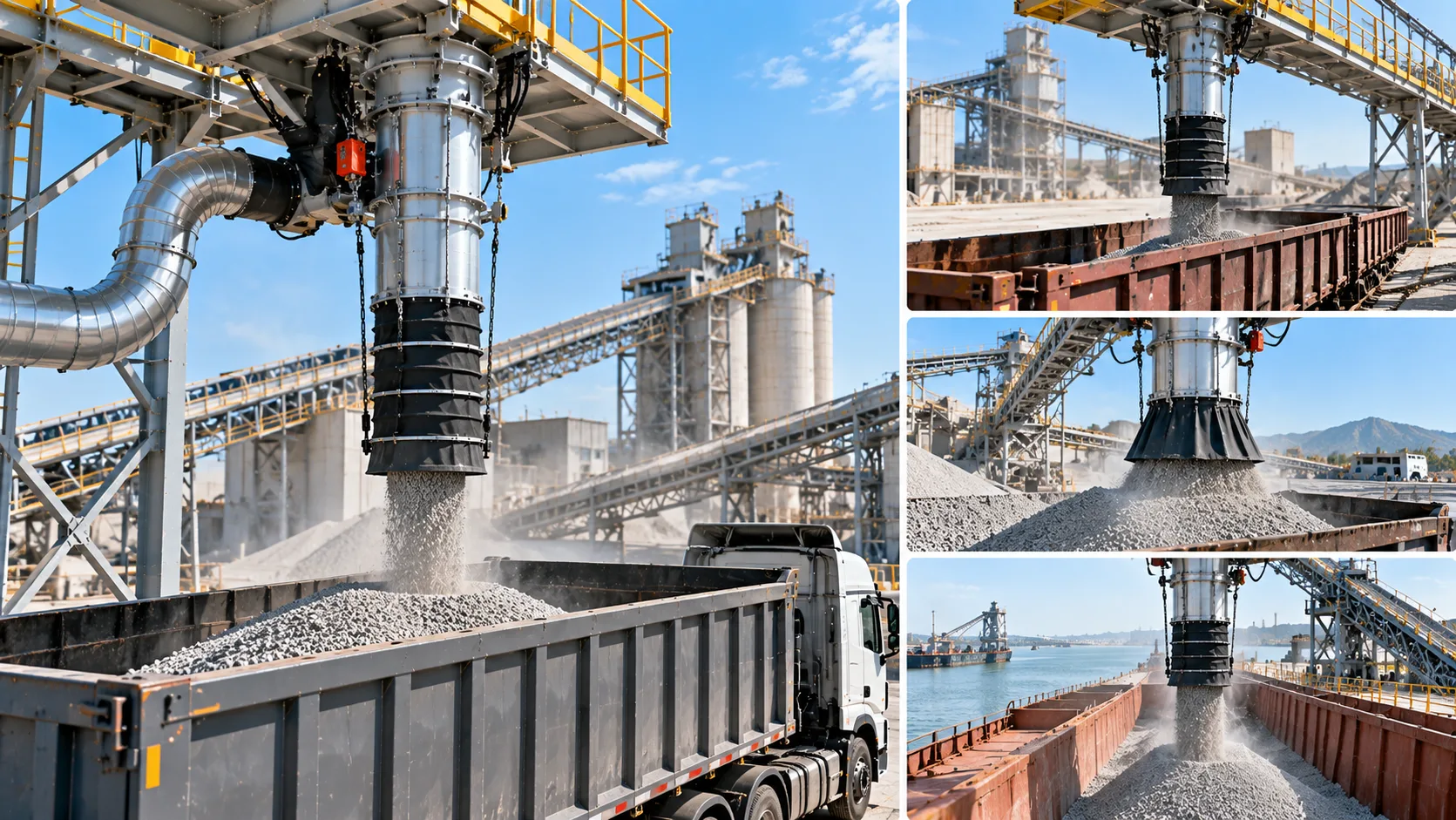
The receiving carrier determines the bottom discharge sealing assembly. Enclosed pneumatic dry-bulk road tankers and rail tank cars require an elastomeric-lined sealing cone that seats tightly onto the hatch manhole to sustain internal negative pressure. Open-top flatbeds, dump trailers, open railcars, and marine barges require a flexible polyurethane dust skirt or apron that rests directly against the rising material pile to contain induced fugitive dust.
Material Flow and Physical Properties
Bulk materials vary widely in bulk density, particle size distribution, Mohs hardness, and aeration behavior. Fluidizable fine powders such as Portland cement, ground granulated blast-furnace slag (GGBS), and fly ash flow rapidly like liquids under gravity feed. Abrasive, coarse materials like cement clinker, aggregates, and mineral ores require heavy-duty modular wear cones with hardened inner liner plates and heat-resistant bellows fabrics.
Loading Capacity and Throughput (TPH)
The inner cone chute diameter must accommodate the peak instantaneous surge volume from upstream air slides, rotary feeders, bucket elevators, or bin discharge gates. Sizing the spout solely for average hourly rates causes internal product bottlenecking, turbulence-induced cone wear, and material backup into the annular dust evacuation channel.
Vertical Telescopic Travel and Clearances
Structural headroom beneath the silo or discharge flange dictates the retracted length, while the lowest vehicle deck elevation determines the required maximum extension. Accurate engineering layouts must account for truck suspension compression during filling, overhead gantry clearances, and an adequate safety margin to protect the flexible bellows from over-extension strain.
Dust Collection and Ventilation Balance
Displaced air generated during high-speed gravity loading creates positive vessel pressure that forces dust into the atmosphere if unmanaged without integrated dust collection equipment. Spout selection must include a properly sized exhaust volume. Facilities can integrate an off-spout connection to existing central baghouse dust collectors or deploy self-contained, top-mounted cartridge dust collectors that return entrained dust directly into the batch.
Drive Mechanism and Safety Interlocks
The winch hoisting mechanism dictates positioning reliability and operational uptime. While two-cable winches work for compact, light-duty units, heavy industrial duty cycles require balanced three-rope or four-rope hoist drums to resist lateral wind drift and cable binding. Integrated slack-cable switches, rotary upper and lower limits, and fail-safe electromagnetic brakes prevent structural drop accidents.
Verify Your Bulk Loadout Parameters with DARKO Engineers
Need assistance verifying vertical travel dimensions, material abrasion wear packages, or dust extraction balance? Share your silo elevations, throughput goals, and material specifications with our technical engineering team for a project-specific sizing recommendation.
Select Loading Spout Structural Configuration by Receiving Carrier
Selecting the correct bulk loading spout architecture depends primarily on the geometric interface and aeration dynamics of the receiving transport vessel. Whether outfitting dedicated dry bulk tanker bays, open-top dump trailers, rail gondolas, or multi-modal dispatch terminals, matching the lower discharge assembly to vehicle hatch dimensions and pile-settling behavior is essential for high-throughput, zero-dust operations.
DARKO manufactures heavy-duty tanker loading spouts, open truck telescopic chutes, and modular hybrid systems. As part of our engineered bulk handling products, each system is designed with abrasion-resistant internal wear cones, heavy polyurethane sealing surfaces, and integrated negative-pressure dust pathways that withstand continuous, high-volume industrial loadout.
Enclosed Tanker Loading Spouts for Aerated Dry Powders
Engineered specifically for pressurized pneumatic road tankers, sealed railcars, and top-hatch bulk containers, this configuration creates a dust-tight mechanical interface over standard 400 mm to 500 mm (16 in to 20 in) vehicle manholes. By isolating aerated powder flow from the surrounding atmosphere, loadout speeds are maximized while completely eliminating product loss.
Sealing Mechanics & Displaced Air Management
Material discharges via gravity through nested inner steel cones while aerated, dust-laden air is displaced upward through the annular outer chamber under constant negative pressure tied to plant dust collection equipment. A heavy-duty neoprene or polyurethane-coated bottom sealing cone seals firmly against the hatch rim to prevent air blowback and fugitive dusting during peak filling cycles.
Core Engineering Characteristics
- Overfill Prevention & Level Sensing: Outfitted with high-sensitivity rotating paddle switches, vibrating tuning forks, or RF admittance probes to trigger immediate upstream slide gate closure upon reaching target fill volume.
- Concentric Extraction Chamber: Generates uniform annular exhaust velocities (12–18 m/s), ensuring consistent negative draft without entraining bulk product into the filtration stream.
- Target Application Media: High-throughput loading of Portland cement, ground granulated blast-furnace slag (GGBS), fly ash, calcined clay, hydrated lime, and raw meal powders.
Key Technical Specifications
- Internal Cone Diameter
- Ø300 mm – Ø450 mm
- Volumetric Throughput
- 100 – 450 t/h
- Required Exhaust Draft
- 1,200 – 2,500 m³/h
- Standard Level Sensor
- Rotary Paddle / RF Admittance

Technical Adaptation Matrix by Transport Category
Compare terminal sealing mechanics, material handling profiles, and dust management strategies across transport vehicle types before finalizing engineering specifications.
| Carrier Type | Terminal Seal Mechanism | Typical Bulk Media | Fugitive Dust Strategy | Level Detection Method |
|---|---|---|---|---|
| Enclosed Powder Tanker | Heavy Neoprene/Polyurethane Sealing Cone | Portland Cement, Slag, Fly Ash, Lime, Alumina | Negative Pressure Annular Exhaust Extraction | Rotary Paddle or Vibrating Fork Level Switch |
| Open Tipper / Dump Truck | Segmented Industrial Dust Apron | Clinker, Crushed Aggregate, Sand, Coal, Gravel | Continuous Mound Containment & Perimeter Suction | Slack-Cable Limit Switch / Tilting Level Probe |
| Open Rail Gondola / Barge | Heavy Scalloped Modular Skirt Assembly | Iron Ore, Run-of-Mine Limestone, Clinker Chunks | High-Volume Central Extraction & Dust Venting | Continuous RF Admittance & Smart Hoist Sync |
| Dual-Carrier Flex Bay | Hybrid Sealing Cone with Modular Skirt | Multi-Grade Finished Cements, Pozzolans, Minerals | Variable-Draft Interlocked Negative Exhaust | Multi-Mode Switchable Console Control Logic |
Optimizing Spout Wear Cone Material and Outer Bellows for Severe Operating Conditions
Selecting the correct internal guide cone metallurgy and external flexible bellows fabric directly determines the service life, structural integrity, and operating uptime of your telescopic loading chute. In heavy-duty bulk material handling, abrasive powder loading accelerates sliding abrasion along inner cones, extreme temperatures trigger fabric embrittlement, and corrosive moisture degrades untreated metal alloys. DARKO incorporates an engineered material selection methodology that pairs wear-hardened cone geometries with thermal- and chemical-resistant flexible composites tailored to your precise operating parameters.
Operating Condition Assessment Matrix
Every dry solid stream creates unique kinetic, friction, and thermal stresses during gravitational discharge through the spout wear cone material assemblies. Evaluate your bulk media against these four degradation parameters to ensure optimal component sizing:
Determines required cone wall gauge, through-hardening levels, hardfaced overlays, or ceramic drop-in tiles to prevent wall breach under continuous scouring.
Dictates specialized silicone-impregnated fiberglass or multi-ply woven composites to resist heat-induced cracking, polymer delamination, and seam failure.
Requires austenitic 304 or 316L stainless steel alloys and chemically inert elastomer coatings for hygienic dry powders, salts, and caustic fly ash.
Mandates permanently bonded conductive filaments and braided copper bonding jumpers across all telescoping joints to disperse dangerous static buildup.
Precision Overlap Engineering
DARKO loading spout inner cones are manufactured with cold-formed dies and robotic weld-overlay tooling. Each interlocking cone maintains a continuous overlap depth of at least 80 mm across the entire vertical stroke, ensuring falling fines stay contained within the core channel and preventing premature abrasive wear against the outer dust extraction bellows connected to centralized dust collection equipment.
Inner Guide Cone Sleeve Material Comparison
The internal telescopic cone column functions as the primary material-conveying conduit, shielding the outer annular dust-scavenging zone from particle impingement. Selecting the appropriate metallurgy balances operational capital expenditure against long-term maintenance cycles:
Carbon Steel (Q235B / ASTM A36)
Standard DutyA cost-effective baseline configuration engineered for non-abrasive or mildly abrasive dry solids, including limestone dust, hydrated lime, flour, and agricultural grains.
Manganese Steel (16Mn / NM400 / Hardox)
Heavy DutyQuenched and tempered abrasion-resistant plate engineered for severe sliding friction and particle impingement caused by ordinary Portland cement, fly ash, and ground slag.
Ceramic Composite & Silicon Carbide
Extreme AbrasionHigh-alumina ceramic tiles or reaction-bonded silicon carbide inserts mechanically bonded to steel shells, providing 5 to 8 times the wear life of conventional quenched steel alloys.
Stainless Steel (AISI 304 / 316L)
Hygienic / CorrosiveElectro-polished and passivated austenitic alloys designed for food powders, chemical reagents, marine terminals, and environments requiring frequent aggressive washdowns.
Telescopic Outer Bellows Fabric Selection
The external flexible accordion sleeve isolates negative pressure dust extraction channels routed to baghouse dust collectors from the surrounding atmosphere. Its construction must endure constant vertical flex cycles, ambient weather exposure, and process temperature spikes:
Neoprene-Coated Polyester Duck Fabric
Rated to 80°CProvides outstanding mechanical tensile strength, tear resistance, and puncture protection. The preferred workhorse material for ambient-temperature dry powder dispatch with continuous extension and retraction cycles.
Silicone-Coated Fiberglass High-Temperature Sleeve
Continuous 250°CEngineered with woven multi-ply fiberglass yarn protected by high-grade silicone elastomer. Designed specifically to withstand thermal radiation and radiant conductive heat from fresh rotary kiln clinker and hot boiler fly ash.
Anti-Static Conductive Interwoven Fabric
ATEX / NFPA 652 CompliantWoven with integrated carbon or brass conductive filaments that maintain constant electrical continuity between structural support rings, preventing static spark discharge during pulverized coal, starch, or sulfur handling.
| Bulk Solid Medium | Bulk Density | Mohs / Wear Profile | Operating Temp | Recommended Inner Wear Cone | Recommended Outer Bellows Fabric |
|---|---|---|---|---|---|
| Portland Cement | 1.1–1.4 t/m³ | Mohs 4–5 (Scouring) | Ambient–90°C | NM400 / 16Mn Manganese Steel | Neoprene-Coated Polyester Duck |
| Hot Cement Clinker | 1.3–1.6 t/m³ | Mohs 6–7 (Severe Impact) | 120–220°C (Peak 250°C) | Alumina Ceramic Mosaic / Hardfaced Alloy | Multi-Ply Silicone Fiberglass (250°C) |
| Pulverized Coal Fuel | 0.7–0.9 t/m³ | Mohs 2–3 (Explosive Fines) | 40–80°C | 16Mn Steel with Copper Bonding Straps | Anti-Static Conductive Interwoven Fabric |
| Silica Sand & Slag | 1.4–1.7 t/m³ | Mohs 7–8 (Aggressive Gouging) | Ambient–110°C | Reaction-Bonded Silicon Carbide / NM500 | Heavy-Gauge Polyurethane / Neoprene |
| Raw Limestone & Gypsum | 1.2–1.5 t/m³ | Mohs 3 (Mild Abrasion) | Ambient–60°C | Q235B / ASTM A36 Carbon Steel | Industrial PVC-Coated Polyester Duck |
Dust-Free Operation: Matching Loading Spouts with Dust Collection Systems and Airflow Sizing
Achieving true zero-fugitive-dust loadout requires an engineered balance between material gravity descent, vehicle volumetric air displacement, and negative-pressure dust extraction powered by dedicated dust collection equipment. As dry bulk powders—such as Portland cement, pulverized fly ash, raw meal, or ground slag—fall through the inner telescoping chute, the incoming mass displaces an equal volume of air while entraining additional induced airflow. Sizing the ventilation volume and selecting the appropriate filtration architecture prevents regulatory emission violations, eliminates product loss, and protects terminal personnel.
Split External Dust Collection System
Designed for multi-bay dispatch terminals and silo skirts where an existing plant-wide negative pressure baghouse network is operational. The loading spout head is equipped with an exhaust take-off flange connected directly via rigid ductwork to central baghouse dust collectors.
Target Operating Scenarios
High-throughput cement distribution terminals, multi-lane truck dispatch stations, and plant modernization projects where central dust extraction capacity is already present.
Mechanical Configuration
Stationary top head with standard flanged exhaust connection (typically DN200–DN300), balanced ducting, flexible transition sleeves, and motorized or manual air balancing dampers.
- ✓ Minimized Hoist Load: Eliminates fan and filter weight from the telescoping head, reducing hoist winch tonnage and structural fatigue.
- ✓ Centralized Maintenance: Filter bag replacements, diaphragm valve rebuilds, and differential pressure checks occur at a single ground-level service bay.
- ⚠ Balancing Requirement: Requires balancing dampers across duct branches to prevent vacuum starvation when multiple loading bays operate concurrently.
Integrated Pulse-Jet Filter Cartridge Spout
A fully autonomous, self-cleaning loading spout integrating compact cartridge dust collectors with high-efficiency pleated filter media and a high-pressure exhaust fan mounted directly to the stationary head frame, eliminating all external ventilation ducting.
Target Operating Scenarios
Remote silo loadout stations, dedicated railcar transfer tracks, bulk marine loading docks, and isolated terminals lacking centralized baghouse access.
Mechanical Configuration
Top-mounted direct-drive centrifugal exhaust blower, integrated compressed-air surge receiver, pulse solenoid valves, and spunbond polyester or PTFE-coated filter cartridges.
- ✓ Direct Product Recovery: Pulsed dust cakes dislodge directly back into the receiving vehicle hatch, eliminating cross-contamination and disposal logistics.
- ✓ Zero Ducting Network: Eliminates duct routing costs, static pressure friction losses, elbow abrasion, and particulate settling blockages.
- ⚠ Overhead Utility Demands: Demands higher structural overhead load capacity and a continuous clean, dry compressed air supply at 0.5–0.7 MPa.

Critical Airflow Sizing and Annular Velocity Dynamics
Accurate dust-free bulk loading airflow calculation resolves two costly field failures: insufficient negative pressure that allows pressurized dust to blast past the tanker hatch, and excessive extraction velocity that pulls salable product directly into the filter media. The annular space between the inner flow cones and outer flexible bellows serves as the dedicated exhaust evacuation channel.
The required exhaust volume (Q_total) is calculated from the displaced material volume (Q_displaced), the air volume entrained by the falling product stream (Q_induced), and atmospheric infiltration allowance (Q_inleakage):
Fine powders loaded up to 250 t/h in sealed tanker trucks.
High-rate cement, fly ash, and clinker loading from 300 to 600 t/h.
Optimal velocity window capturing dust without fluidizing bulk mass.
Engineered Integration with DARKO Pulse-Jet Baghouse Systems
DARKO Cement Machinery designs telescoping loading spouts and dust collection modules as a cohesive pneumatic unit. By tailoring inner cone throat diameters, outer bellows annular area, and exhaust fan performance curves to your exact material bulk density and aeration behavior, DARKO guarantees clean loadout bays, regulatory compliance, and maximum operational uptime.
Loading Spout Travel Length & Headroom Sizing Calculator
Enter your terminal elevations and target loading capacity to review preliminary vertical travel requirements. Send the calculated dimensions directly to DARKO's engineering team via WhatsApp for equipment selection and a project-specific quotation.
Terminal Geometry & Flow Parameters
Unit: mm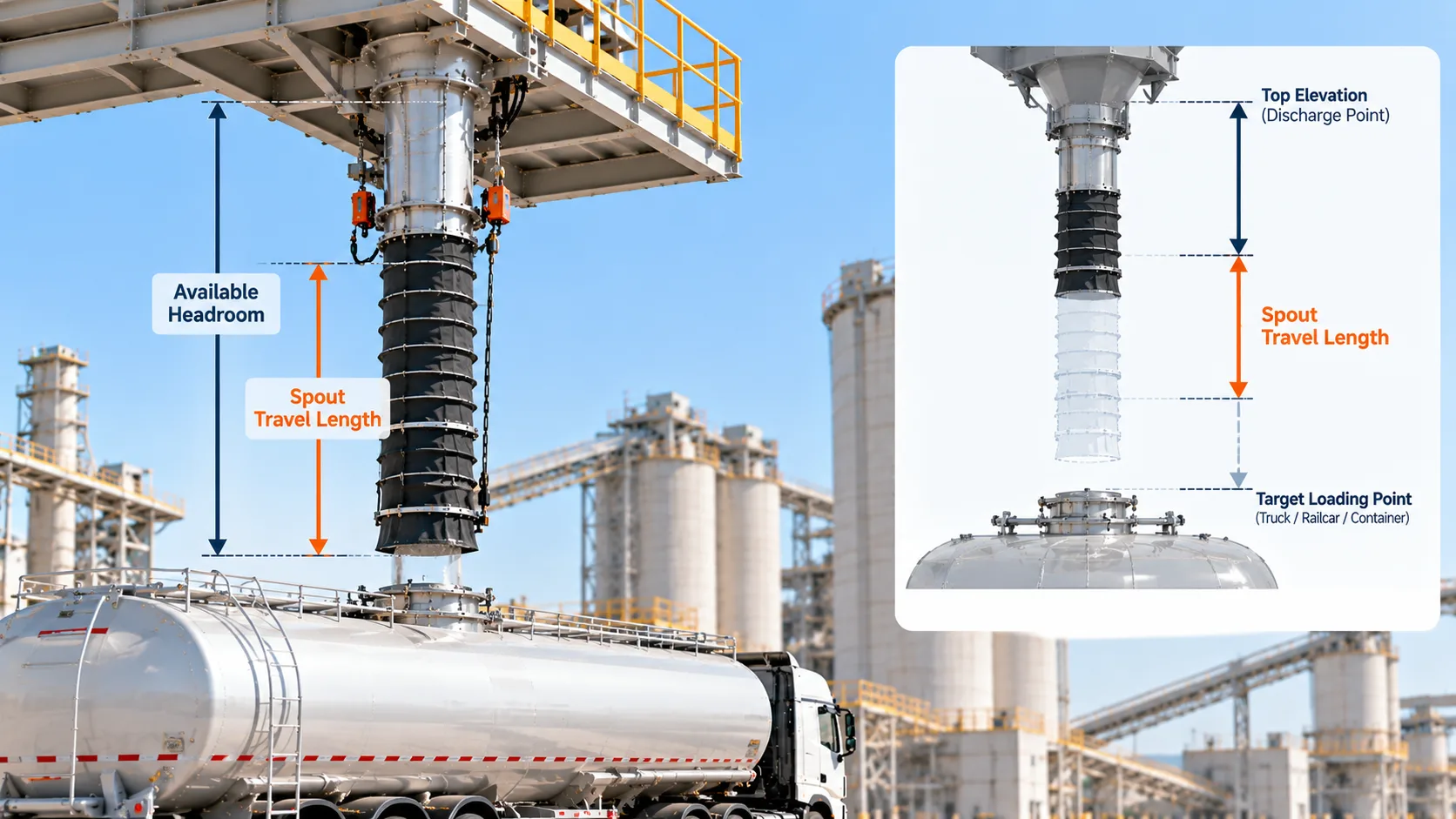
Preliminary Geometry Results
Awaiting inputsIndicative travel span (H2 − H3 + allowance)
Flange-to-highest-inlet distance (H1 − H2)
Flange-to-lowest-target distance (H1 − H3)
Nominal spout diameter / hoist power
Engineering review requiredGeometry only. Actual retracted length, stroke, overlap, outlet position, wear protection, diameter and hoist motor must be confirmed against equipment drawings and material properties. Assumes all elevations share the same datum and H1 > H2 ≥ H3.
Send Your Sizing Data to DARKO
We'll prepare a WhatsApp message containing your inputs and calculated geometry. You can review it and send it to our engineering team.
DARKO Engineering Support: We can evaluate loading spout dimensions, abrasion-resistant wear packages and dust aspiration requirements for tankers, open trucks and bulk terminals. Final specifications are subject to engineering review.
Standard Telescopic Loading Spout Specifications
Compare dimensional envelopes, drive ratings, and handling capacities across heavy-duty loading chute products engineered for dust-controlled terminal operations.
| Model Series | Application Focus | Loading Capacity | Retracted Height | Max Extended Stroke | Hoist Motor Power | Hoisting Geometry | Slide Gate Interface | Engineering Asset |
|---|---|---|---|---|---|---|---|---|
| DLS-300 | Standard Enclosed Powder Tanker | 150 – 300 t/h | 1,200 mm (47.2 in) | 3,500 mm (137.8 in) | 1.5 kW (Brake Motor) | Dual-drum diagonal 4-cable balance | Square pneumatic bi-directional slide gate | Request CAD / 3D Drawings |
| DLS-400 | Heavy-Duty Open Truck & Clinker Chute | 300 – 600 t/h | 1,600 mm (63.0 in) | 6,000 mm (236.2 in) | 3.0 kW (Brake Motor) | Dual-drum diagonal 4-cable balance | Heavy-duty pin gate / emergency cut-off slide | Request CAD / 3D Drawings |
| DLS-500 | High-Throughput Railcar, Container & Barge | 600 – 1,000 t/h | 2,200 mm (86.6 in) | 12,000 mm (472.4 in) | 5.5 kW (Brake Motor) | Reinforced 4-point cable balancing hoist | High-tonnage square flange with flow regulative gate | Request CAD / 3D Drawings |
Dual-Limit Safety System
All DARKO loading spouts undergo dynamic balancing and full-stroke load verification, equipped with primary rotary limits, ultimate stop switches, and slack-cable detection.
Diagonal 4-Cable Balance
Dual grooved hoist drums drive an opposing diagonal cable layout that eliminates chute tilting, rope bunching, and internal sleeve pinching under rapid vertical extension.
Pre-Engineered Valve Mating
Standard precision-machined inlet flanges bolt directly to pneumatic bi-directional slide gates, positioner valves, and terminal dust collection equipment, interfacing smoothly with centralized baghouse dust collectors without field modifications.
Bulk Loading Spout Selection and Technical Troubleshooting FAQ
Resolve loadout bottlenecks, prevent abrasive sleeve wear, and maintain compliance across high-volume terminals. Review field-tested engineering guidance covering wear life, automated level shutoff, high-temperature clinker chutes, and hazardous dust containment.
Premature bellows failure is rarely a result of fabric quality alone. In heavy bulk terminals, rapid tearing typically stems from three mechanical root causes: lateral misalignment of inner cones rubbing against the sleeve, uneven cable tension causing diagonal binding during retraction, and excessive negative pressure from auxiliary dust collection equipment that pulls the outer fabric directly into the high-velocity material stream.
- Deep Cone Overlap: Specify nested inner cones with an overlap of at least 80 mm (3.15 in) across full extension to prevent abrasive grit from bypassing the product stream into the outer ventilation annular chamber.
- Four-Cable Hoist Balancing: Choose a dual-drum, four-rope hoisting system over two-rope layouts to eliminate eccentric tilting and prevent the fabric from bunching or catching during vertical cycles.
- Intermediate Restraint Rings: Incorporate heavy-duty external anti-sway guide rings and internal spacers to keep the flexible bellow concentric during high-wind loadout or sudden truck vibrations.
DARKO bulk loading spouts incorporate precision-stamped abrasion-resistant cones and calibrated four-point suspension to ensure uniform vertical travel across thousands of duty cycles.
Original Spares & Engineering Support
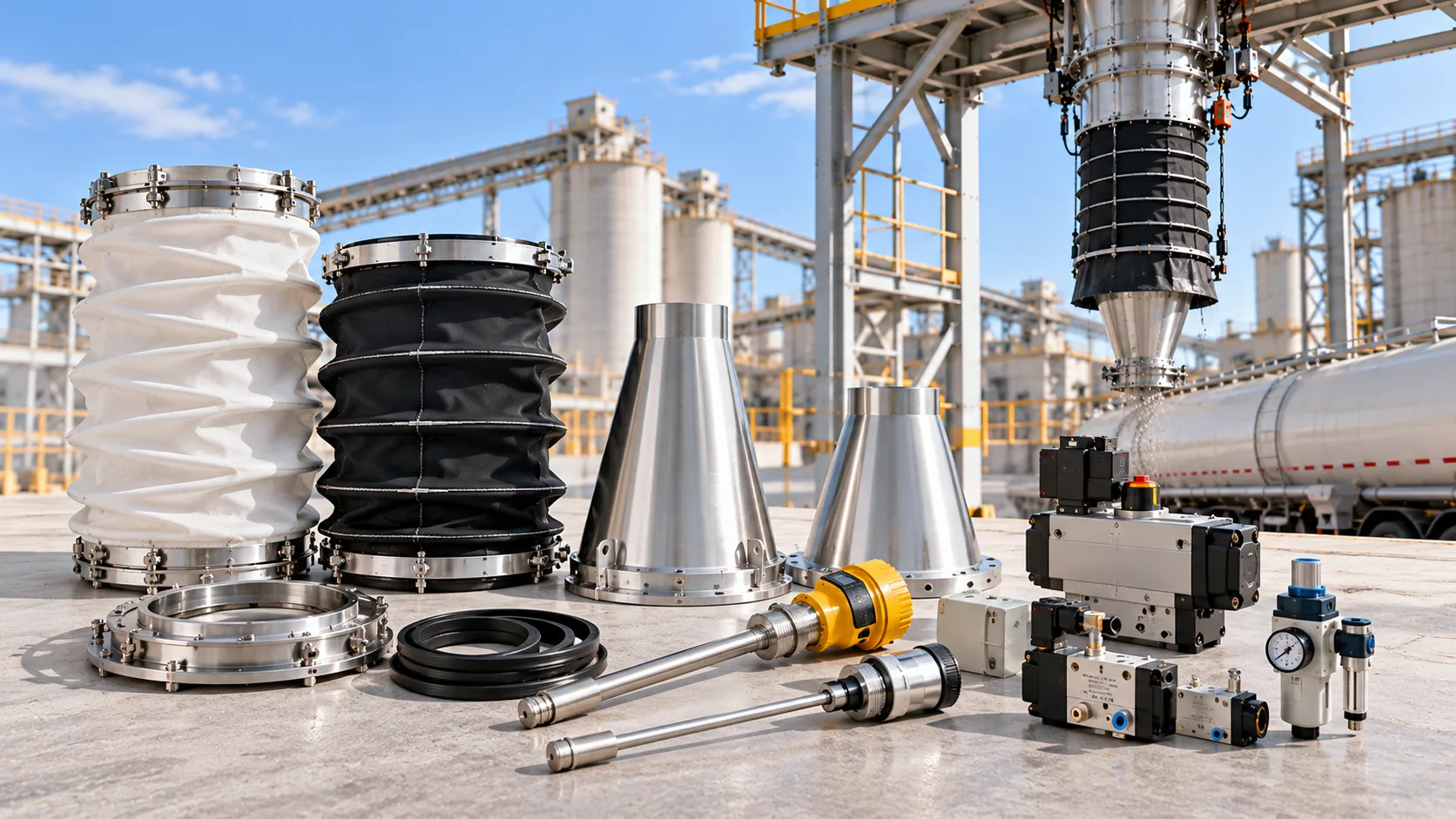
Ensure dependable terminal performance with DARKO original replacement parts. We supply precision-machined inner flow cones, high-tensile silicone bellows, level probes, and pneumatic control valves designed for exact fit.
Need Custom Sizing Support?
Our application specialists review loading drops, material bulk density, and dust extraction airflow to prevent premature equipment failure.
Plan Your Next Bulk Loading System with DARKO Engineers
Share your material characteristics, throughput targets, vehicle type and available loading-bay headroom. DARKO can review equipment selection, telescopic travel requirements and dust collection interfaces for a project-specific proposal.

Loading Geometry
Spout travel, hatch alignment, retracted clearance and installation envelope.
Dust Control
Aspiration, discharge sealing and integration with plant filtration systems.
Application Fit
Material abrasiveness, target capacity and loading vehicle requirements.
Need to explore equipment first? Visit our bulk loading equipment range.
Request Engineering Support
Tell us about your loading application. Only your name and email are required.
Engineering drawings and lead times are discussed after reviewing the project requirements.