Core Technical Performance & Energy Metrics
DARKO Cement Machinery engineers heavy-duty grinding circuits that maximize throughput while minimizing operational kilowatt-hours per ton. Through precision chamber partitioning, custom length-to-diameter aspect ratios, and dynamic ball charge distribution, every DARKO cement ball mill across our line of heavy grinding products maintains world-class energy efficiency across demanding clinker and slag grinding operations.
Ball Mill Grinding Capacity
High-volume continuous output tailored for raw meal preparation, clinker finish grinding, and multi-component cement blending plants.
Cement Blaine Fineness
Precision surface area regulation from 3,200 to over 4,500 cm²/g for tight particle size distribution and optimized 28-day hydration strength.
Specific Power Consumption
Low 30–34 kWh/t benchmark in closed-circuit operations, cutting electrical expenditure significantly when paired with dynamic separators and high-performance baghouse dust collectors.
Liner Service Interval
Extended mean time between maintenance using wear-resistant high-chromium alloy wave liners and double-blind discharge diaphragms.
Dynamic Separator Integration
High-efficiency O-Sepa style dynamic air classifiers recirculate coarse particles, eliminate over-grinding, and ensure sharp particle separation while venting into downstream dust collection equipment.
Hydrodynamic Trunnion Bearings
Spherical trunnion and slide-shoe bearings with automated high/low-pressure oil stations ensure continuous hydrodynamic film support under heavy loading.
FEA Shell Stress Validation
Heavy-gauge rolled shell plates undergo comprehensive post-weld stress-relief annealing and FEA validation to eliminate mechanical fatigue.
Cement Ball Mill Working Principle and Grinding Process Systems
Industrial cement ball mills operate on combined mechanical impact and high-shear attrition to reduce hardened cement clinker, gypsum, and supplementary cementitious materials into ultrafine powders. The choice between open-circuit and closed-circuit grinding flowsheets directly dictates plant grinding efficiency, specific power consumption (kWh/t), and final cement particle size distribution (PSD).
DARKO Cement Machinery engineers advanced grinding circuits tailored to specific clinker grindability profiles, moisture levels, and production targets. Our process designs establish an optimal balance across capital expenditure, operating economy, and finished cement hydraulic performance.
Cataracting Kinetic Impact
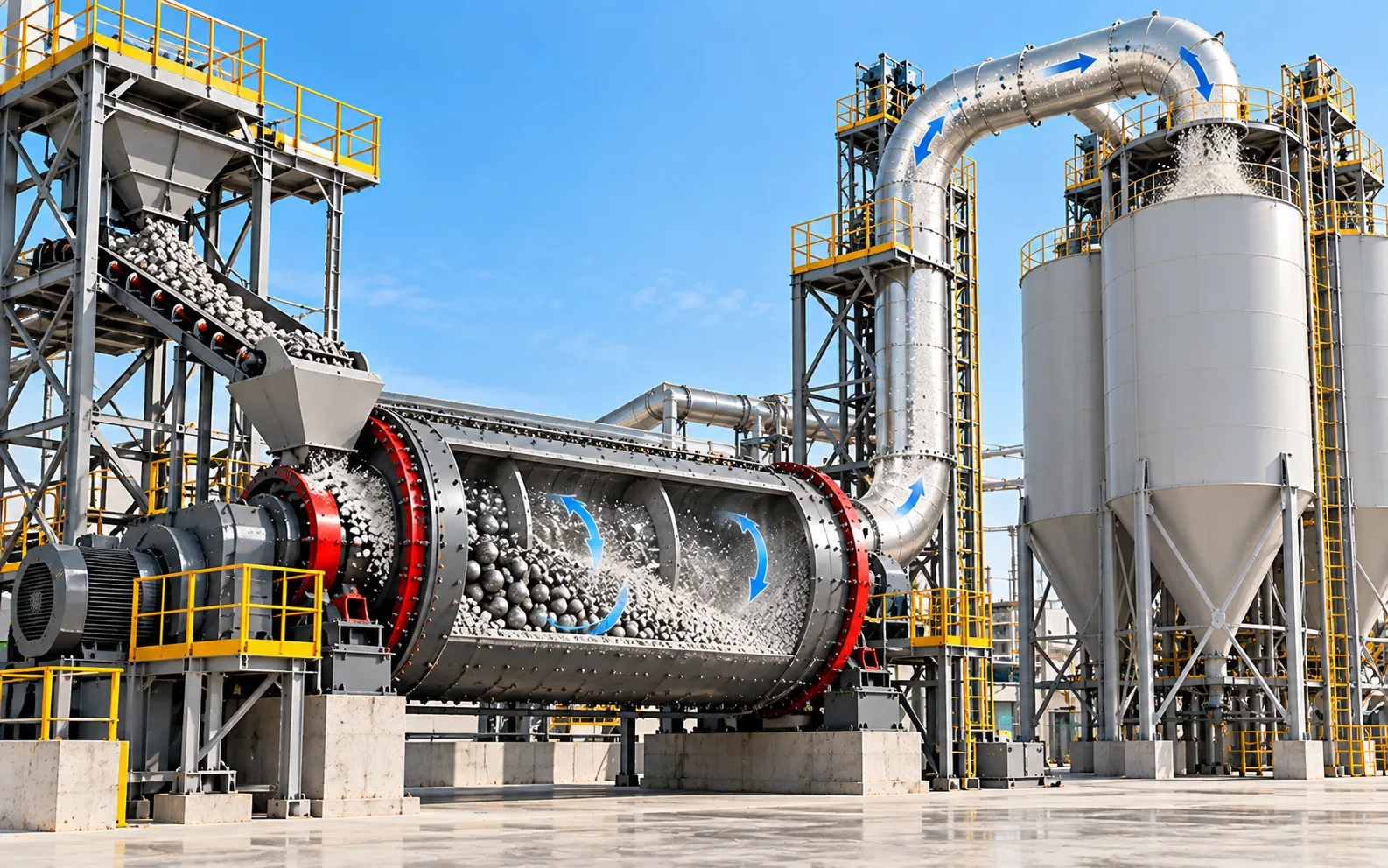
As the heavy mill shell rotates at optimized critical speeds (typically 72% to 76% of critical speed), high-chromium alloy wave liners lift the grinding media charge to a calculated apex. The charge cascades and cataracts downward, delivering intensive kinetic impact energy that shatters coarse feed materials up to 25 mm in diameter upon entry.
Cascading Attrition & Shearing
In the fine grinding compartment, smaller alloy balls and cylpebs roll, slide, and cascade in dense continuous contact. This high-friction shearing action pulverizes intermediate granules into ultrafine micro-particles, systematically developing Blaine fineness levels from 3,200 up to 4,500 cm²/g while preventing shell wear.
Internal Aerodynamic Sweeping
Controlled longitudinal ventilation maintained at 0.5 to 1.0 m/s rapidly evacuates airborne micro-fines, eliminating cushioning dust beds that soften ball impact. Simultaneously, dynamic airflow dissipates frictional heat, maintaining internal mill temperatures below 110°C to safeguard against gypsum dehydration and false setting.
System Process Flow Comparison
Compare material circulation, power consumption, and operating flexibility between circuit architectures.
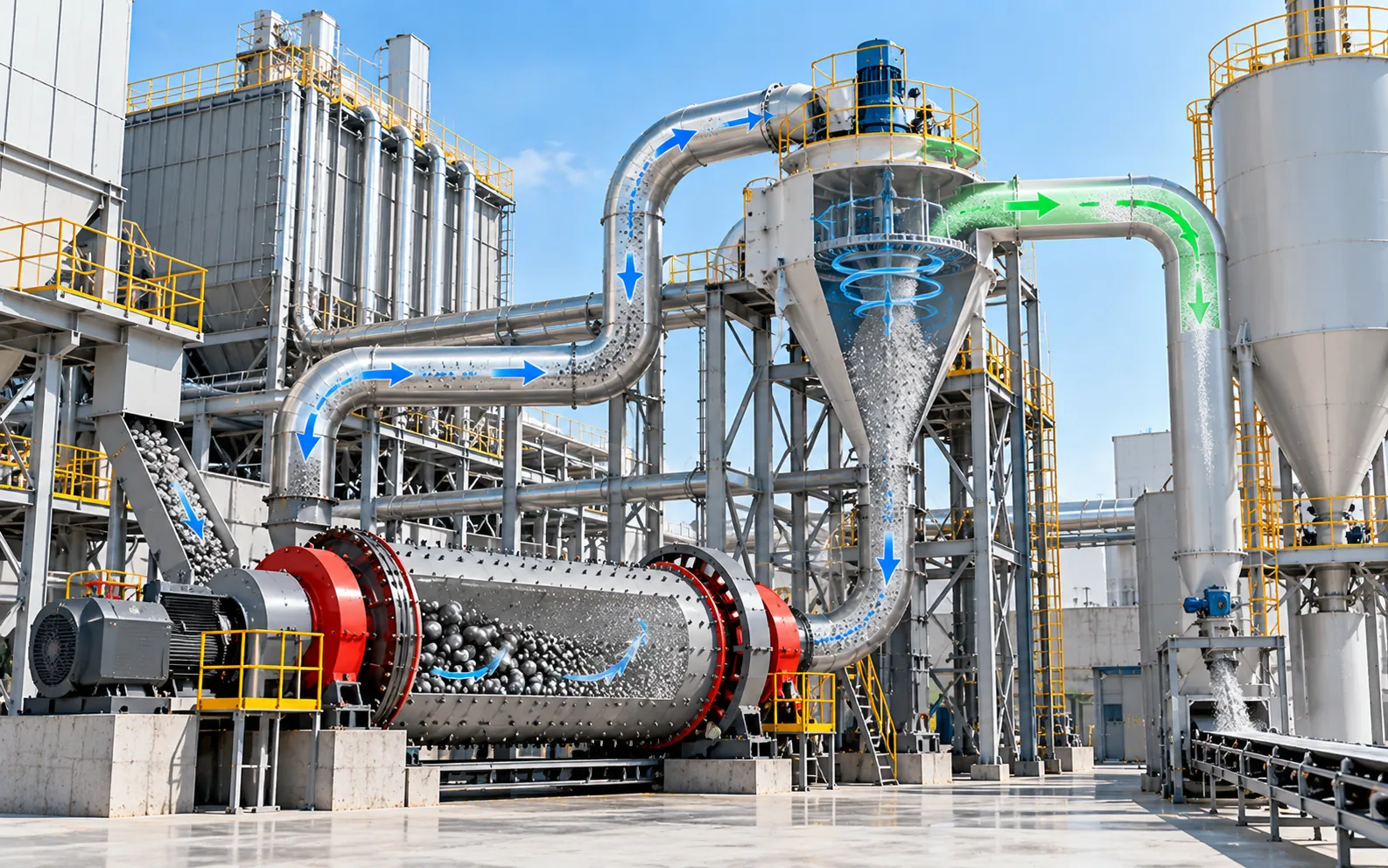
Closed-Circuit Grinding with Dynamic Classifiers
In a closed-circuit setup, discharge from the ball mill is continuously elevated into a high-efficiency dynamic air separator. The variable-speed cage rotor precisely classifies the product: coarse tailings are rejected and returned to the mill inlet for selective regrinding, while on-spec micro-fine powder passes directly to the finished cement silo.
Prevents over-grinding of compliant particles, dramatically maximizing throughput.
Delivers verified electrical power savings compared to conventional single-pass mills.
- ✓ Optimized Particle Size Distribution: Tight granulometry slope improves water demand and accelerates 28-day concrete compressive strength.
- ✓ Instant Fineness Adjustments: Dynamic separator rotor speed can be modulated via VFD in real time without interrupting mill production.
- ✓ Active Thermal Regulation: Continuous ambient cooling air inside the dynamic separator keeps product temperatures safely within specification.
Process Parameter Engineering Matrix
Direct engineering comparison between open-circuit and closed-circuit cement grinding methodologies.
| Process Dimension | Open-Circuit System | Closed-Circuit System (DARKO Standard) | Engineering Evaluation |
|---|---|---|---|
| Specific Grinding Power | 38 – 45 kWh/t | 30 – 34 kWh/t | Closed circuits reduce specific energy consumption by 15% to 25% |
| Particle Size Distribution (PSD) | Wide spread, high ultrafine over-grinding | Steep, uniform Rosin-Rammler curve | Optimized PSD enhances early and 28-day concrete strength development |
| Production Throughput Rate | Baseline standard (1.0x) | 1.20x – 1.30x Throughput | Dynamic recirculation evacuates fines before impact cushioning occurs |
| Internal Operating Temperature | Elevated (115°C – 135°C) | Controlled (85°C – 105°C) | Air classification loop provides effective thermal cooling during operation |
| Product Fineness Flexibility | Requires manual media re-grading | Instant dynamic classifier speed adjustment | Enables rapid switching between OPC, blended, and slag cements |
| Auxiliary Equipment Scope | Minimal (Lower upfront machinery costs) | Full loop (Elevators, bag filter, dynamic separator) | Higher initial CAPEX is swiftly recovered through lower operating power costs |
Seamless Auxiliary Integration for Dust-Free Conveying
A cement ball mill delivers maximum continuous availability when supported by heavy-duty material handling and advanced dust collection equipment. DARKO designs and manufactures fully integrated auxiliary suites engineered for zero-leakage, dust-free circuit operations.
Dynamic Air Separators
High-efficiency third-generation dynamic separators with guide vanes and low-turbulence rotors provide sharp particle cut-points and recovery rates up to 90%.
Pulse-Jet Bag Filters
Heavy-duty pulse-jet dust collectors engineered with high air-to-cloth ratios and PTFE membrane media reliably maintain clean stack emissions below 10 mg/Nm³.
Air Gravity Conveyors
Low-energy fluidizing air slides transport finished cement micro-powders with zero mechanical friction, negligible power draw, and dust-tight operation.
Heavy-Duty Bucket Elevators
High-capacity central-chain and continuous plate-link bucket elevators ensure dependable vertical recirculation of abrasive mill tailings under 24/7 service.
Industrial Ball Mill Series Customized for Different Process Stages
Modern cement manufacturing requires purpose-built comminution dynamics across every thermal and mechanical phase. Across our heavy-duty grinding machinery and auxiliary plant products, DARKO Cement Machinery delivers ball mill configurations specifically engineered for raw meal preparation, clinker finish grinding, and abrasive slag processing. By optimizing internal compartment length ratios, liner lifting kinematics, and grinding media charge distributions to the exact grindability of your material, our mills maximize mechanical efficiency while substantially cutting specific power consumption per ton.
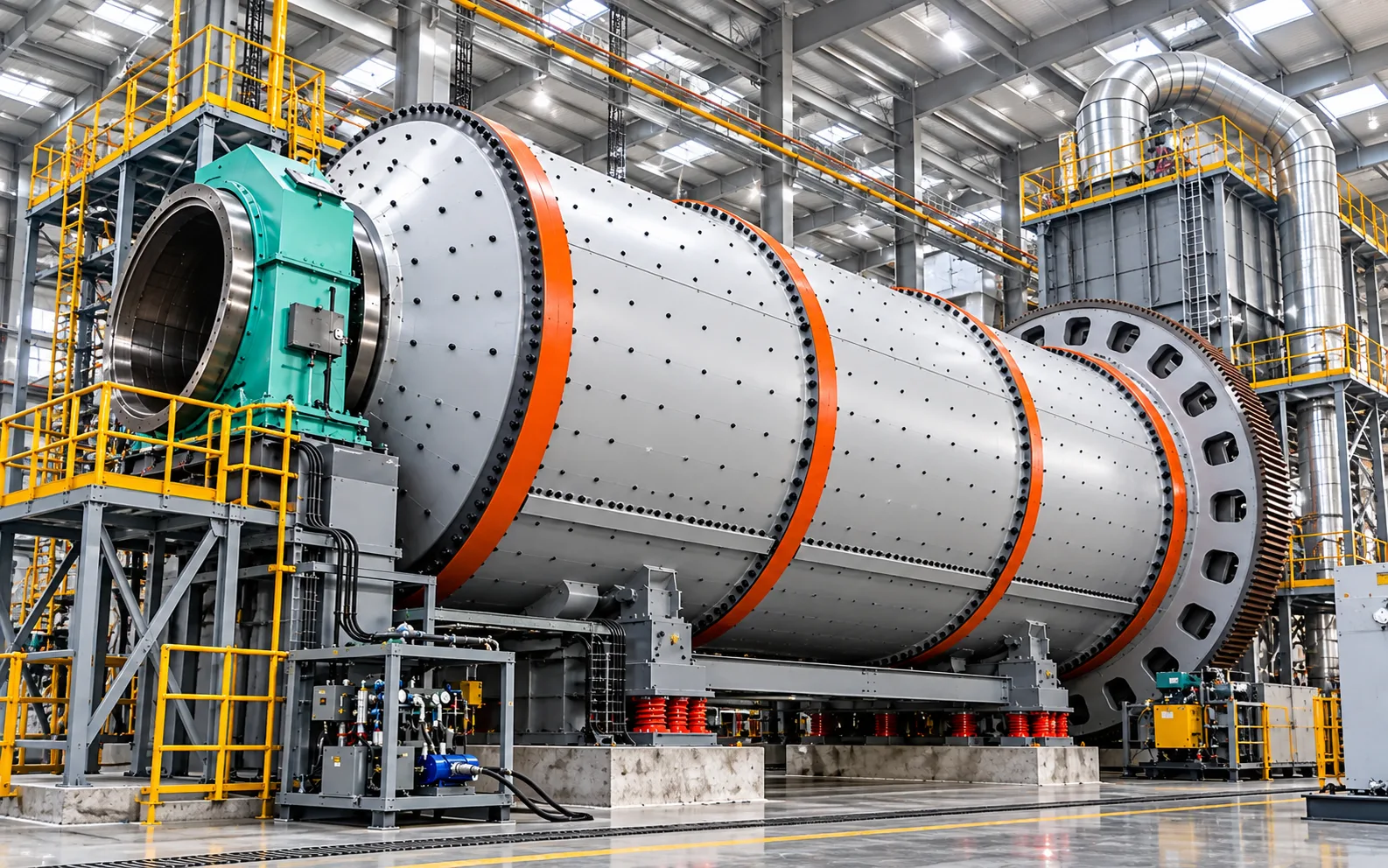
Raw Meal Ball Mill
Built for high-throughput dry or wet grinding of limestone, clay, shale, and iron correctives prior to pyroprocessing. Features heavy-duty impact-absorbing shells, rugged step-wave liners, and integrated air-swept drying capability connected with high-efficiency dust collection equipment, utilizing preheater exhaust gases to process high-moisture raw mixes efficiently.
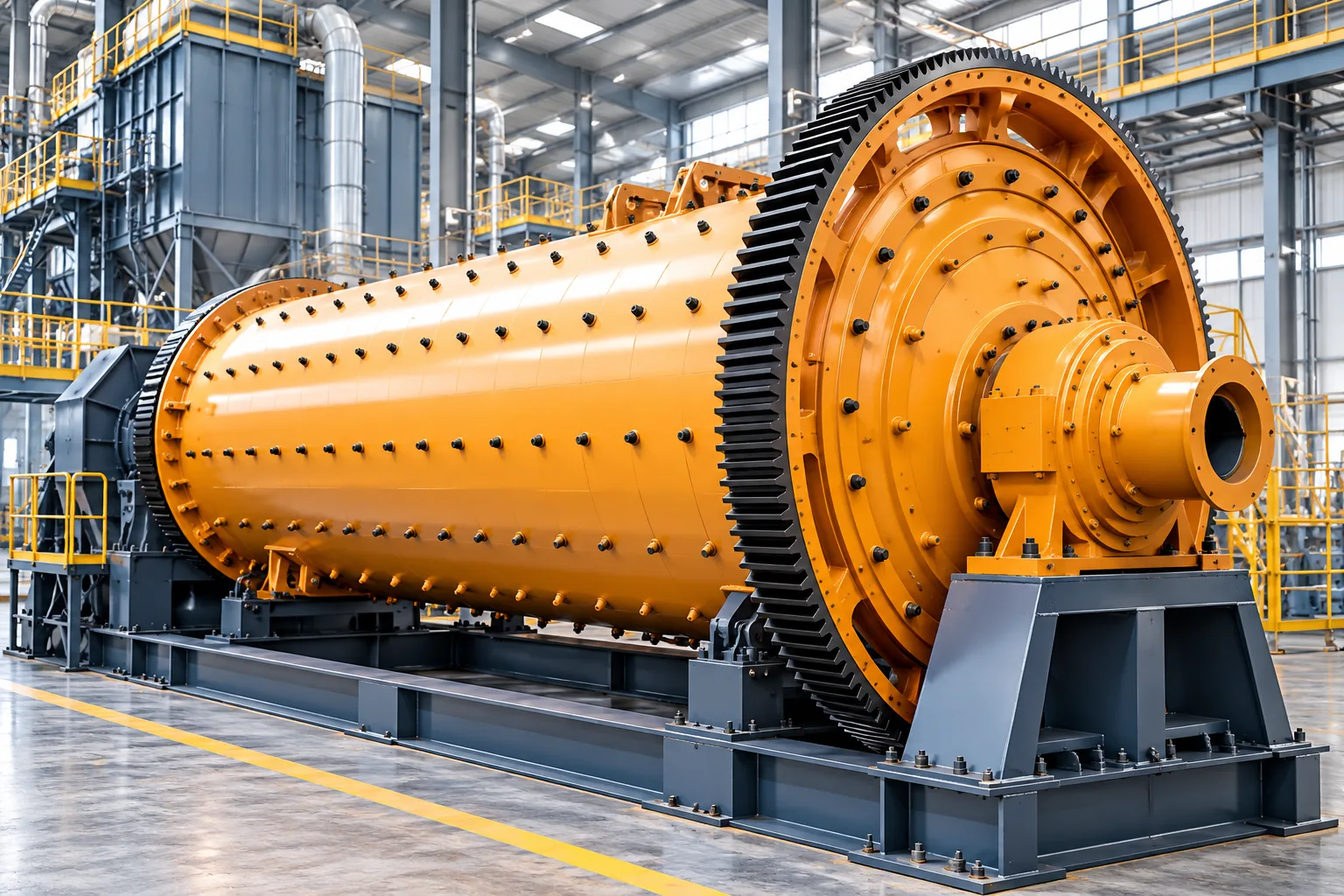
Cement Clinker Finish Grinding Mill
Precision multi-compartment mill designed to grind clinker, gypsum, and mineral admixtures with controlled particle size distribution (PSD), venting cleanly through dedicated baghouse dust collectors. Produces rounded grains with wide size spreads to minimize standard water demand while maximizing both early compressive strength and 28-day hydration performance.
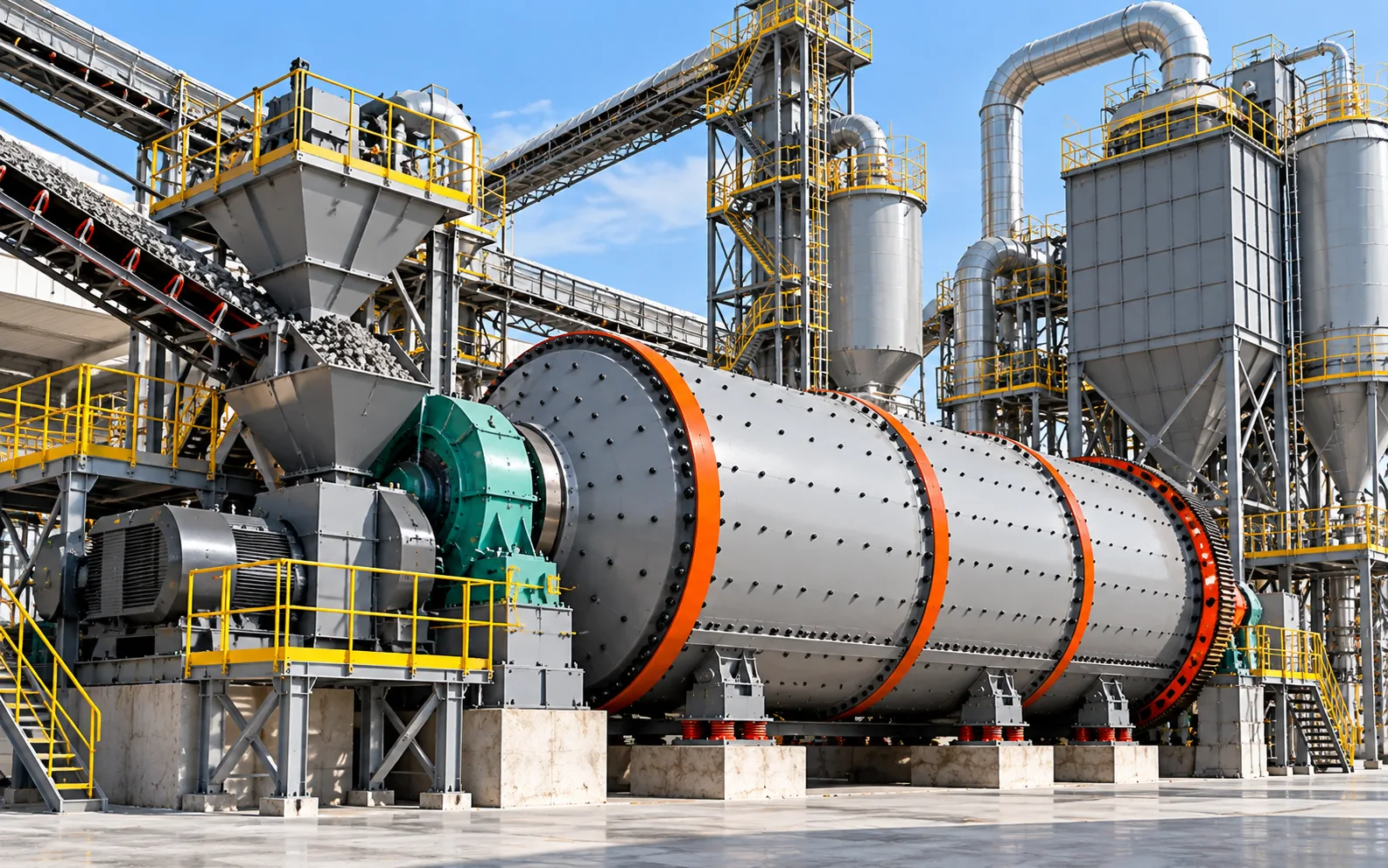
Slag & Pozzolan Fine Grinding Mill
Heavy-duty, high-power mill engineered to overcome the high Bond Work Index and abrasive nature of Ground Granulated Blast Furnace Slag (GGBFS) and volcanic pozzolans. Incorporates high media filling rates and micro-cylpebs charges to unlock maximum hydraulic reactivity and glass phase activation.
Process Stage Material Application Matrix
The engineering parameters below illustrate the mechanical adaptations required when comminuting feedstocks with varying Bond Work Indices (Wi), abrasiveness levels, and target specific surface requirements across the industrial cement manufacturing circuit.
| Material Stream | Mohs Hardness | Bond Work Index (Wi) | Target Specific Surface | Chamber Ratio (L1 : L2) | Recommended Circuit |
|---|---|---|---|---|---|
| Cement Raw Meal | 3.0 – 4.0 | 10.5 – 13.0 kWh/t | 80 μm ≤ 12% | 1.0 : 1.5 (Air-Swept) | Air-Swept Dynamic Circuit |
| Portland Clinker (Standard) | 5.0 – 5.5 | 13.5 – 15.5 kWh/t | 3,500 – 3,800 cm²/g | 1.0 : 2.2 | Closed Circuit with Dynamic Separator |
| Hard-Burned Belitic Clinker | 5.5 – 6.0 | 15.5 – 18.0 kWh/t | 3,800 – 4,200 cm²/g | 1.0 : 2.5 | Pre-Crush / Closed Grinding Circuit |
| Granulated Blast Furnace Slag | 6.0 – 7.0 | 18.0 – 23.0 kWh/t | 4,200 – 5,000 cm²/g | 1.0 : 3.0 | High-Efficiency Classifier Loop |
| Natural Pozzolan / Trass | 4.5 – 6.0 | 14.0 – 17.5 kWh/t | 4,000 – 4,500 cm²/g | 1.0 : 2.0 | Combined Grinding Circuit |
Custom Grinding Media and Chamber Length Optimization
Every grinding project involves distinct feed sizing, moisture constraints, and target fineness targets. For raw materials and clinkers spanning 3.0 to 7.0 on the Mohs scale, DARKO process engineers calculate the precise chamber length ratio (L1:L2), slotted diaphragm openings, and progressive media weight curves. We configure high-impact forged alloy steel balls in the primary chamber and precision-graded high-chromium cast balls or cylpebs in the fine attrition chambers to maximize grinding efficiency.
Targeted Kinetic Impact: Stepped wave liners deliver optimal trajectory lift for coarse fragmentation in chamber one.
Micro-Attrition Precision: Classifying liners keep the smallest media at the discharge end for uniform Blaine surface area.
Send your raw meal, clinker, or slag samples to DARKO testing facilities for comprehensive grindability testing and custom media charge modeling.
Precision Mechanical Engineering: Core Components Built for Continuous Harsh Duty
Industrial cement ball mills operate in the most abrasive, impact-intensive environments in bulk materials handling. DARKO Cement Machinery engineers every critical sub-assembly—from thick-walled, stress-relieved steel shells to metallurgical alloy ball mill liners and hydrostatic trunnions—to endure decades of continuous clinker and slag pulverization prior to dispatch via bulk-loading equipment. Discover the rugged mechanical architecture that delivers maximum mill availability and a lower total cost of ownership.
Mill Internal Anatomy
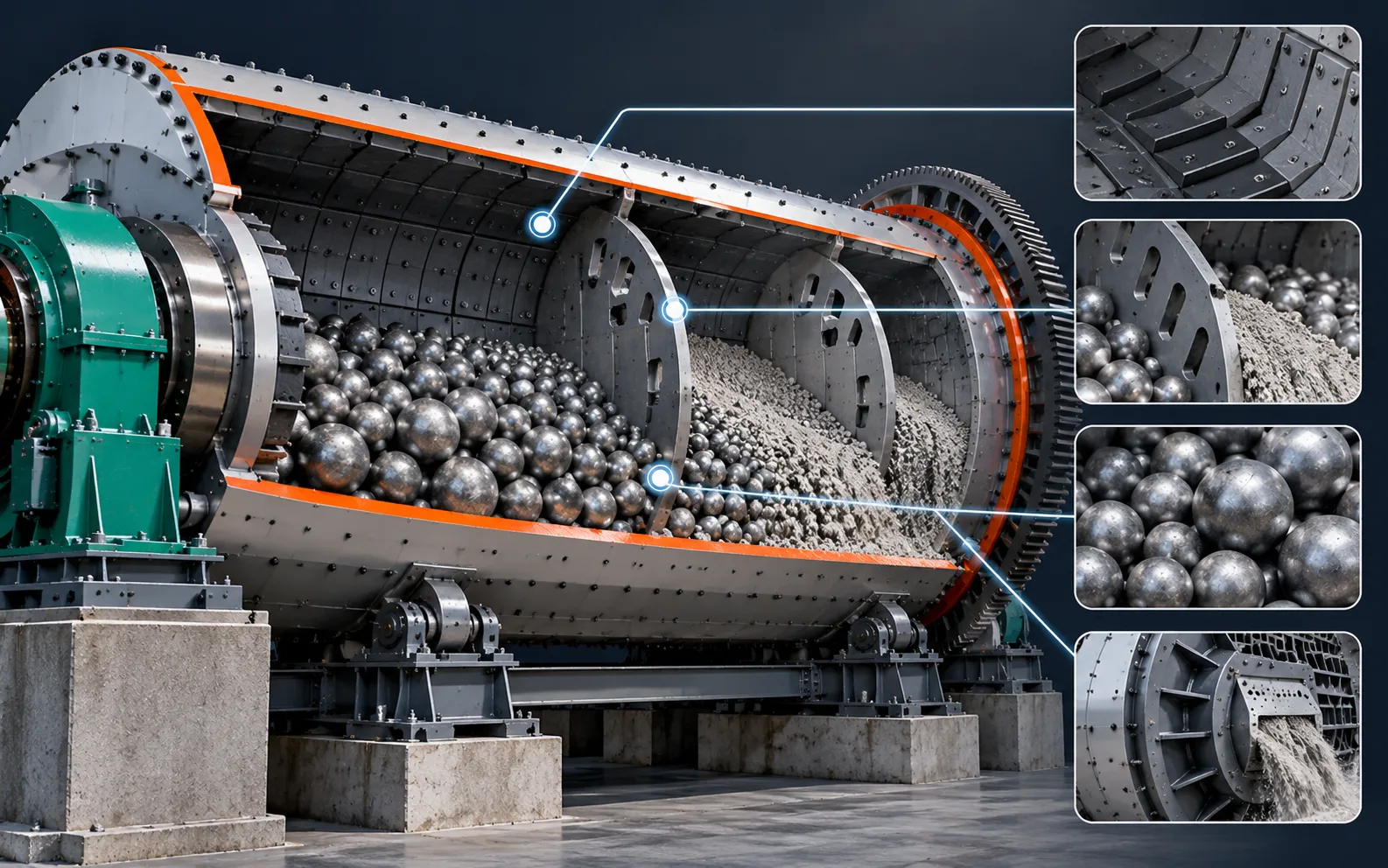
100% Ultrasonic Flaw Detection (UT) and Magnetic Particle Testing (MT) applied to all structural welds and high-alloy castings to guarantee zero internal defects.
Shell Structural Integrity
Q245R / Q345RAll DARKO ball mill shells undergo comprehensive furnace post-weld thermal stress-relief annealing. This eliminates residual fabrication stresses, ensuring cylindrical concentricity and preventing shell deformation over decades of high-impact grinding.
01
High-Chromium Alloy Stepped Wave Liners
Optimized Ball Lifting Trajectories & Maximum Kinetic Impact
High-Chromium Alloy Stepped Wave Liners
Optimized Ball Lifting Trajectories & Maximum Kinetic ImpactThe internal shell is protected by premium high-chromium (Cr15–Cr26) and modified manganese alloy stepped wave liners. Engineered with precise wave lift angles, these ball mill liners elevate the grinding media charge to critical cataracting trajectories for high-impact primary crushing while shielding the structural shell from abrasive wear.
- Custom step height configurations tailored to target grinding media charge distributions and mill RPM.
- Heavy-duty elastomeric underlay pads isolate mechanical stress and dampen shell vibration.
02
Double-Deck Lifting Diaphragms & Discharge Grates
Internal Material Bed Control & Multi-Chamber Media Segregation
Double-Deck Lifting Diaphragms & Discharge Grates
Internal Material Bed Control & Multi-Chamber Media SegregationOptimal grinding dynamics require strict separation between coarse crushing and fine polishing chambers. The DARKO intermediate double-deck diaphragm regulates internal material bed depth, preventing oversized clinker bypass while ensuring fine particles transfer smoothly to the second chamber without ball migration.
- Adjustable blind plate ratios to fine-tune material retention time in the grinding chamber.
- Discharge grate design built with a central screen trommel to purge worn grinding media fragments before material reaches silos and telescopic loading spouts .
03
Heavy Trunnions & Hydrodynamic Slide Shoe Bearings
High-Load Hydrostatic Jacking & Continuous Dual-Circuit Lubrication
Heavy Trunnions & Hydrodynamic Slide Shoe Bearings
High-Load Hydrostatic Jacking & Continuous Dual-Circuit LubricationOur ball mill support structures utilize either heavy cast-steel trunnions with self-aligning spherical roller housings or advanced hydrodynamic slide shoe bearing assemblies. Reliable trunnion bearing lubrication is ensured by high-pressure hydrostatic lifting pumps that float the journal on an oil film during startup, eliminating metal-to-metal wear.
- Babbitt-lined or bronze alloy bearing shoes engineered for high shock absorption.
- Zero-leakage labyrinth seal rings protect bearing cavities from fine clinker dust ingress.
04
Large-Module Alloy Girth Gears & Drive Train
High-Precision Hardened Flank Reducers & Peripheral Pinion Drives
Large-Module Alloy Girth Gears & Drive Train
High-Precision Hardened Flank Reducers & Peripheral Pinion DrivesThe mill drive system employs large-module split or solid girth gears forged from premium 42CrMo or ZG45CrMo alloy cast steel. Meshed with carburized, ground pinions and driven by hardened heavy-duty helical gearboxes, the transmission delivers over 96% mechanical efficiency under continuous peak torque.
- Machined to AGMA 11 / ISO 1328 Grade 6 accuracy to eliminate tooth chatter and vibration.
- Synchronized dual-pinion options available for high-power mills exceeding 3,500 kW.
Core Mechanical Wear Material & Manufacturing Standards
Engineered metallurgy and fabrication tolerances across major mechanical sub-assemblies
| Component Group | Primary Metallurgy / Grade | Hardness / Tensile Rating | Standard Manufacturing Process | Target Service Life |
|---|---|---|---|---|
| First Chamber Liners | High Chromium White Iron (KmTBCr20Mo) / Modified Mn13Cr2 | HRC 58 - 64 / AK ≥ 12 J/cm² | Vacuum suction casting & quench tempering | 12,000 - 16,000 hrs |
| Second Chamber Liners | Ultra-High Cr Alloy (KmTBCr26) / Corrugated Class | HRC 60 - 66 | Secondary sub-critical tempering & stress relief | 16,000 - 24,000 hrs |
| Girth Gear & Pinion | Forged ZG45CrMo / 42CrMo Cast-Forged Alloy | HB 260 - 320 / HRC 52 - 58 (Flank) | Induction tooth hardening & 10m CNC gear hobbing | 20+ Years |
| Main Trunnion Journal | Cast Steel ZG270-500 / Normalized Forging | Tensile ≥ 500 MPa | Single setup CNC vertical turning & micro-fine polishing | 30+ Years |
Finite Element Analysis (FEA) Shell Modeling
Each shell design is verified via three-dimensional finite element modeling to analyze thermal gradients and dynamic bending moments under 100% grinding media load, ensuring zero fatigue cracking at trunnion transition welds.
Computer-Balanced Dynamic Rotation
Before leaving the fabrication yard, full shell structures and girth assemblies undergo dynamic balancing tests to verify harmonic stability, reducing structural foundation vibration to below 2.0 mm/s RMS.
Modular Fast-Lining Engineering
Our specialized stepped wave liners utilize standardized bolt pitch spacing and high-tensile oval-head liner bolts with cup washers, cutting scheduled mill relining turnaround times by up to 35%.
Cement Grinding Equipment Selection Guide: Ball Mill vs. Vertical Roller Mill (VRM)
Selecting the optimal finish grinding circuit represents one of the most critical capital expenditure and operational decisions for cement manufacturers, terminal operators, and EPC contractors. The evaluation requires balancing upfront machinery and civil costs against long-term operational expenditures, system availability, maintenance overhead, and the critical influence of finished cement particle morphology on concrete performance.
While Vertical Roller Mills (VRMs) offer specific energy savings for raw material drying-grinding and slag processing, closed-circuit cement ball mills remain the global gold standard for clinker finish grinding due to unmatched operational reliability, spherical particle geometry, and predictable maintenance cycles. Integrated with high-efficiency auxiliary dust collection equipment, ball mill systems deliver stable and emission-compliant processing. Below is an objective technical comparison prepared by DARKO Cement Machinery process specialists.
Initial Capital Investment (CAPEX)
Closed-circuit cement ball mill systems require 30% to 40% lower initial capital expenditure than VRMs. Simplified concrete foundations and low-profile building structures substantially lower structural steel and civil engineering costs.
Particle Morphology & Quality
Ball mill impact and attrition grinding generate spherical grains with a broad particle size distribution (PSD). This grain geometry delivers lower water demand, superior rheology, and higher 28-day concrete strength.
Operational Reliability & Maintenance
Ball mills operate without high-pressure hydraulic loading units or frequent on-site roller hardfacing. High-chromium alloy shell liners routinely achieve service lifespans exceeding 12,000 to 18,000 operating hours.
Specific Power Consumption
While stand-alone VRMs consume 15% to 25% less grinding energy, hybrid circuits pairing high-pressure roller presses (HPGR) with finish ball mills achieve equivalent energy efficiency while retaining optimal cement hydration properties.
Head-to-Head Technical Evaluation Matrix
Detailed engineering comparison across capital cost, cement performance, process stability, and lifecycle servicing.
| Evaluation Dimension | Industrial Cement Ball Mill (Closed Circuit) | Vertical Roller Mill (VRM) |
|---|---|---|
| Initial Capital Investment (CAPEX) Total equipment procurement and installation expenditure | 30% – 40% Lower Investment Proven mechanical design with standardized drive trains, reducing initial equipment outlay and expediting capital payback cycles. | High Initial Expenditure Substantially higher initial cost driven by high-pressure hydraulic cylinders, integrated dynamic classifiers, and specialized planetary reduction gearboxes. |
| Civil Foundations & Building Footprint Foundation complexity, building height, and structural steel volume | Low-Profile Horizontal Layout Ground-supported foundation piers and standard building overhead clearances (10–14 m) substantially reduce structural concrete and steel erection costs. | Multi-Story Tower Structure Vertical machine architecture requires tall process towers (30–45 m), heavy overhead crane systems, and complex dynamic anti-vibration table foundations. |
| Particle Morphology & Size Distribution (PSD) Grain roundness, sphericity, and RRSB distribution slope (n) | Spherical Grains & Broad PSD High-energy tumbling media generate rounded, spherical particle shapes with a wide Rosin-Rammler slope (n = 0.85–0.95), optimizing concrete dry-packing density. | Angular Grains & Narrow PSD Direct roller compression produces angular, flaky particles with a steeper size distribution curve (n = 1.05–1.20), which tends to increase water demand. |
| Cement Hydration & Compressive Strength Water demand for standard consistency and 28-day concrete strength | Superior Strength & Low Water Demand Produces low standard water demand (25–27%) and consistent 28-day compressive strengths. Concrete mixtures demonstrate improved flowability and lower admixture usage. | Higher Admixture Consumption Standard consistency water demand is typically 1.5% to 3.0% higher, frequently necessitating increased superplasticizer dosages to maintain target concrete slump. |
| Operational Stability & Feed Fluctuations Tolerance to clinker liter-weight swings, moisture, and tramp metal | High Resistance to Feed Swings Uninterrupted operation during fluctuations in clinker grindability or bulk density. Shell and grinding media are fully immune to uncrushable tramp metal passage. | Sensitive Grinding Bed Dynamics Susceptible to bed instability, mill vibration trips, and roller scouring caused by feed granulometry shifts, moisture variations, or tramp metal contamination. |
| Maintenance Complexity & Labor Requirements Specialized engineering skill sets and diagnostic tooling | Standard Mechanical Servicing Straightforward mechanical components. Routine liner re-bolting, diaphragm inspection, and ball media top-ups can be executed by plant mechanical crews. | Specialized Hydraulic & Welding Crews Demands specialized technicians for proportional hydraulic systems, nitrogen accumulators, automated in-situ roller hardfacing, and complex planetary seals. |
| Wear Element Service Life & Sourcing Liner replacement intervals and spare parts supply security | 12,000 to 18,000 Operating Hours DARKO premium high-chromium alloy wave liners deliver over 15,000 continuous operating hours. Replacement liners and forged grinding balls are readily available globally. | 4,000 to 8,000 Hours (Between Hardfacing) Roller tyre segments and table wear plates require recurring automated weld hardfacing every 4,000 to 8,000 hours to maintain correct grinding profile geometry. |
Why Concrete Producers Prefer Ball Mill Ground Cement
The fundamental distinction between ball mills and VRMs originates in comminution mechanics. In a ball mill, clinker nodules experience repeated high-velocity impacts from cascading forged alloy balls combined with continuous inter-particle attrition. This dual grinding action creates distinct engineering advantages:
- Optimized Particle Size Distribution: A balanced ratio of sub-3 µm fines (for early setting) and 3–32 µm particles (for long-term 28-day hydration strength).
- Reduced Interstitial Water Demand: Rounded grain morphology packs efficiently in paste matrices, preventing bleeding and maintaining workability in ready-mix concrete.
- Controlled Gypsum Dehydration: Controlled mill internal temperatures ensure precise dihydrate-to-hemihydrate conversion ratios, eliminating false-set risks.
Operational Benchmark: Ball mill ground Ordinary Portland Cement (OPC) and Portland Pozzolana Cement (PPC) consistently deliver 2 to 4 MPa higher 28-day strength compared to VRM product at identical Blaine fineness.
Lifecycle TCO: When Does a Ball Mill Deliver Higher ROI?
While specific power consumption (kWh/t) is important, overall plant profitability depends on Total Cost of Ownership (TCO) evaluated across a 25-year service lifecycle:
- Lower Financing Charges: 35% reduced initial CAPEX lowers initial loan debt servicing and shortens overall project capital payback to under 3.5 years.
- Open Wear-Parts Sourcing: Liners and grinding bodies are standard foundry castings, avoiding captive OEM proprietary pricing structures.
- Unmatched Operating Availability: Closed-circuit ball mills routinely maintain over 96% annual technical availability without sudden vibration shutdowns.
Economic Guideline: For production capacities below 160 TPH or regions with moderate power tariffs, closed-circuit cement ball mills consistently deliver higher Net Present Value (NPV).
The Optimal Compromise: Roller Press + Ball Mill Hybrid Circuits
For high-capacity cement plants seeking both ultra-low electrical energy consumption and superior cement grain sphericity, DARKO engineers hybrid combined grinding systems equipped with high-performance pulse jet dust collectors:
- High-Pressure Pre-Crushing: An upstream High-Pressure Grinding Roll (HPGR) introduces extensive micro-cracking into clinker nodules before mill entry.
- Energy Parity with VRMs: Hybrid circuits reduce ball mill specific power draw by 30% to 40%, reaching overall system consumption of 28–32 kWh/t.
- Preserved Grain Morphology: Finish grinding in the ball mill compartment ensures finished cement retains ideal roundness and high early strength development.
DARKO provides turnkey engineering packages for both new hybrid grinding stations and roller-press retrofits on existing ball mill production lines.
The Engineering Verdict: When to Choose an Industrial Cement Ball Mill
Primary Scenarios Mandating a Ball Mill Circuit:
- • High-Performance Cement Markets: Where high 28-day concrete compressive strength, low standard water demand, and chemical admixture compatibility are critical commercial differentiators.
- • Capacity Ranges of 20 to 180 TPH: Where the high capital expenditure and elevated process towers of VRM installations cannot be amortized efficiently.
- • Remote Grinding Terminals & Standard Crews: Where access to specialized hydraulic technicians, dynamic vibration diagnostics, or in-situ roller hardfacing crews is constrained.
- • Clinker Grindability Fluctuations: Where hard-burnt clinker nodules or variable moisture levels would induce frequent grinding bed collapses and vibration trips in a VRM.
DARKO Unbiased Sizing Methodology:
DARKO Cement Machinery manufactures both heavy-duty ball mill circuits and high-efficiency dynamic air separators. We evaluate your raw material Bond Ball Mill Work Index (BWI), clinker moisture, target Blaine fineness (3,200–4,500 cm²/g), power tariffs, and project budget to recommend the most cost-effective comminution setup, integrated with high-efficiency baghouse dust collectors for optimal emissions control.
Every ball mill system is engineered with optimized length-to-diameter aspect ratios, tailored diaphragm compartments, and high-chromium alloy wave liners designed for over 30 years of continuous service.
Unsure Which Grinding Circuit Fits Your Plant?
Selecting between a ball mill and a vertical roller mill requires careful evaluation of material grindability, production capacity, target fineness, energy consumption, and project investment. Share your operating requirements with DARKO Cement Machinery to discuss a suitable grinding configuration and request a preliminary technical and economic assessment.
Share your project details for a tailored response.
DARKO Cement Ball Mill Technical Specifications & Sizing Matrix
Standard industrial design parameters for EPC contractors, design institutes, and plant engineers to evaluate mill dimensions, drive ratings, throughput capacities, and auxiliary dust collection equipment.
| Model Number | Shell Dimensions (Dia × Length, m) | Grinding Media Charge (t) | Feed Size (mm) | Capacity Range (t/h) | Main Motor Power (kW) |
|---|---|---|---|---|---|
| DBM 2413 | 2.4 × 13.0 m | 38 t | ≤ 25 mm | 22 – 26 t/h | 800 kW |
| DBM 3213 | 3.2 × 13.0 m | 85 t | ≤ 25 mm | 45 – 55 t/h | 1,600 kW |
| DBM 3813 | 3.8 × 13.5 m | 135 t | ≤ 25 mm | 80 – 95 t/h | 2,500 kW |
| DBM 4214 | 4.2 × 14.5 m | 185 t | ≤ 25 mm | 120 – 140 t/h | 3,550 kW |
| DBM 4614 | 4.6 × 14.5 m | 230 t | ≤ 25 mm | 180 – 220 t/h | 4,500 kW |
Rated throughput capacities are based on standard OPC finish grinding at a Blaine fineness of 3,200–3,500 cm²/g, assuming a clinker Bond Work Index (BWI) of 12–14 kWh/t. Actual performance depends on material grindability, feed size, moisture content, circuit configuration, and operating conditions.
Custom Aspect Ratio Sizing
DARKO engineers custom shell length-to-diameter (L/D) aspect ratios, multi-chamber diaphragm configurations, and discharge systems to fit specific building heights and existing civil foundations.
Drive & Power Optimization
Select between heavy-duty girth gear peripheral drives or central planetary reducer systems, precision-matched to regional grid voltages and high starting torque demands.
End-to-End Turnkey Build
DARKO delivers complete manufacturing capabilities spanning compact pilot mills to ultra-large industrial cement grinding plants with integrated baghouse dust collectors and high-efficiency pulse jet dust collectors for full plant emission control.
Heavy-Duty Mill Shell Fabrication, Rigorous Quality Control, and Turnkey Plant Commissioning
As an established industrial cement ball mill manufacturer, DARKO Cement Machinery integrates heavy fabrication infrastructure with uncompromising quality assurance. From rolling heavy-gauge alloy steel plates and full-furnace thermal stress relief annealing to large CNC lathe turning and turnkey plant commissioning, our engineering processes ensure every cement grinding mill delivers superior mechanical reliability and over 30 years of continuous service in severe clinker, raw meal, and slag grinding circuits.
Heavy-Duty Shell Plate Rolling & Thermal Annealing
Mill shell cylinders are formed on heavy four-roll hydraulic bending machines capable of rolling high-strength steel plate up to 120 mm thick. Fully welded shell sections are loaded into our specialized thermal annealing furnace for controlled heat soaking (580°C to 620°C), eliminating residual welding stress and preventing long-term shell deflection under heavy dynamic grinding loads.
10-Meter CNC Vertical Lathe Machining
Shell trunnion flanges, mill head end covers, and heavy split cast-steel girth gears are machined in a single setup on our 10-meter CNC vertical turning lathes. This single-clamping machining method ensures strict concentricity, face parallelism, and radial runout within 0.15 mm, eliminating drive transmission vibration and irregular tooth flank wear.
100% NDT & Dynamic Balancing
Cast steel main trunnions, alloy drive gears, and full-penetration longitudinal and circumferential shell welds undergo full non-destructive ultrasonic (UT) and magnetic particle (MT) testing. Prior to dispatch, each completed mill cylinder is balanced on specialized dynamic rigs to eliminate harmonic resonance during continuous plant operation.
Onsite Installation Supervision & Commissioning
DARKO field service engineers provide comprehensive onsite management, including sole plate precision leveling, bearing optical alignment, girth gear mesh verification, no-load rotation runs, and loaded trial commissioning. We coordinate grinding media gradation loading, separator fine-tuning, and operational training for your plant staff.
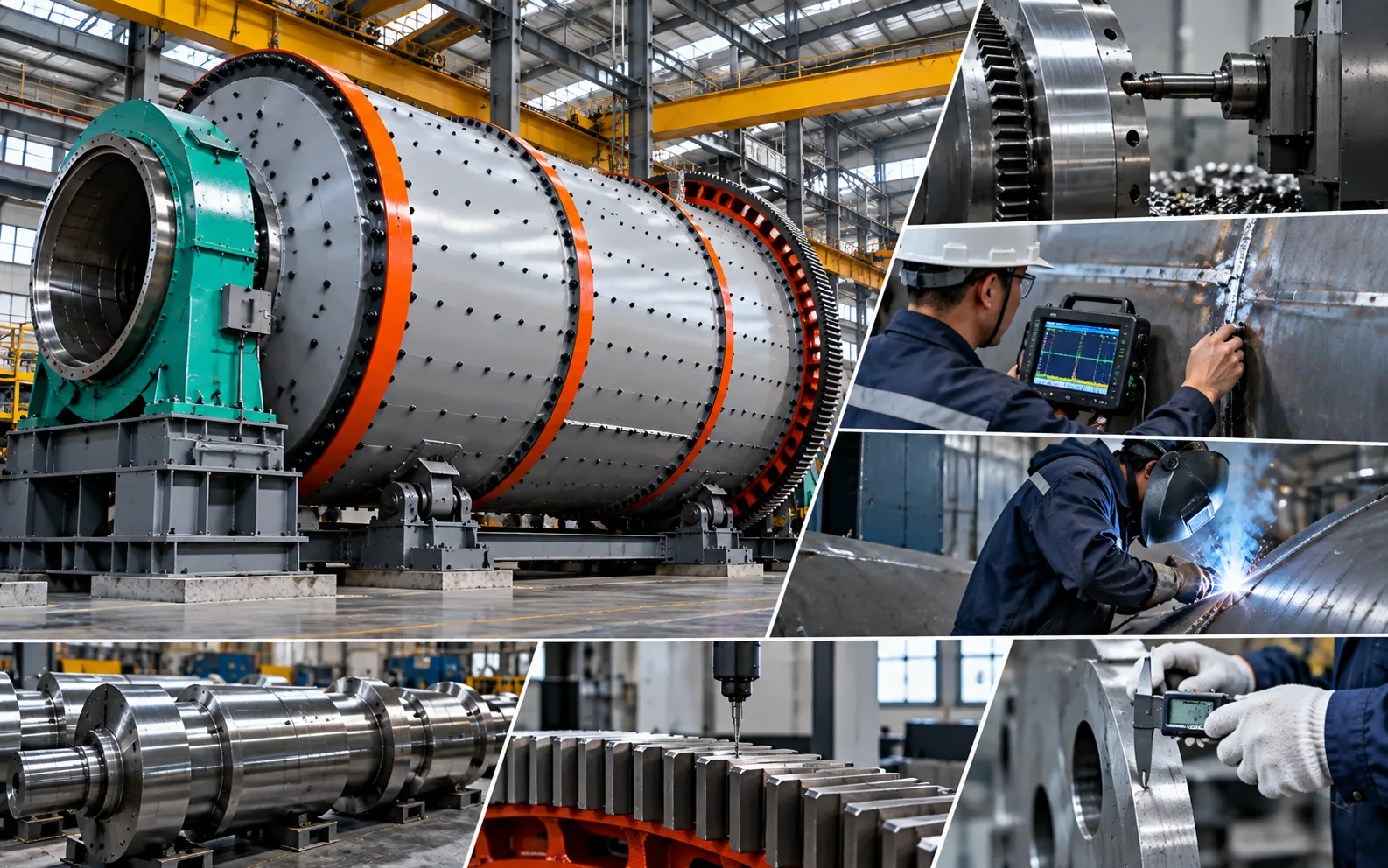
Heavy-Duty Mechanical Engineering and Quality Assurance
Industrial cement grinding facilities operate under continuous heavy service. An industrial cement ball mill—often exceeding 400 metric tons including the grinding media charge and material bed—exerts severe dynamic and torsional loads across shell weldments, trunnion journals, and drive assemblies. DARKO enforces stringent quality assurance systems compliant with ISO 9001 quality management standards and CE machinery directives.
Every production stage, from spectroscopic chemical analysis of pressure-vessel grade steel plates (Q245R/Q345R) to ultrasonic inspection of cast alloy trunnions (ZG270-500), is backed by verifiable material test reports (MTR). This disciplined manufacturing oversight prevents shell fatigue cracking, trunnion bearing overheating, and premature gear wear in high-tonnage clinker and slag grinding circuits.
Charpy V-notch low-temperature impact testing and spectroscopic chemical analysis for all shell plates, trunnions, and high-chromium alloy liners.
Automated multi-pass submerged arc welding (SAW) ensures deep penetration, supported by continuous interpass preheat and temperature logging.
Dual-axis laser coordinate tracking across trunnion journals and girth gear mounting flanges eliminates axial and radial runout.
High- and low-pressure trunnion lubrication skids undergo 72-hour continuous pressure and flow-rate testing prior to modular packaging.
Standardized Quality Assurance Protocols & Factory Acceptance Testing (FAT)
Standardized testing matrices govern every manufacturing phase to ensure verified equipment delivery for cement engineering contractors and plant owners worldwide.
| Fabrication Phase | Critical Component | Inspection Method & Protocol | Acceptance Criteria & Tolerance |
|---|---|---|---|
| Shell Fabrication | Longitudinal & Circular Welds | 100% Ultrasonic (UT) & Radiographic (RT) | ISO 5817 Quality Level B / Zero Flaws |
| Thermal Treatment | Full Welded Mill Cylinder | Furnace Thermocouple Logging (580°C–620°C) | Residual Stress Relief > 92% |
| Precision Machining | Trunnions & Mating Flanges | CNC Dual-Axis Laser Metrology | Radial Runout ≤ 0.15 mm |
| Drive Transmission | Girth Gear & Pinion Assembly | Tooth Flank Contact Staining & MT Test | Contact Area ≥ 70% Tooth Height |
| Assembly & Balance | Complete Rotating Cylinder | Dynamic Balancing Rig Inspection | Balance Grade ISO 1940 G6.3 |
Turnkey Grinding Station EPC & Field Engineering Services
Beyond standalone ball mill manufacturing, DARKO provides turnkey closed-circuit grinding packages on an EPC basis. We integrate raw material feed bins, weigh feeders, dynamic high-efficiency air separators, pulse-jet baghouse filters, pneumatic air slides, bucket elevators, high-capacity bulk loading equipment including dust-suppressed truck loading spouts and marine ship loaders, and central PLC electrical automation. From greenfield site layout engineering to hot-load commissioning, we ensure streamlined project delivery and guaranteed production targets.
Cement Ball Mill Technical and Sizing FAQ
Authoritative engineering guidance on reducing specific power consumption, optimizing grinding media charge distributions, integrating auxiliary plant equipment, and executing turnkey commissioning.
Lowering specific energy consumption to the target benchmark of 30 to 34 kWh/t requires synchronized optimization across feed sizing, mill ventilation, and classification efficiency:
- Feed Size Reduction (Crushing Over Grinding): Implementing roller presses or secondary tertiary crushers to limit top feed size below 3 mm reduces the primary chamber impact workload by up to 25%.
- Dynamic Classifier Upgrades: Integrating third-generation high-efficiency dynamic separators swiftly removes finished particles (Blaine 3,200–4,500 cm²/g), mitigating over-grinding and maintaining circulating load ratios between 150% and 220%.
- Longitudinal Air Ventilation: Maintaining internal airspeed between 0.5 and 1.0 m/s via high-capacity baghouse dust collectors evacuates fine material cushions, lowers internal shell temperatures below 110°C, and prevents gypsum dehydration.
- Chemical Grinding Aids: Continuous liquid grinding aid injection neutralizes electrostatic particle agglomeration on ball surfaces and liners, providing an 8% to 12% boost in throughput.
DARKO Engineering Note: Every DARKO closed-circuit cement grinding system undergoes custom aerodynamic modeling to balance diaphragm open areas and separator rotor velocities for optimal surface area creation per kilowatt-hour.
The grinding media grading curve balances kinetic impact energy in the primary chamber with high-surface-area attrition grinding in the fine chamber:
First Compartment (Impact Crushing)
Engineered to shatter raw clinker feed from ≤25 mm down to under 1.5 mm through high-energy cataracting action.
- Media Type: Forged alloy steel grinding balls
- Size Distribution: Ø90 mm (15%), Ø80 mm (30%), Ø70 mm (35%), Ø60 mm (20%)
- Liner Configuration: Stepped lifting liners engineered for maximum lift angle
- Volumetric Charge: 28% to 32% filling degree
Second Compartment (Attrition & Pulverization)
Optimized for inter-particle friction and fine pulverization to achieve target Blaine surface area.
- Media Type: High-chromium cast alloy balls or cylpebs
- Size Distribution: Ø35 mm (25%), Ø30 mm (35%), Ø25 mm (25%), Ø20/17 mm (15%)
- Liner Configuration: Classifying corrugated liners for size segregation
- Volumetric Charge: 30% to 35% filling degree
DARKO process specialists establish baseline charging matrices and replenishment schedules derived from laboratory Bond Work Index (BWI) testing and required target cement strength profiles.
A fully integrated closed-circuit cement grinding station incorporates balanced auxiliary dust collection equipment and transport systems to maintain reliable material circulation, temperature management, and strict emissions compliance:
High-efficiency pulse-jet dust collectors with PTFE membrane filters guarantee stack emissions below 10 mg/Nm³.
High-capacity central chain bucket elevator handling recirculating mill discharge tailings.
Fluidized air slides for energy-efficient, low-wear transport of finished powder.
Counterweighted motorized airlock flap valves eliminating ambient false air ingress.
DARKO provides fully synchronized packages complete with acoustic mill ear sensors, automated feed weigh feeders, and variable frequency drives (VFDs) for dynamic loop stabilization.
Fabrication, dispatch, and on-site commissioning are planned around equipment specifications, production schedules, and site readiness:
| Equipment Specification | Shop Manufacturing Period | Civil Curing & Transit Window | Mechanical Erection & Trial Runs |
|---|---|---|---|
| Standard Mills (Ø2.4m – Ø3.2m) | 60 – 90 Days | Concurrent with site foundations | 30 – 35 Working Days |
| Heavy-Duty Mills (Ø3.8m – Ø4.6m) | 100 – 120 Days | Heavy transport staging | 40 – 45 Working Days |
| Turnkey EPC Grinding Station | 120 – 150 Days | Integrated layout schedule | 60 – 75 Working Days |
DARKO deployment engineers manage on-site foundation verification, girth gear alignment, hydrostatic bearing tests, 72-hour continuous no-load testing, and hot load performance sign-offs.
DARKO wear components are cast from high-chromium and high-manganese alloys (Cr15–Cr27) to maximize mean time between maintenance (MTBM) under continuous duty:
- First Chamber Stepped Liners: Service life averages 12,000 to 16,000 operating hours under heavy clinker impact. Replacement is recommended when the lifter wave profile wears past 60% of original height.
- Second Chamber Classifying Liners: Service life spans 18,000 to 24,000 operating hours due to finer material beds and predominantly frictional wear.
- Intermediate Double-Deck Diaphragms: Grate plates require slot gap inspections every 4,000 operating hours. Replace grates when slot widths exceed 8 mm to prevent media back-migration.
All replacement shell liners are supplied with precision-machined bolt holes and synthetic elastomeric seals to prevent slurry leakage and bolt shearing.
DARKO trunnion and slide shoe bearing assemblies utilize dual-circuit high/low pressure centralized lubrication stations designed for non-stop plant operation:
- Hydrostatic High-Pressure Jacking: Before motor start, auxiliary high-pressure pumps inject oil at 16 to 25 MPa under journals and shoes, floating the mill shell by 0.15 mm to eliminate dry friction wear at startup.
- Hydrodynamic Low-Pressure Flooding: At operational speed, low-pressure high-flow pumps (0.4 to 0.6 MPa) maintain a stable oil wedge, recirculating oil through plate heat exchangers for continuous thermal regulation.
- Duplex Filtration & Safety Interlocks: 25-micron duplex filters permit online cartridge changes. Dual PT100 sensors provide automated warning alarms at 55°C and emergency shutdown interlocks at 65°C.
Need a Custom Ball Mill Sizing Calculation?
Discuss material grindability, ball charge grading, mill sizing, and closed-circuit retrofit options with the DARKO engineering team.
Find the Right Grinding Solution for Your Plant
Tell us what you need. Our team can discuss ball mill selection, grinding circuit configurations, and a quotation based on your project requirements.
Request a Quote
Just a few details to get started. Technical specifications can be discussed later.