
Industrial Filter Bag Materials and Temperature Classifications
Matching the right filter cloth to your baghouse operating environment is essential for maintaining low differential pressure, meeting <5 mg/Nm³ ultra-low emission limits, and maximizing operating run-time. Operating zones across raw meal grinding, clinker cooling, coal pulverizing, and kiln pyroprocessing present severe abrasive mechanical wear, rapid thermal fluctuations, and corrosive acid gas condensates.
DARKO processes premium virgin synthetic and inorganic fibers into high-density needle punched felts tailored to withstand cement plant acid gases and thermal shocks. Explore our core technical media classifications below, organized by continuous operating temperatures, chemical resistance ratings, and specific industrial process zones.
Polyester Needle Felt
High mechanical tensile stability and cost-effective surface filtration for non-acidic bulk material transfer, packing bins, and raw limestone storage.
Nomex / Aramid Felt
Exceptional dimensional strength and abrasion tolerance engineered for hot gas environments and coarse, highly abrasive clinker dust streams.
PPS / Ryton Felt
Market-proven resistance to sulfur oxides, moisture hydrolysis, and reactive acid dew points across solid-fuel burning systems and coal preparation circuits.
Fiberglass + PTFE
High-tenacity woven fiberglass needle felt bonded with an expanded microporous PTFE membrane, designed for intense continuous pyroprocessing heat.
100% Virgin PTFE
Complete chemical inertness (pH 0–14) and reliable high-temperature stamina for cement kilns co-processing hazardous wastes and high-chloride fuels.
Advanced Surface Finishes for Stable Differential Pressure
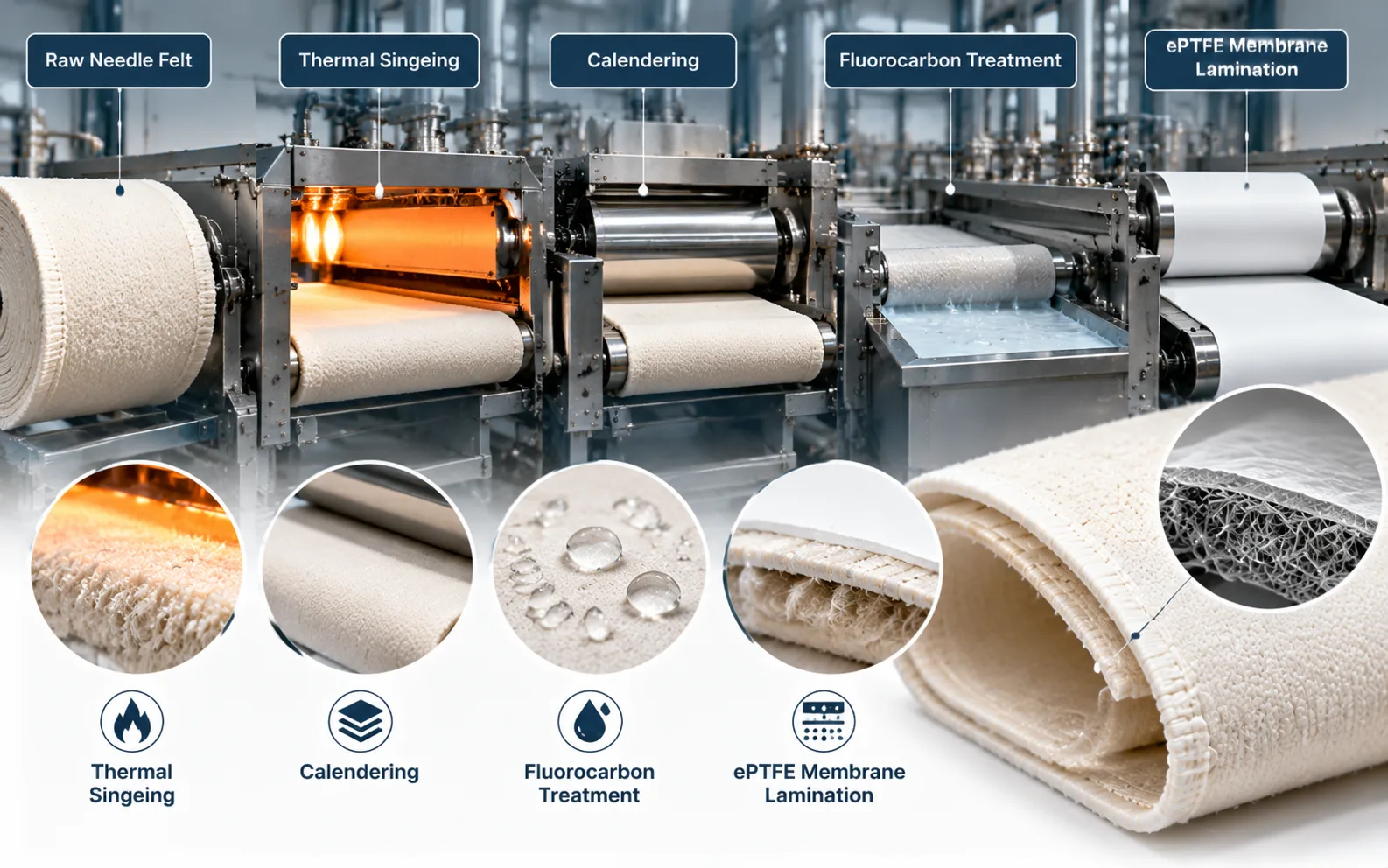
Raw needle felt requires precision thermal and chemical finishing to enhance dust cake release, lower pulse jet energy consumption, and isolate internal scrim filaments from corrosive flue gas. DARKO applies continuous thermal singeing, calendering, fluorocarbon baths, and thermal ePTFE membrane lamination under strict process controls.
ePTFE Membrane
Microporous surface barrier capturing sub-micron particulates down to <5 mg/Nm³.
Oleophobic Finish
Fluororesin immersion protecting felt fibers against moist dust blinding and mud-coating.
Antistatic Scrim
Stainless steel or epitropic carbon grid safely grounding combustible coal dust charges.
Optimizing Thermal and Chemical Media Selection in Cement Baghouses
Industrial dust collector filter bags operate under continuous mechanical shock, chemical aggression, and thermal stress in cement manufacturing facilities. Specifying filter bags based solely on nominal peak temperature ratings frequently leads to premature media blinding or fabric degradation caused by acid dew-point condensation, abrasive particulate impact, and moisture hydrolysis. Modern pyroprocessing kilns release significant concentrations of sulfur dioxide (SO₂), nitrogen oxides (NOx), alkali chlorides, and elevated moisture levels.
In environments operating above 180°C with elevated sulfur levels, polyphenylene sulfide (PPS) or high-density fiberglass needle felt with ePTFE membrane provides reliable structural endurance and acid corrosion defense. While Nomex filter bags deliver outstanding flex fatigue life and high-temperature abrasion tolerance for clinker cooler baghouse dust collectors, they require strict operational moisture control to prevent hydrolytic degradation.
- Fiberglass Needle Felt: Delivers superior dimensional stability with <1% thermal elongation under full mechanical cage tension up to 260°C continuous operation.
- PTFE Membrane Bags: Restricts particulate capture entirely to the membrane surface layer, cutting pulse jet compressed air consumption by up to 35%.
- Conductive Antistatic Blends: Eliminates static electrical charge accumulation in coal milling systems and combustible dust storage silos.
Media Selection Benchmarks and Laboratory Quality Standards
Every production batch engineered by DARKO undergoes rigorous laboratory verification to ensure consistency across weight distribution, thickness, tensile load resistance, and Frazier air permeability tolerances.
Need technical verification for your specific flue gas chemistry or operating temperatures? DARKO engineering specialists provide laboratory fabric assessments, bag wear analysis, and customized media recommendations to eliminate high differential pressure.
Baghouse Filter Cloth Specifications & Technical Media Comparison
Evaluating industrial baghouse filter cloth specifications is essential for stabilizing air-to-cloth ratios in heavy-duty baghouse dust collectors, lowering operating differential pressure, and ensuring compliant particulate capture across harsh cement manufacturing circuits. DARKO ensures every production batch of dust filter cloth complies with stringent tensile and permeability tolerances before delivery to bulk material handling sites, verifying needle-punched and woven textiles against strict ASTM D737 and ISO 9073 protocols.
Filter Felt Weight
Calibrated base weights from 450 to 850 g/m² ensure sufficient needle-felt fiber depth for fine particulate collection without triggering premature drag across reverse-pulse cleaning cycles.
Air Permeability
Precision throughput ratings from 80 to 300 L/m²/s at 200 Pa ensure consistent face velocities across high-dust circuits while curbing particulate bleed-through on raw grinding lines.
Tensile Strength
Reinforced woven scrim cores deliver longitudinal warp and crosswise weft tensile figures exceeding 1,000 N/5cm, preventing bag sag, mechanical fatigue, and wire cage abrasion.
Limiting Oxygen Index
Media engineered for coal mills and preheater bypass gas streams offer high flame-retardant index ratings up to 95%, suppressing ignition risks caused by spark carryover or fuel surges.
Industrial Media Parameter & Performance Matrix
Review mechanical properties, continuous thermal thresholds, and chemical endurance metrics for standard cement plant baghouse filters.
| Base Material & Construction | Working Temp (°C) | Fabric Weight (g/m²) | Thickness (mm) | Permeability (L/m²/s) | Tensile Warp/Weft (N/5cm) | LOI (%) | Chemical Resilience | Target Cement Plant Unit |
|---|---|---|---|---|---|---|---|---|
| Polyester (PE Needle Felt) Plain, Singed, or Conductive Scrim | 130 Cont. / 150 Peak | 500 – 550 | 1.8 – 2.0 | 150 – 250 | 1,000 / >1,200 | 20 – 22 | Abrasion: ★★★★★ Hydrolysis: ★★☆☆☆ Oxidation: ★★★★☆ | Silo Top & Packing Line |
| Aramid (Nomex Needle Felt) Heat-Resistant Polyamide Base | 200 Cont. / 220 Peak | 500 – 550 | 1.9 – 2.2 | 130 – 200 | 900 / >1,100 | 28 – 30 | Abrasion: ★★★★☆ Hydrolysis: ★★☆☆☆ Oxidation: ★★★★☆ | Clinker Cooler Discharge |
| PPS (Polyphenylene Sulfide / Ryton) Acid-Resistant Engineered Polymer | 190 Cont. / 210 Peak | 500 – 600 | 1.7 – 2.0 | 120 – 180 | 950 / >1,150 | 34 – 36 | Abrasion: ★★★★☆ Hydrolysis: ★★★★★ Oxidation: ★★☆☆☆ | Raw Grinding Mill Circuit |
| Fiberglass + PTFE Membrane Woven Filament with ePTFE Laminate | 240 Cont. / 260 Peak | 750 – 850 | 1.3 – 1.6 | 80 – 140 | 1,800 / >2,200 | 90 | Abrasion: ★★★☆☆ Hydrolysis: ★★★★★ Oxidation: ★★★★★ | Cement Kiln Tail Exhaust |
| 100% Virgin PTFE (Teflon) High-Density Acid & Alkali Shield | 250 Cont. / 280 Peak | 700 – 750 | 1.4 – 1.8 | 90 – 150 | 800 / >950 | 95 | Abrasion: ★★★★☆ Hydrolysis: ★★★★★ Oxidation: ★★★★★ | Waste Co-Processing Kiln |
Physical parameters measured under ASTM D737, ISO 9073-3, and ASTM D3776 textile testing protocols.
Custom weight profiles, micro-pore finishes, and special surface coatings engineered upon review.
Textile Verification & Quality Control Protocols
Dust collector filter bags endure continuous pneumatic pulsing and aggressive thermal cycling within cement production environments. Minor deviations in felt thickness or scrim tension can induce localized dust bleed-through, elevated differential pressure, or cage wear. DARKO qualifies all incoming polymer fibers and finished needle felts through multi-stage quality assurance to ensure long-term structural integrity and compliant particulate emission levels.
Permeability Consistency
Full-width automated air permeability verification guarantees uniform velocity distribution, preventing premature localized dust caking.
Thermal Stability Index
Continuous heat-setting chambers guarantee longitudinal and crosswise fabric shrinkage remains below 1.0% under peak thermal load.
Burst Pressure Resistance
Mullen burst tests exceeding 3.5 MPa verify high-pressure reverse shock resistance across pulse jet dust collectors without rupturing micro-porous needle pathways.
Chemical Exposure Defense
Accelerated immersion tests in hot sulfuric acid and basic condensates confirm chemical defense near acid dew-point margins.
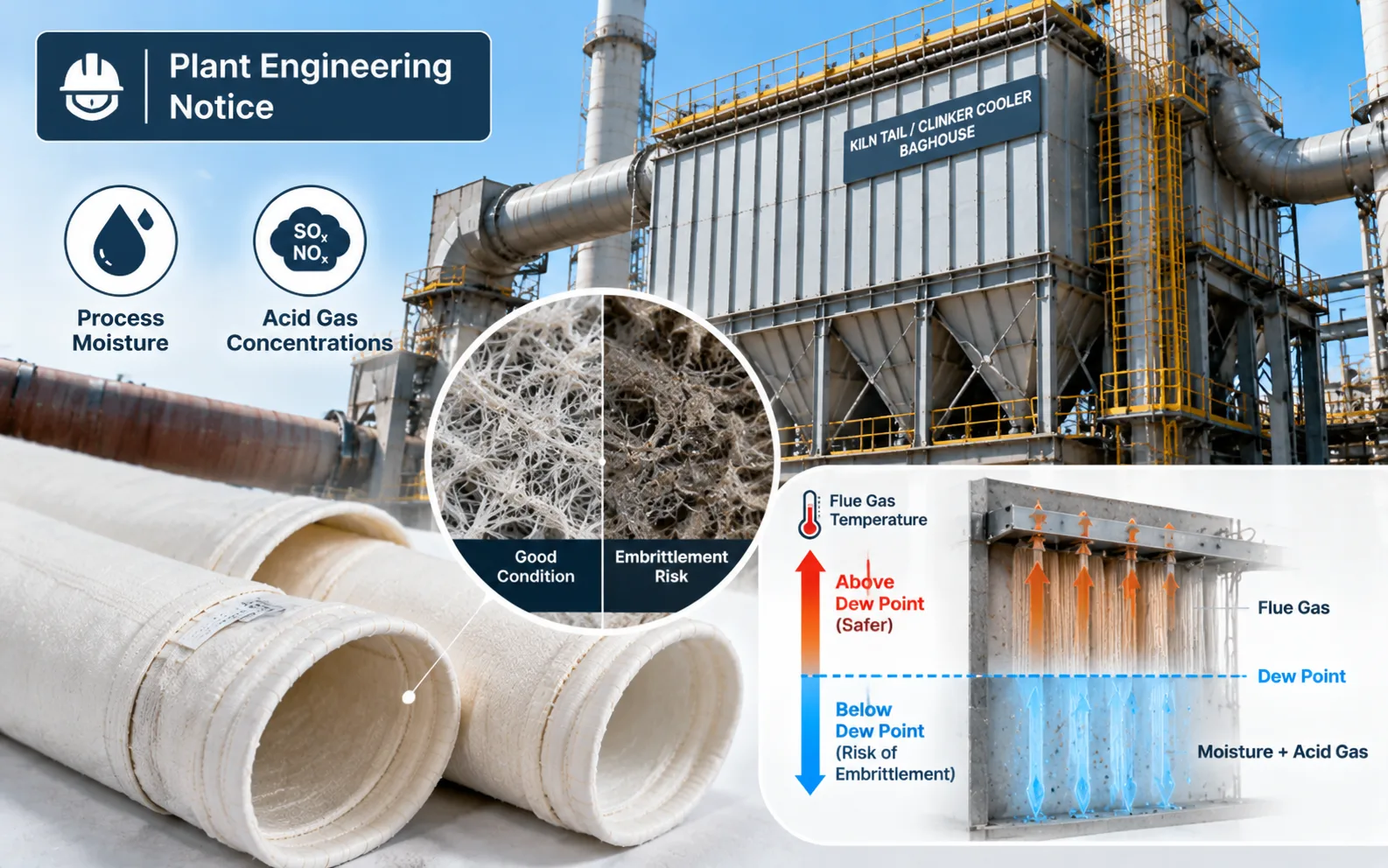
When specifying replacement filter bags for kiln tail or clinker cooler baghouses, verify process moisture and acid gas concentrations. Media with moderate hydrolysis resistance require maintained temperatures above flue gas dew points to avoid premature polymer embrittlement.
Need Custom Fabric Weights or Surface Finishes?
DARKO engineers application-matched filter bags with hydrophobic, oleophobic, antistatic, and ePTFE membrane options, configured to your plant's air-to-cloth ratio, operating conditions, and dust characteristics.
Cement Plant Baghouse Solutions Across the Entire Pyroprocessing Flow
Industrial dust collector filter bags operating in clinker manufacturing must endure transient thermal surges, acidic flue gases, and continuous mechanical abrasion from calcined minerals. Having outfitted over 150 cement production lines, DARKO provides site-specific filter media engineering tailored to clinker, grinding, and kiln process air across heavy-duty dust collection equipment.
Cement Kiln Dust Collection
Engineered for kiln inlet and exhaust gas cleaning systems handling high concentrations of sulfur dioxide, alkali bypass fumes, and ultrafine calcined feed particles in severe-duty baghouse dust collectors.
Operational Pain Points
- Acid dew-point corrosion from SO2 and HCl
- Thermal excursions exceeding standard fiber limits
- Pore blinding caused by sticky, volatile alkali salts
DARKO Engineering Remedy
Fiberglass Needle Felt + ePTFE Membrane: Preserves structural tensile integrity up to 260°C while the microporous membrane prevents sub-micron particulate penetration and eliminates acid condensation binding.
Raw Mill & Coal Mill Baghouse
Configured for raw grinding circuits, coal pulverizers, and dynamic separator circuits where fine combustible dusts demand continuous static dissipation.
Operational Pain Points
- Deflagration hazards from high-friction coal dust
- Abrasive quartz particle scouring on seams
- Moisture condensation leading to heavy cake crusting
DARKO Engineering Remedy
Antistatic Coal Mill Filter Felt: Stainless steel micro-fibers or epitropic conductive threads integrated throughout the scrim safely bleed electrostatic build-up straight to ground.
Clinker Cooler Filtration
Constructed to withstand high-velocity exhaust streams coming off reciprocating grate coolers laden with angular, superheated clinker nodules and calcined grits.
Operational Pain Points
- Abrasive clinker particles cutting lower filter sleeves
- Unpredictable cooler heat spikes during process upsets
- Inlet velocity turbulence causing cage impact fatigue
DARKO Engineering Remedy
Reinforced Aramid / Blend Felt: Woven with high-modulus multifilament scrims and heavy wear cuffs to withstand continuous pulse flex cycles and severe coarse particulate bombardment.
Silo Venting & Bulk Packing
Installed on finished cement storage silos, air-slide conveyor vents, bucket elevator heads, and high-throughput bulk tanker loading spouts during bagging operations.
Operational Pain Points
- Fluidized micron dust embedding deep in media pores
- Excessive cleaning cycle frequency straining valves
- Unscheduled product losses through standard needle punctures
DARKO Engineering Remedy
High-Permeability Glazed Polyester Felt: Treated with an oleophobic singed-and-glazed finish to accelerate dust cake release during short cleaning pulses while holding differential pressure low.
Optimized Filter Media Selection for Cement Plant Baghouse Systems
Mismatched filter media can cause premature thermal degradation, blinded bags, higher fan energy consumption, and unplanned kiln shutdowns. DARKO evaluates flue-gas chemistry, moisture, acid dew points, temperature, and dust loading to recommend filter bags suited to your operating conditions.
Need the Right Filter Media?
Send your baghouse dimensions, operating temperature, dust characteristics, or current filter specifications. Our team will recommend a suitable media configuration.
Request Sample & Quote Send Your RequirementsManufacturing Precision and Ultra-Low Emission Compliance
Modern cement plants operate under rigorous environmental mandates that demand clean-gas particulate concentrations well below 5 mg/Nm³. Achieving sustained compliance requires eliminating the structural weaknesses inherent in conventional sewn filter media. DARKO applies precision thermal-bonding and automated sewing standards across advanced filtration products to guarantee particulate leakage well below international environmental thresholds.
Our industrial baghouse filter bags are engineered on automated fabrication lines to eradicate seam blowouts, needle puncture bypassing, and pulse fatigue in high-capacity baghouse dust collectors. From continuous ultrasonic hot-melt welding to precision PTFE membrane thermal lamination, every processing step directly addresses the root causes of baghouse dust penetration, elevated differential pressure, and premature media degradation in severe kiln and mill circuits.
Thermal Welded Seams and Automated Fusion
Traditional needle stitching introduces mechanical perforations that allow fine sub-micron dust to bypass the filtration plane during high-energy pulse cleaning. DARKO uses computerized ultrasonic fusion and hot-air welding to molecularly fuse synthetic felt fibers into a continuous, leak-free joint.
- Tensile Joint Strength: Retains over 95% of the virgin parent fabric tensile rating.
- Zero Needle Perforations: Completely eliminates interstitial dust bleed-through paths.
- Automated CNC Guidance: Guarantees uniform seam width, weld depth, and joint integrity.
Gradient PTFE Coating and Heat Setting
Untreated needle felts are vulnerable to deep-bed particle entrapment, driving up operating differential pressure and energy consumption. Our multi-stage finishing combines gradient PTFE immersion, thermal heat setting, and microporous membrane lamination to form an efficient surface-filtration barrier.
- Dust Cake Detachment: Improves particulate cake release efficiency by more than 40%.
- Lower Differential Pressure: Reduces induced draft fan load and compressed air demand.
- Thermal Dimensional Stability: Maintains longitudinal shrinkage below 1.0% at peak rated heat.
Multi-Layer Cuff and Base Reinforcement
Repetitive high-pressure reverse air pulses subject top cuffs, snap bands, and bottom discs to intense mechanical stress against support cages. DARKO fortifies these critical wear zones with multi-layer felt wraps and precision-tempered spring steel snap bands to prevent displacement.
- Snap Band Calibration: Formed within ±0.5 mm tolerances for a hermetic tube sheet seal.
- Reinforced Bottom Cups: Dual-layer wear cuffs resist bottom cage abrasion and turbulences.
- Pulse Fatigue Resistance: Prevents collar dislodgement during vigorous 0.6 MPa pulse cleaning.
Four-Stage Quality Assurance and Emission Verification Process
Reliable sub-5mg/Nm³ ultra-low emission performance requires strict quality controls at every stage of fabrication. Every batch of DARKO industrial filter bags undergoes rigorous raw-media verification, laser-calibrated cutting, automated weld strength testing, and certified particulate retention audits for modern dust collection equipment.
Roll-Stock Inspection
Automated optical sensors inspect fiber distribution, needle-punch uniformity, scrim alignment, and base weight consistency across 100% of incoming felt rolls.
CNC Ultrasonic Profiling
Multi-axis CNC cutting tables trim felt to exact baghouse tube sheet dimensions while sealed hot-cut edges prevent fraying and fiber migration during operation.
Weld and Snap Calibration
Automated tensioning fixtures position spring steel snap bands while ultrasonic welding horns create continuous longitudinal seams with zero pinhole bypass.
Aerosol Penetration Testing
Random production lot samples undergo standardized fractional aerosol penetration scans to verify sub-5mg/Nm³ particulate retention and air permeability limits.
Engineered for Sub-5mg/Nm³ Industrial Emission Standards
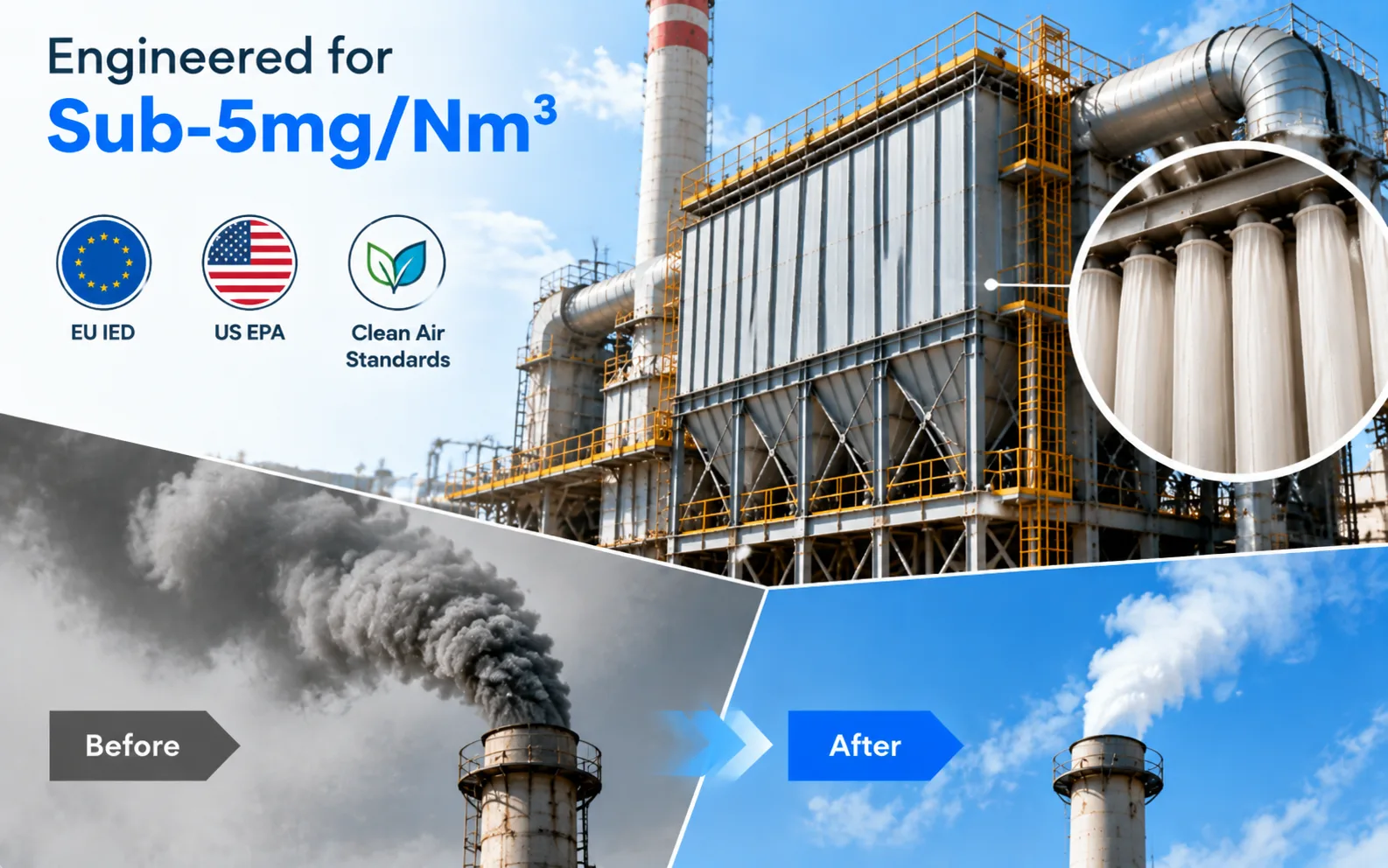
Environmental regulations are tightening worldwide across heavy process industries. The European Union Industrial Emissions Directive (IED), US EPA MACT regulations, and national clean-air standards require continuous capture of PM10, PM2.5, and hazardous clinker and raw mill dust over extended production campaigns without emission spikes.
Filter Bag Collar Structural Types and Filter Cage Compatibility
Long-term particulate capture in industrial pulse-jet dust collectors requires both high-grade filter media and precision mechanical seating at the tube sheet. In cement processing lines and heavy bulk material plants, premature sleeve failure often stems from mechanical misalignment, incorrect snap band tension, or inadequate cage clearances rather than chemical breakdown. Ensuring a tight interface between the replacement bag collar, tube sheet aperture, and inner support cage stops dust bleed-through, lowers localized shear fatigue, and protects system differential pressure across demanding reverse-pulse cleaning cycles.
DARKO Cement Machinery designs industrial filter bags and matching wire cages concurrently to eliminate friction wear and extend operational intervals. Establishing the correct mounting configuration, bottom reinforcement, and cell plate hole tolerances ensures zero-bypass sealing and dependable operation across kiln lines, grinding mills, and material transfer baghouse dust collectors.
Top Collar Attachments and Tube Sheet Geometry
The collar assembly forms the primary barrier between dirty process gas and the clean air plenum. Meeting ultra-low emission targets below 5 mg/Nm³ requires exact dimensional matching to the baghouse tube sheet diameter and plate thickness.
Double-Beaded Snap Band Cuffs
Fabricated with high-tensile spring steel or dual stainless steel bands encased in matched felt gaskets. These collars snap directly into laser-cut cell plates, seating firmly in the grooved rim for an airtight, tool-free mechanical lock that withstands high-pressure pulse vibrations.
Flange Collar and Rolled Top Configurations
Designed for top-access dust collectors featuring integral rolled or flat felt flanges that rest flat against the tube sheet face. Typically paired with hold-down rings or integrated venturi clamps to maintain continuous downward compression under high air-to-cloth ratios.
Compression Clamp Rings
Used in bottom-removal collectors, plenum pulses, and bin vent units. Heavy-duty stainless steel worm-drive or T-bolt clamps fasten the reinforced cuff securely over extended tube stubs, delivering strong mechanical grip in high-vibration hopper environments.
Drawstring and Corded Cuffs
Mainly deployed on ambient shaker baghouses, storage bin vents, and discharge spouts. High-strength braided cords or elastic drawstrings cinch the fabric cuff over beaded pipe spigots for straightforward, cost-effective maintenance.
Bottom Reinforcement Construction
Filter bags experience substantial turbulence and abrasive wear near the hopper inlet. Heavy dust loading and turbulent gas streams can cause bottom seam blowouts without multi-layered reinforcement and high-tensile stitching.
- Reinforced Disc Bottoms: Double-ply circular fabric bases sewn with heat-resistant PTFE or aramid thread to prevent internal cage impact punctures during rapid pulse cycles.
- Folded Cup Bottoms: Heavy 2-inch to 4-inch outer wear cuffs wrapped around the base circumference to resist direct abrasion from raw meal, clinker dust, and high-velocity entry currents.
- Integrated Grounding Straps: Built-in braided copper or stainless steel grounding wires bonded from collar to base cap to safely dissipate static charges in combustible coal grinding systems.
Support Cage Tolerance and Clearance Mechanics
The annular clearance between the filter bag inner diameter and the support cage outer diameter directly dictates pulse-cleaning efficiency and fabric service life. DARKO maintains rigorous dimensional standards to ensure controlled fabric expansion without excessive mechanical stress.
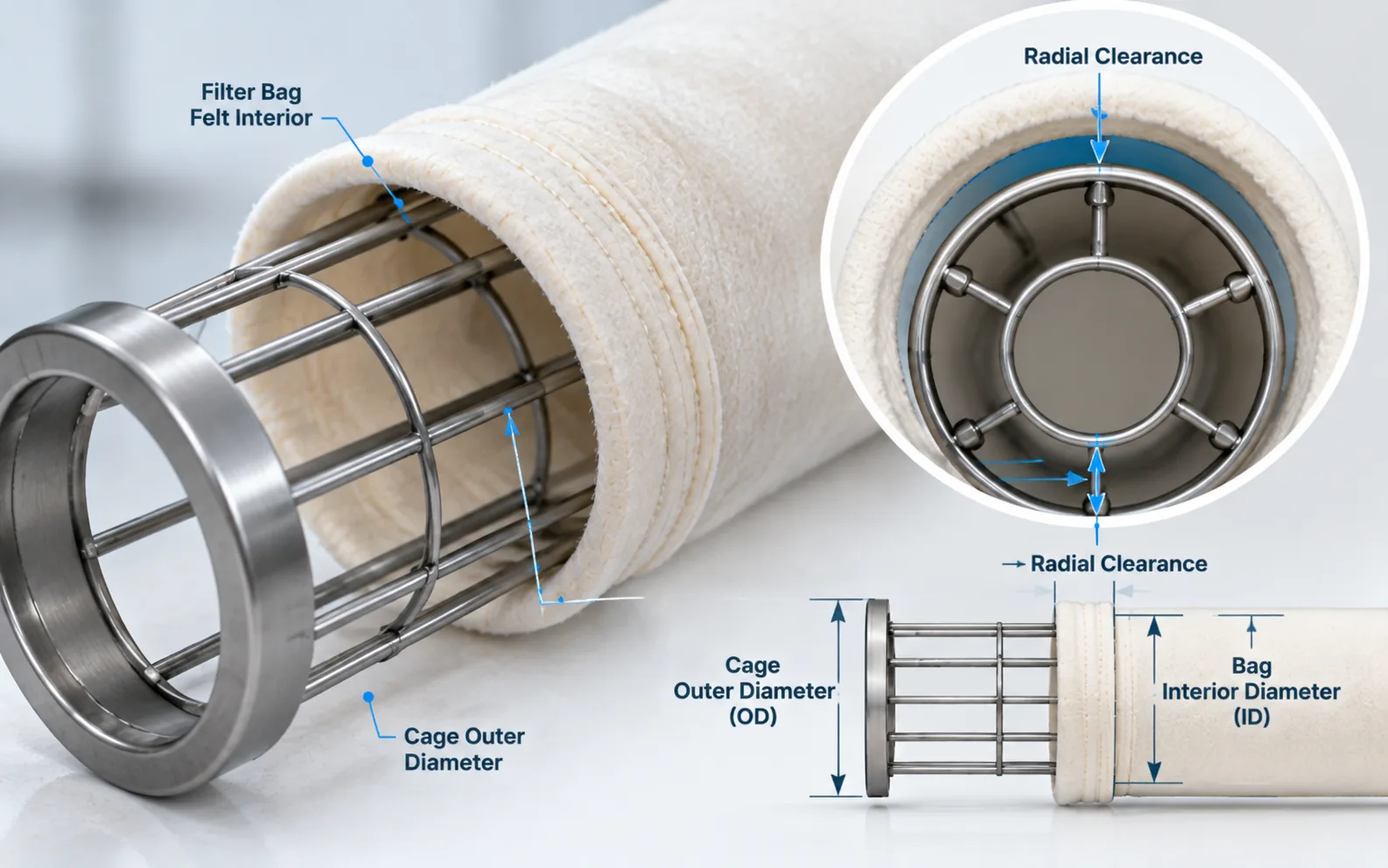 Dimensional diagram: Exact radial clearance tolerances between cage outer diameter and filter bag felt interior.
Optimal 3mm to 5mm Radial Clearance Standard
Maintaining a total 3 to 5 mm diametrical clearance lets the filter bag expand smoothly during reverse pulses to break up the dust cake, without slapping violently against support cage wires upon deflation.
Consequences of Undersized Bag Diameter (< 2mm Clearance)
An overly tight fit limits fabric displacement during pulse-jet cycles, preventing proper dust cake release, elevating operating differential pressure, and complicating cage installation and removal.
Hazards of Oversized Bag Diameter (> 6mm Clearance)
Excessive clearance causes aggressive fabric snapping against cage longitudinal wires during deflation cycles, accelerating internal fiber wear and causing premature vertical seam splits.
Integrated Cage Specifications
To prevent premature fabric wear, DARKO supplies companion support cages configured for specific media weights, operating temperatures, and baghouse layouts:
Achieve Zero-Bypass Filtration with Matched Bag and Cage Systems
Mismatched cage wire counts, burred welds, and bent support rings can cause premature filter sleeve wear. DARKO supplies galvanized, electro-polished stainless steel, and specialty-coated support cages matched to your tube sheet layout and operating conditions.
Filter Bag Maintenance Diagnostics and Technical FAQ
Reliable baghouse operation requires proactive monitoring of airflow dynamics, mechanical wear, and chemical exposure across the entire filtration system. DARKO Cement Machinery delivers specialized troubleshooting expertise, root-cause failure analysis, and preventative maintenance strategies tailored to heavy-duty dust collection equipment and filter bags across all cement manufacturing circuits.
System Diagnostics Protocol
Drawing from decades of cement process servicing, DARKO engineers provide root-cause failure analysis and lifespan optimization plans for industrial baghouse dust collectors. Systematic evaluation of pressure drops and pulse jet timing maintains airflow balance and ensures sustained sub-5 mg/Nm³ particulate emission compliance.
Differential Pressure Monitoring: Continuous evaluation of baseline resistance across individual baghouse compartments to detect fabric blinding early.
Pulse Valve Optimization: Calibrating reservoir tank pressure, pulse duration, and cleaning cycle frequency to prevent mechanical shock fatigue.
Fluorescent Leak Detection: Monochrome powder testing for rapid localization of torn filter cloth, failed seams, or compromised tube sheet seals.
Need Expert Diagnostics?
If your facility encounters unresolvable differential pressure spikes, premature bag abrasion, or flue gas moisture blinding, our technical specialists provide detailed process reviews and forensic fiber testing.
Engineering Consultation: Direct technical support available for clinker cooler baghouses, kiln exhaust systems, raw mills, and cement storage silos.
The standard filter bag lifespan in a cement plant depends heavily on operating temperatures, dust particle abrasiveness, gas moisture levels, and pulse cleaning settings across each stage of production:
- Ambient Storage Silos and Bulk Loadouts: 24 to 36 months using premium polyester needle felt under standard pulse jet cycles and stable ambient humidity conditions.
- Raw Grinding and Finish Ball Mills: 18 to 24 months, where continuous dust abrasiveness, dynamic airflow fluctuations, and mechanical cage friction represent the main wear factors.
- Clinker Coolers and Kiln Exhaust Baghouses: 12 to 24 months for woven fiberglass needle felts with ePTFE membranes, Nomex, or PPS media operating in continuous 180°C to 260°C thermal zones with acid gas exposure.
Proper cage alignment, compressed air moisture removal, and conservative air-to-cloth ratios are essential to maximizing service life and preventing premature fabric degradation.
Ready to Upgrade Your Dust Collection Efficiency?
Share your filter bag requirements, operating conditions, or current specifications with DARKO. Our engineering team can recommend suitable filter media, dimensions, and configurations for cement plants, kilns, raw mills, clinker coolers, and other demanding dust collection applications.
DARKO supplies replacement filter bags and related baghouse components for industrial dust collection systems, with customized solutions available for different temperatures, dust characteristics, and operating conditions.
Sample sleeves and filter fabrics can be provided for evaluation and application trials.
Coordinated international shipping for scheduled maintenance and replacement requirements.
Filter media and bag configurations matched to your equipment and operating conditions.
Request Sample & Quote
Tell us what you need and our team will get back to you with suitable options and pricing.