Formula details
Product Details
Overview
Types of Railcar Loading Spouts: Open vs. Enclosed Hopper Loading
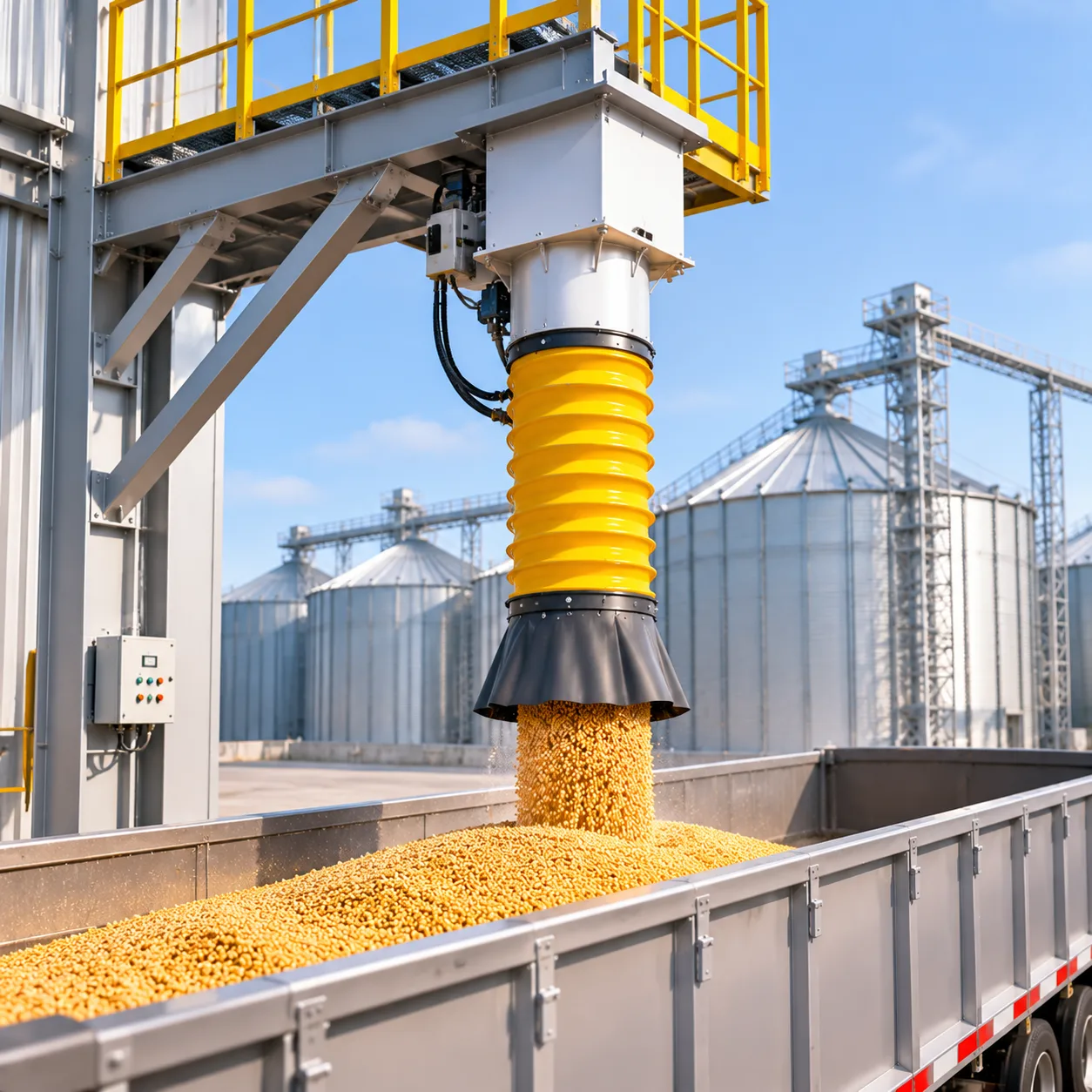
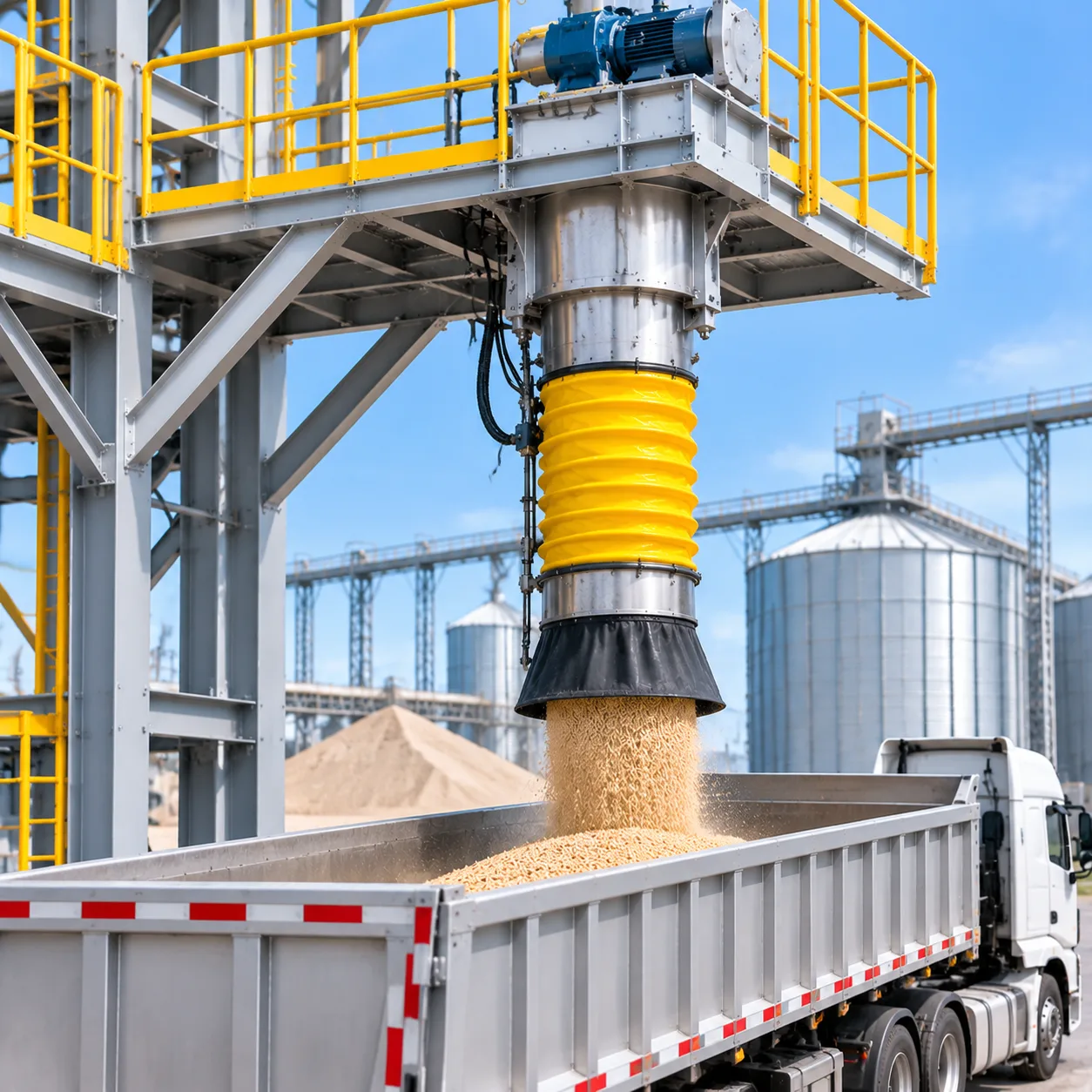
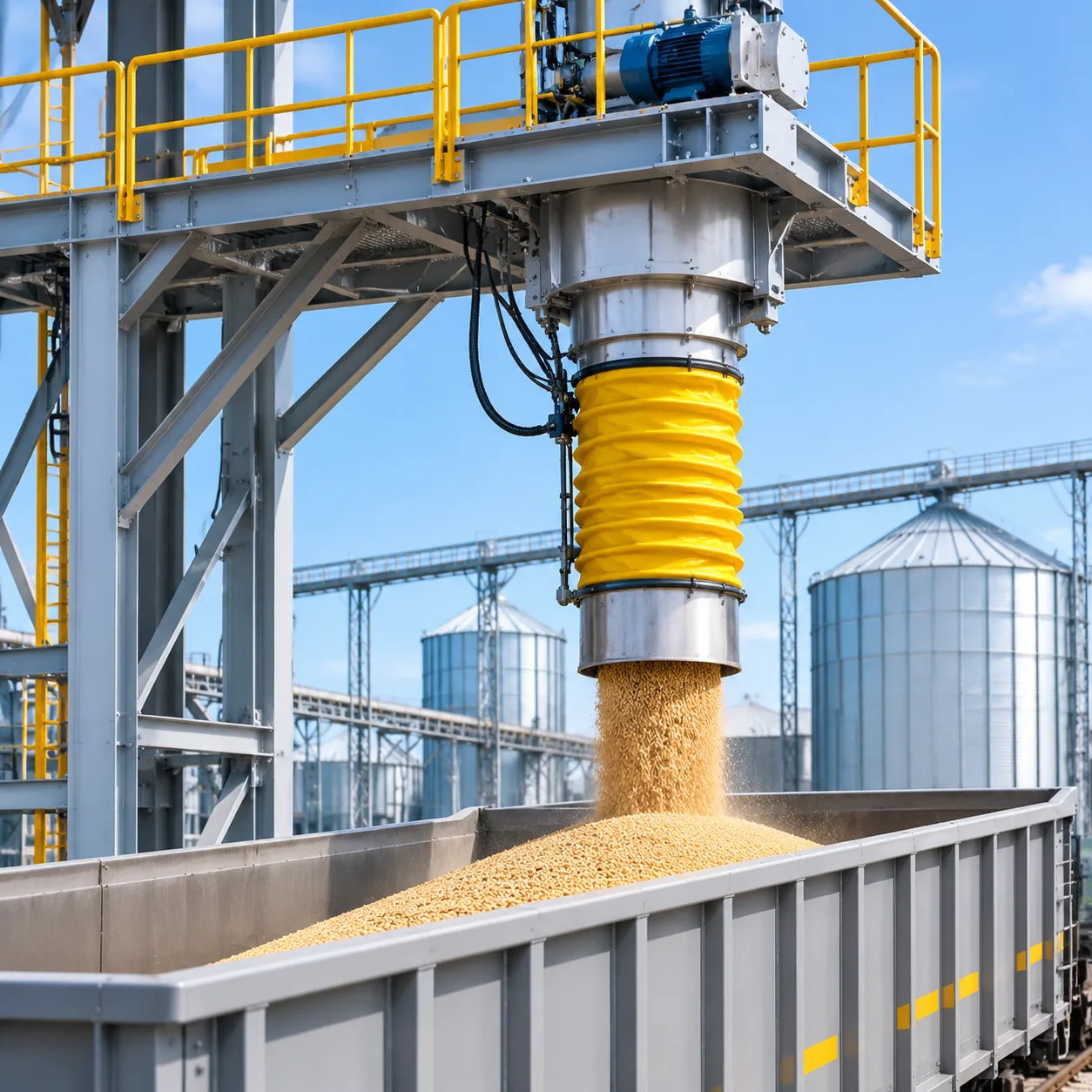
Loading dry bulk materials into railcars presents distinct challenges depending on car design, material behavior, and yard throughput targets. In our field experience, mismatched loading equipment leads directly to fugitive dust plumes, spillage penalties, and unnecessary cycle delays. We engineer each railcar loading spout to isolate the material stream from ambient air, matching the discharge geometry directly to the receiving car.
Choosing between open and enclosed designs dictates your dust collection configuration, mechanical stroke, and terminal safety protocols.
| BULK FEED HOPPER | |
| ↓ | |
| Motorized Cable Winch Drive | |
| ↓ | |
| Telescopic Outer Bellows Annular Dust Evacuation (Negative Pressure CFM) Inner AR Stacking Cones |
|
| ↓ | |
| Open-Top Hopper Car | Enclosed Hatch Hopper |
| • Multi-ply Dust Skirt • Pile-conforming seal • Level tilt switch |
• Resilient Sealing Cone • Mechanical hatch lock • Vent-off backpressure |
Open-Top Rail Loading Spouts with Heavy-Duty Dust-Containment Skirts
Open-top hopper cars require continuous dust containment as materials fall from silo discharge heights into an open bay exposed to crosswinds. When handling coal, grain, aggregates, or ballast, uncontained free-fall generates instant particulate clouds.
-
- Positive Pile Contact: Our open rail loading spout configurations utilize multi-ply, heavy-duty neoprene or silicone rubber skirts that drape directly over the expanding material mound.
- Integral Level Sensing: A tilt switch or rotary paddle rides just below the lower skirt edge. As the pile crests, the sensor signals the motorized hoist to automatically index upward, keeping the discharge point buried without stalling the feed gate.
- Containment Geometry: The skirt acts as a localized vacuum chamber, forcing particulate back into the annular extraction zone between the inner cones and the outer bellow.
Enclosed Railcar Loading Spouts with Automated Hatch-Sealing Cones
Loading fine powders—such as Portland cement, fly ash, hydrated lime, or plastic pellets—into enclosed hopper car hatches demands an airtight mechanical seal to withstand severe displacement backpressure.
-
- Pneumatic Docking Action: We equip enclosed units with heavy-duty cast aluminum or structural steel sealing cones faced with replaceable, closed-cell elastomer gaskets.
- Backpressure Relief: As bulk solids fill the railcar compartment, displaced air is pulled under negative pressure up through the exhaust ducting, preventing blowback at the hatch rim.
- Self-Centering Entry: The tapered cone profile guides itself into standard 20-inch to 30-inch railcar hatches, compensating for minor spotting misalignments without tearing hatch gaskets.
Dual-Purpose Combination Spouts for Mixed Railcar and Tanker Truck Operations
Terminals handling both enclosed railcars and flat-bed open trucks or pneumatic tankers often lose productivity when swapping loading bays. Our dual-purpose telescopic railcar loading spout combines both discharge profiles into a single mechanical head.
| DUAL-PURPOSE RETRACTABLE DISCHARGE HEAD | |
| Outer Telescopic Dust Bellows / AR Wear Cones | |
| ↓ | |
| Tapered Hatch-Sealing Cone (Engages Enclosed Hopper Hatches) |
|
| ↙ ↘ | |
| Retracted Position | Lowered Position |
| Exposes sealing cone for enclosed railcar & tanker truck fill ports. | Extends heavy rubber skirt past cone base for open-top gondolas and open trucks. |
-
- Enclosed Mode: The outer rubber skirt retracts mechanically, exposing the rigid sealing cone to seat directly into tanker or railcar ports.
- Open-Bed Mode: The skirt lowers past the cone base, creating an enclosed settling chamber over open gondolas or flatbeds.
- Drive Efficiency: A single motorized hoist manages vertical travel across both modes, cutting capital equipment costs and footprint constraints in half.
Telescopic Heavy-Duty Chutes Engineered for Extreme Abrasive Bulk Materials
Standard loading chutes fail rapidly under the impact of sharp, high-density bulk solids like clinker, iron ore, granite aggregate, and raw bauxite. We eliminate abrasive failure by separating structural load-bearing from product-contact wear paths.
| Structural Feature | Standard Duty Spout | Our Heavy-Duty Abrasive Chute | Operational Benefit |
|---|---|---|---|
| Inner Cones | 12–14 ga Mild Steel | 1/4" to 3/8" AR400 / AR500 Steel | Resists sliding abrasion and impact puncture |
| Optional Liners | None | Bolt-in Ceramic Tile or Urethane | Multiplies wear life in ultra-abrasive handling |
| Lifting System | 2-Cable Light Winch | 3-Cable Drive with Drive Shaft Sync | Eliminates cone tilting, binding, and cable snags |
| Outer Sleeve | Standard PVC Coated | Heavy Hypalon or Polyurethane Kevlar | Resists puncture from airborne jagged fines |
-
- Overlapping Stacking Cones: Gravity directs product inward away from the outer bellow, while high-velocity exhaust air travels safely in the outer void.
- Modular Component Replacement: Wear sections unbolt independently, allowing your maintenance crews to swap worn impact cones without dropping the entire telescopic assembly from the tower.
Core Mechanical Components of an Industrial Rail Loading Spout
A reliable rail loading spout must endure constant abrasion, high volume drops, and harsh weather conditions without dropping product or spewing dust. In our designs, we isolate the heavy bulk material flow from the dust evacuation path to prevent early wear and costly railcar loading downtime.
Inner Stacking Cones: Abrasion and Impact Protection
The inner cone stack channels the descending bulk stream directly into the railcar, absorbing high-velocity product impact so the outer sleeve never touches moving material. We match cone construction directly to your bulk density and abrasiveness:
-
- AR400 Abrasion-Resistant Steel: Ideal for high-tonnage aggregates, grain, and mineral processing where sliding abrasion ruins standard mild steel within months. Applying a specialized wear-resistant loading spout coating further extends cone life against corrosive or damp materials.
- Molded Polyurethane: Best for fine abrasives, pellets, and friable goods. Polyurethane cushions material impact, reduces noise during high-speed loadouts, and prevents material sticking.
- Ceramic Tile Liners: Built for extreme wear applications such as clinker, metallic ores, and raw sand where even hardened alloys fail rapidly.
Heavy-Duty Outer Dust Bellows and High-Temp Sleeves
The outer telescopic dust bellows create the negative-pressure evacuation chamber between the inner cones and the exterior environment. We engineer these sleeves to withstand repeated cycling, heavy UV exposure, and internal negative air pressure without collapsing:
-
- Neoprene & Hypalon-Coated Polyester: Tough, all-weather fabrics engineered for outdoor rail terminals handling standard non-abrasive chemicals and dry bulk.
- Silicone-Coated Fiberglass: Engineered for fly ash, hot cement, and chemical loadouts operating up to continuous high temperatures.
- Static-Dissipative Fabrics: Critical for explosive grain dust and combustible synthetic powders to eliminate spark generation hazards.
Three-Cable Motorized Hoist and Fail-Safe Braking
Spout balance is essential when extending into deep hopper car compartments. Dual-cable drives frequently bind or tilt; we utilize a heavy-duty three-cable motorized hoist drive assembly to ensure perfectly vertical, bind-free retraction and extension.
-
- Precision Machined Cable Drums: Keep aircraft-grade steel lift cables winding evenly, preventing slack cable binds.
- Mechanical Fail-Safe Brake Motors: Lock the railcar loading spout securely in position if terminal power drops unexpectedly, preventing chute falls and railcar damage.
- Upper and Lower Rotary Limit Switches: Define precise home and maximum extension points to stop over-travel before mechanical binding occurs.
Precision Material Level Sensors
Automating the fill cycle keeps operators off top-of-car walkways and eliminates chute plugging. Our industrial rail loading spout assemblies integrate direct level sensing at the discharge cone:
| Sensor Type | Best Product Applications | Functional Advantage |
|---|---|---|
| Tilt Switch | Grains, dry aggregates, hard pellets | Simple, rugged mechanical trigger; tilts when the bulk pile contacts the probe to signal the hoist to raise. |
| Capacitance Probe | Fine powders, fly ash, aerated cement | Non-mechanical detection that senses dielectric shifts without false-tripping from airborne dust. |
| Rotary Paddle | Coarse bulk materials and plastics | Positive resistance shut-off that ignores ambient dust clouds inside the railcar compartment. |
Dust Collection and Environmental Control for Rail Loading Operations
Integrated Cartridge Filter Spouts vs. Remote Dust Collection
Choosing between onboard filtration and a centralized extraction line comes down to terminal layout, headroom, and product reuse requirements:
-
- Integrated Pulse-Jet Cartridge Spouts: These units incorporate top-mounted cartridge dust collectors right on the spout frame. Filtered fines are pulsed directly back into the railcar, eliminating waste, separate discharge hoppers, and ductwork runs.
- Remote Dust Collection Tie-Ins: For high-temperature materials or massive air-volume requirements, ducting the spout to centralized baghouse dust collectors or pulse-jet systems is preferred. This setup decreases the physical weight suspended over the rail siding and simplifies multi-bay maintenance.
Calculating Negative Pressure CFM to Prevent Product Loss
Achieving effective dust capture without vacuuming good sellable product into the filters depends entirely on balancing volumetric airflow. We calculate negative pressure air volume using this baseline criteria:
| Parameter | Operational Rule of Thumb |
|---|---|
| Material Displacement | Match 1 CFM of exhaust per 1 CFM of displaced solid volume entering the car. |
| Air Entrainment Allowance | Add 30% to 50% extra CFM to counter the draft induced by falling bulk stream. |
| Annular Velocity | Maintain 150 to 250 FPM through the outer telescopic dust bellows to prevent fallout. |
| Capture Velocity at Hatch | Maintain minimum 100 FPM across open or semi-sealed inspection areas. |
Too little suction allows dust clouds to escape the rail hatch. Too much negative pressure draws usable bulk grain, cement, or mineral fines out of the flow stream, creating unnecessary filter cake buildup.
Meeting EPA, OSHA, and MSHA Compliance Standards
Rail transfer points face tight scrutiny under EPA Title V limits, OSHA combustible dust guidelines, and MSHA air quality rules. Our rail loading spout installations eliminate compliance headaches through specific design safeguards:
-
- Combustible Dust Mitigation: Explosion-vented filter housings and static-grounded bellows protect against deflagration during grain, coal, or resin loading.
- Visible Emission Standards: Continuous negative draft keeps opacity well below standard Method 9 thresholds during high-speed loading.
- Worker Exposure Thresholds: Sealed loading keeps respirable silica and toxic particulate counts well under OSHA PEL limits on the loading deck.
Inflatable Hatch-Sealing Collars for Positive Pressure Mitigation
For enclosed hopper cars, handling positive pressure build-up inside the vessel is critical. Standard cones rely strictly on downward mechanical pressure, which can gap when cars rock under load.
We utilize pneumatic inflatable hatch collars fitted with heavy-duty elastomer bladders. Once the spout enters the loading hatch, the collar inflates against the hatch rim, creating an airtight, positive-pressure barrier. Displaced air and dust are routed exclusively up through the spout's exhaust path, completely sealing the transfer point against fugitive leaks.
Railcar Loading Spout Performance Across Dry Bulk Industries
Agricultural Bulk Handling: Grains, Corn, Soybeans, and Animal Feed Pellets
Moving seasonal grain requires high volumetric flow rates without degrading product quality or triggering explosive dust clouds.
-
- Gentle Material Handling: Preserves kernel integrity and prevents cracked corn or damaged seed hulls during gravity drop.
- Explosion Prevention: Integrated dust containment prevents explosive airborne starch dust, meeting strict grain terminal safety requirements.
- Sanitary Construction: Food-grade rubber compounds and smooth chute interiors prevent product hang-up, mold development, and cross-contamination between crop batches.
Mineral and Construction Loadout: Cement, Fly Ash, Sand, and Limestone
Fine powders fluidize easily, while construction sands generate rapid abrasive wear. Operating a heavy-duty rail loading spout in this sector demands airtight seals and aggressive venting to stop fugitive plumes.
-
- Fluidized Powder Control: Paired directly with cement and fly ash conveying systems to handle aerated fines without blowout at the railcar hatch.
- Positive Hatch Sealing: Durable resilient cones compress tight to the car opening to withstand loading pressures.
- High-Throughput Filling: Handles up to 400–800 TPH of dense material, drastically shortening railcar staging times.
Chemicals and Specialty Materials: Fertilizers, Plastic Resins, and Soda Ash
Chemical and resin distribution requires strict moisture protection and zero particulate contamination.
-
- Corrosion Resistance: Stainless steel inner cones and specialized sleeve fabrics withstand corrosive potash and chemical fertilizers.
- Anti-Contamination Barriers: Dust-tight closures isolate high-purity plastic pellets from ambient humidity, road dust, and weather.
- Automated Flow Shut-off: High-accuracy sensors communicate with feeding slide gates to stop product line overfills before spillage occurs on car roofs.
Extreme Abrasives: Coal, Bauxite, Raw Aggregates, and Metallic Ores
Loading coarse, heavy ores will destroy standard chutes in a matter of weeks. We equip our heavy-duty chutes with replaceable wear components to absorb continuous physical punishment.
-
- Wear-Resistant Liners: Hardened AR400, AR500, or ceramic-lined nesting cones withstand extreme gouging and impact.
- Reinforced Lifting Cables: Heavy multi-cable drive systems support massive rock volume without chute deflection.
- Open Hopper Loading Skirts: Heavy-duty rubber drop skirts contain heavy dust clouds inside open-top gondolas and hopper cars without slowing discharge speeds.
| Material Group | Typical Bulk Density | Primary Operational Challenge | Recommended Spout Configuration |
|---|---|---|---|
| Grains & Feeds | 40–50 lbs/ft³ | Combustible dust, kernel breakage | High-capacity food-grade sleeve with auto-level tilt switch |
| Cement & Fly Ash | 55–95 lbs/ft³ | Fluidized product blowing past seals | Enclosed cone with dedicated dust return and hatch seal |
| Plastics & Chemicals | 30–65 lbs/ft³ | Moisture sensitivity, contamination | 304/316 Stainless steel product path with sealed bellows |
| Ores & Minerals | 90–140 lbs/ft³ | Severe impact and chute liner abrasion | AR400 telescopic inner cones with heavy external drive hoist |
Whether operating an open-top loadout or integrating sealed chutes into an automated bulk loading dispatch system, matching the chute's mechanical build to the exact material profile prevents costly downtime, maintenance rebuilds, and terminal dust citations.
Optimizing Rail Terminal Efficiency with Positioners and Automation
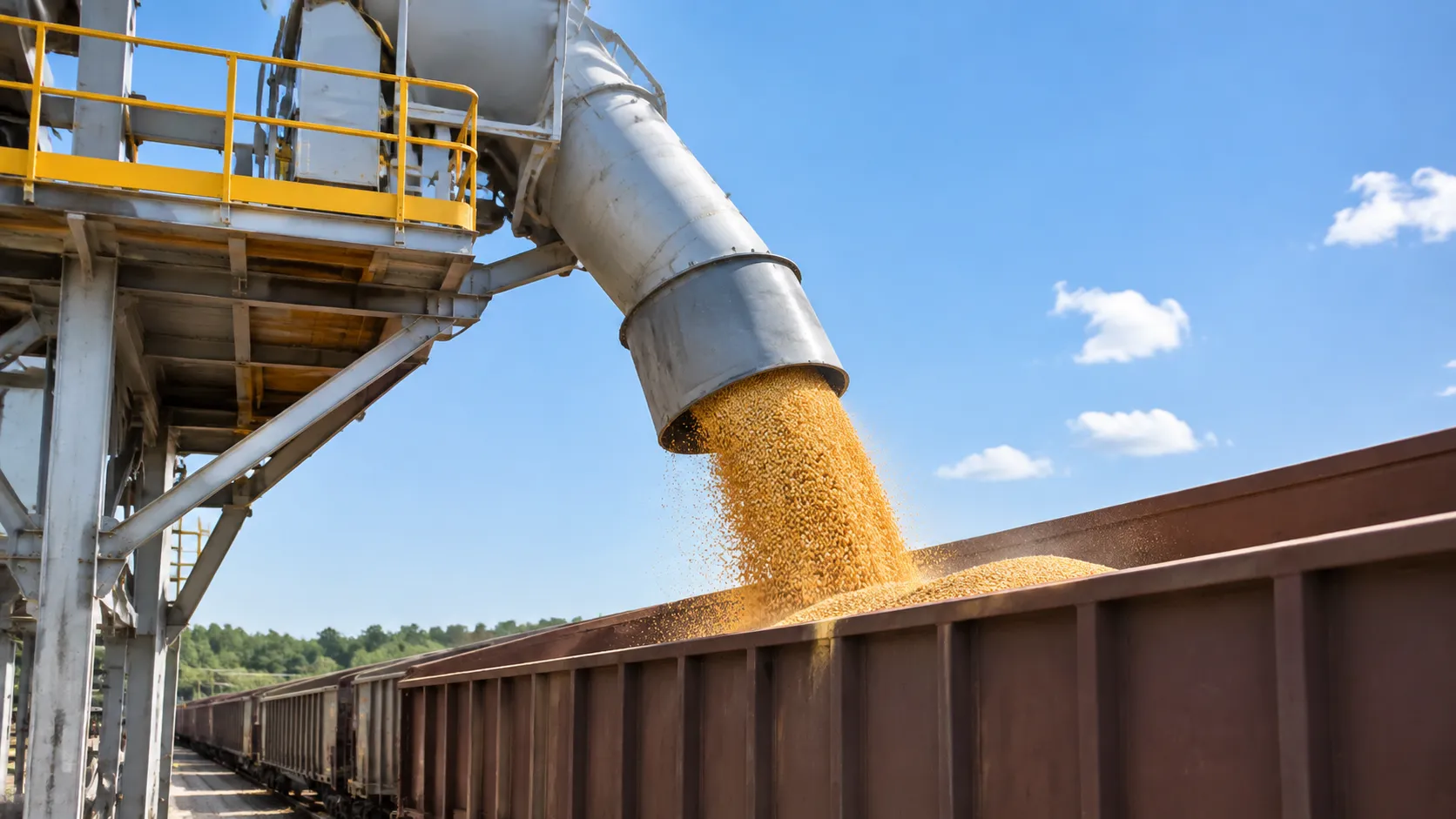
Misaligned railcars and manual chute repositioning stall terminal throughput. In our experience, pairing a heavy-duty railcar loading spout with motorized positioners and smart automation cuts railcar turnaround times, eliminates material spillage, and protects operators from climbing onto car tops.
Single-Axis and Dual-Axis Motorized Railcar Spout Positioners
Spotting a multi-compartment hopper car directly beneath a fixed discharge drop point burns switch engine fuel and operational hours. Spout positioners eliminate the need to inch 100-ton cars forward and backward.
-
- Single-Axis Positioners: Deliver motorized linear travel (typically 4 to 12 feet) along or across the track centerline to correct front-to-back spotting variance.
- Dual-Axis Positioners: Combine bridge and carriage movement (X-Y plane travel) to quickly address cross-track misalignment and variable hatch layouts without repositioning the train string.
- Heavy-Duty Construction: Built with low-headroom structural steel tracks, rack-and-pinion drives, and sealed-bearing rollers to handle the weight of integrated dust filtration units.
PLC-Integrated Level Tracking and Self-Raising Fill Cycles
Relying on spotters to monitor hatch fill levels invites product choke-offs, crushed discharge skirts, and bellow blowouts. Automated rail loading spout automation ties hoist motors directly to terminal PLCs.
-
- Continuous Level Detection: High-reliability tilt switches or rotating paddle probes track product buildup at the spout discharge cone in real time.
- Automatic Chute Retraction: As the dry bulk angle of repose climbs, the hoist motor automatically steps upward, maintaining the optimal seal distance without starving the negative-pressure dust draft.
- Automated Full-Stop Cycle: The terminal control system registers the high-high level signal, closes the feed gate instantly, and executes a timed dust evacuation purge before retracting the chute to the park height.
Emergency Shut-Off Slide Gates and Flow Regulation
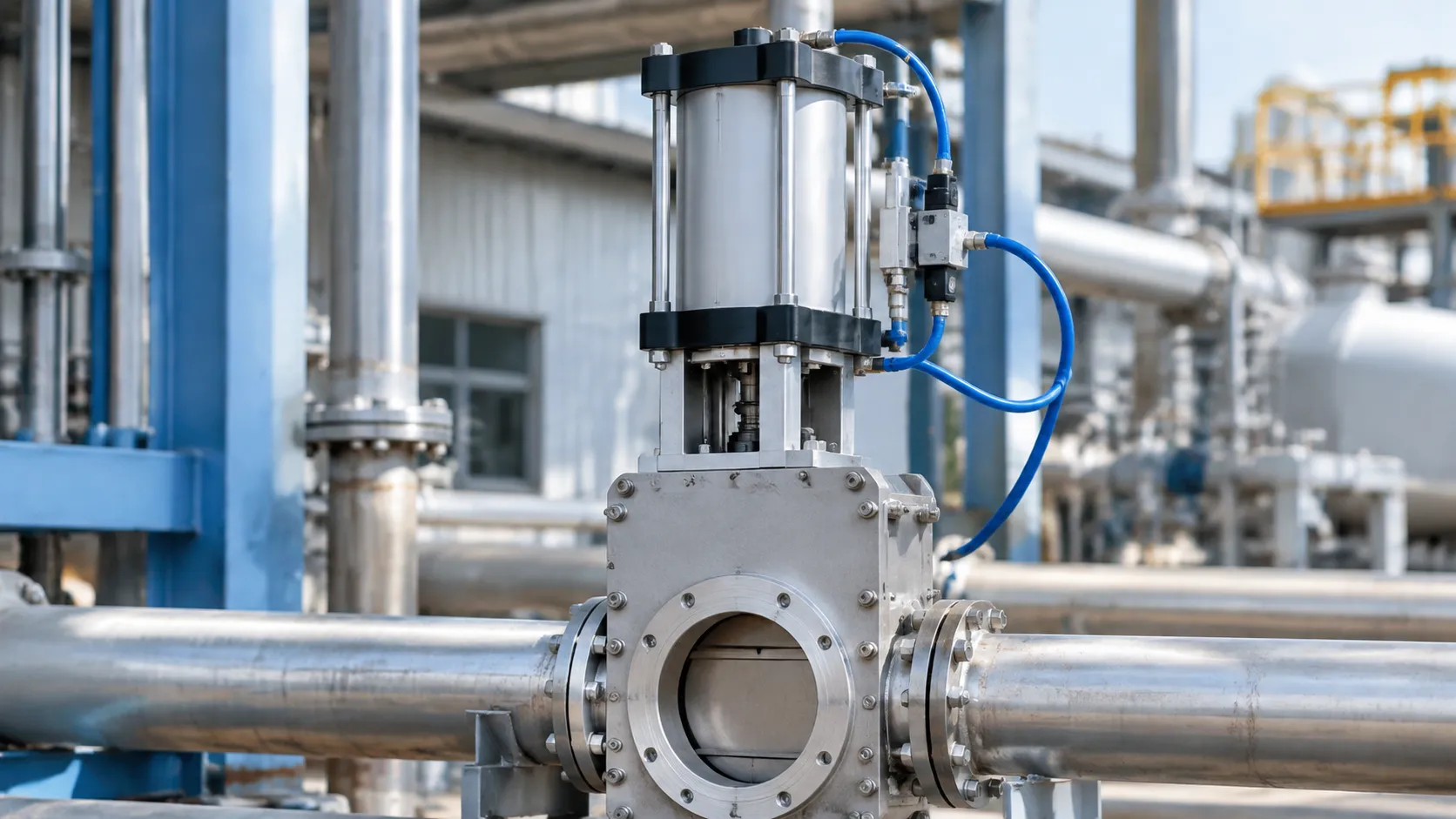
Fast, clean product shut-off is critical when swapping hatches or hitting maximum axle weights. We install pneumatic or electric slide gate valves directly above the telescopic spout inlet for zero-leakage isolation.
Coupled with engineered valves and flow control packages, terminal operators can throttle high-velocity product streams, transition cleanly between compartments, and immediately stop gravity feed in the event of an emergency trip or power interruption.
Minimizing Spotting Times and Terminal Bottlenecks
| Loadout Step | Manual Yard Operation | Automated Railcar Loading Spout Setup |
|---|---|---|
| Railcar Alignment | Shunting train back and forth to hit hatch targets | Motorized positioner traverses to the hatch opening |
| Chute Deployment | Manual pendant jogging; risk of hatch damage | One-touch auto-lower with automatic hatch sealing |
| Material Monitoring | Visual check through airborne dust clouds | Probe-guided PLC auto-raise level tracking |
| Flow Termination | Lagged manual gate closure with frequent overflows | Instant knife gate cutoff tied to scale systems |
| Turnaround Time | 35 to 50 minutes per railcar | Under 15 minutes per railcar |
How to Select and Size the Right Railcar Loading Spout
Sizing an industrial railcar loading spout demands exact math. If the chute diameter is too narrow, material backs up into your upstream conveyors; if the vertical stroke is off, you risk ripping off equipment on moving railcars or creating severe dust plumes. We focus on four critical engineering metrics to ensure the right fit for your loadout terminal.
Volumetric Flow Rate (CFH) and Tons Per Hour (TPH)
Rail loadout terminals operate on tight switching schedules. We size chute inner diameters based on peak volumetric demand rather than average speed, ensuring that high-capacity gravity feeds do not choke the intake cones.
To calculate the required volumetric capacity:
CFH = (TPH × 2,000) / Bulk Density (lbs/cu ft)
| Target Capacity (TPH) | Typical Bulk Density | Required Chute Diameter | Airflow Exhaust Rating |
|---|---|---|---|
| 100 – 250 TPH | 50 – 100 lbs/cu ft | 12" to 16" (300–400 mm) | 900 – 1,500 CFM |
| 250 – 500 TPH | 35 – 75 lbs/cu ft | 18" to 22" (450–550 mm) | 1,800 – 2,800 CFM |
| 500 – 1,000+ TPH | 45 – 120 lbs/cu ft | 24" to 30" (600–760 mm) | 3,000 – 4,500 CFM |
For sites handling multiple loading points, our heavy-duty telescopic loading spouts accommodate high-volume continuous flow across varying hatch configurations.
Determining Vertical Stroke: Retracted Height vs. Extended Reach
Getting your vertical elevations right prevents catastrophic rail yard collisions and guarantees an airtight seal:
-
- Clearance Line (Retracted Height): The distance from the top of the railhead to the lowest point of the fully retracted discharge cone must clear standard rail clearance envelopes (typically a minimum of 17 to 22 feet above the rail, depending on local track regulations and locomotive heights).
- Working Position (Extended Reach): The spout must extend down into the deepest trough hatch or open-top hopper car. We design for a minimum of 6 to 12 inches of over-travel past the hatch rim to account for car suspension settle as the load weight increases.
- Telescopic Ratio: Standard fabric bellow and stacking cone designs offer roughly a 3:1 to 4:1 extension-to-retraction ratio. High-clearance bays requiring 18 feet of stroke demand multi-stage nested cone configurations.
Product Characteristics: Density, Particle Size, and Flowability
Bulk solids behave differently under gravity discharge. We tailor the inner chute geometry and wear liners to three primary material behaviors:
-
- Bulk Density & Aeration: Light, aerated powders like fly ash or raw cement fluidize rapidly, demanding larger outer dust annuluses to prevent discharge backpressure.
- Particle Abrasion & Sharpness: Heavy, jagged materials such as silica sand, bauxite, and clinker require drop-in AR400, AR500, or ceramic-lined inner cones to stop high-velocity wear through the main chute walls.
- Flowability & Angle of Repose: Sluggish bulk materials (e.g., wet grain byproducts or meals) require steep interior discharge cones (60° minimum slope) and slick liner materials like ultra-high-molecular-weight polyethylene (UHMW-PE) to eliminate bridging.
Hazardous Environment Ratings: Class II, Div 1 and Div 2
Dry bulk loadout frequently generates combustible dust clouds. Installing an unrated rail loading spout in these terminals violates safety regulations and introduces severe flash-fire risks. We engineer each electrical drive and sensor package to meet stringent environmental classifications:
-
- Class II, Division 1: Mandated for enclosed loading bays where combustible grain dust, coal dust, or fine chemical powders are continuously suspended in air during normal operations. Requires NEMA 7/9 explosion-proof motor enclosures, intrinsically safe level probes, and continuous copper static bonding straps across every bellow joint.
- Class II, Division 2: Applied to areas where combustible dust is present only under abnormal operating or mechanical failure conditions. Outfitted with dust-ignition-proof motors, sealed non-sparking junction boxes, and rated proximity limit switches.
- Static Dissipation: Polyurethane-coated bellows and non-conductive sleeves must incorporate integrated braided stainless ground lines at every cone connection to drain static charges directly to earth ground.
Railcar Loading Spout Inspection and Maintenance Practices
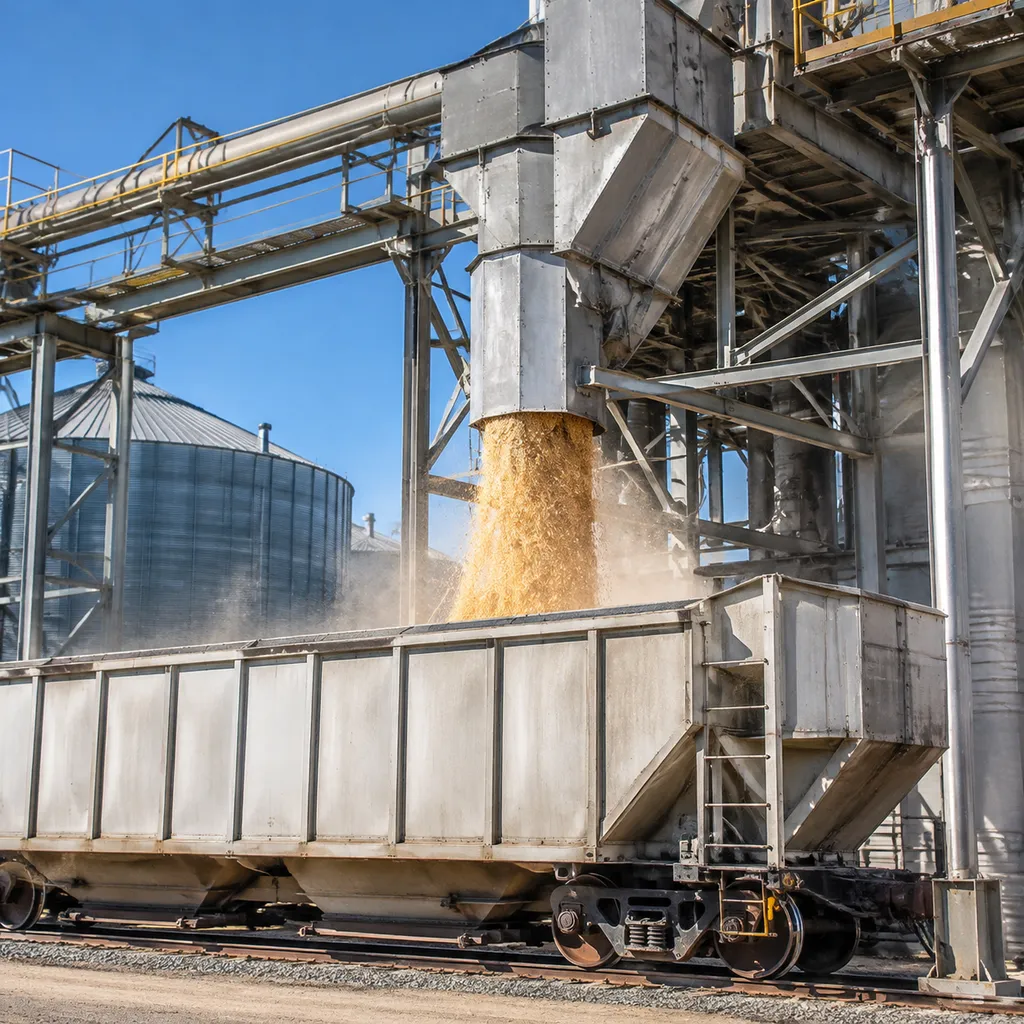
Routine maintenance keeps your rail loading operations running smoothly and prevents sudden equipment failures that halt railhead throughput. In our field experience, adhering to a proactive maintenance schedule on your railcar loading spout keeps fugitive dust under control, prevents costly product spills, and eliminates unsafe operating conditions.
Cable and Pulley Wear Protocols to Prevent Chute Drops
A chute drop is an absolute worst-case scenario at the rail terminal. We engineer our lifting drives with multi-cable redundancy, but routine cable inspections remain critical:
-
- Inspect Wire Ropes Weekly: Check for fraying, bird-caging, kinks, and broken strands along the entire working length of each lifting cable.
- Examine Sheaves and Pulleys: Inspect pulley grooves for uneven wear, burrs, or wobble. A worn sheave pinches the cable and accelerates fatigue.
- Check Cable Clamps and Tension: Confirm all wire rope clips and terminations are torqued to specification. Uneven cable tension causes the rail loading spout to retract at an angle, binding the telescoping mechanism.
- Lubrication: Clean and lubricate cables with a non-tacky, penetrating wire rope lubricant that repels dry bulk dust build-up.
Monitoring Sleeve Abrasion and Inner Cone Wall Thinning
High-volume bulk handling takes a direct toll on internal contact components and outer flexible sleeves.
| Component | Inspection Frequency | Failure Sign | Corrective Action |
|---|---|---|---|
| Inner Abrasion Cones | Monthly | Localized thinning under 3/16", cracking, missing liners | Rotate cones 180° to equalize wear patterns, or replace worn stacking sections. |
| Outer Dust Bellows | Bi-weekly | Pinholes, flex fatigue tears, seam separation | Patch small punctures immediately; replace entire sleeve if fabric loses tension. |
| Hatch Sealing Ring | Weekly | Worn neoprene gasket, structural deformation | Re-seat or replace sealing face to ensure negative pressure retention. |
To stop abrasive wear before a blowout occurs, we measure the shell thickness of inner cones using ultrasonic thickness gauges during planned terminal shutdowns.
Pulse-Jet Filter Maintenance and Diaphragm Valve Checks
Integrated filtration systems keep your loadout dust-free. If negative pressure drops, dust escapes immediately into the operator bay.
-
- Pulse Diaphragm Valves: Listen for crisp, distinct pulsing. A sluggish pulse or constant air hissing indicates a ruptured diaphragm or a failed pilot solenoid valve.
- Differential Pressure (DP) Tracking: Monitor the Magnehelic gauge or transmitter. A high DP reading indicates blinded filter media, while an abrupt drop signals torn media or an unseated seal.
- Filter Bag and Cage Audits: Inspect internal dust collector filter bags for product caking, structural blinding, and physical wear. Ensure mating filter cages remain straight, rigid, and rust-free to preserve proper filter alignment and pulse efficiency.
- Compressed Air Supply: Verify your plant air supply delivers clean, dry compressed air between 80 to 90 PSI to prevent moisture from agglomerating dust inside the filter housing.
Drive Motor, Gearbox, and Limit Switch Calibration
Accurate travel limits prevent the hoist drive from tearing bellows or crushing railcar hatches.
-
- Rotary Limit Switches: Test and calibrate upper, lower, and slack-cable safety switches monthly. The upper limit must engage before the inner cones bottom out against the headbox. The lower limit must halt downward travel before the cables unspool completely.
- Gearbox and Brake Checks: Verify oil levels and check for seal leaks on the hoist drive gearbox. Test the fail-safe motor brake holding capacity under full simulated load to prevent downward drift when suspended.
- Level Sensor Testing: Clean material buildup from tilt switches, capacitive probes, or tuning forks at the discharge cone. A blinded sensor fails to detect the rising material pile, risking catastrophic spout plugging and chute back-ups.
Frequently Asked Questions About Railcar Loading Spouts
What is the difference between a truck loading spout and a railcar loading spout?
While both systems handle dry bulk materials, the key differences lie in vertical travel, capacity, and mechanical duty ratings. Railcars require significantly longer vertical strokes and heavier structural components to withstand higher volumetric rates.
| Operational Factor | Standard Truck Loading Spout | Industrial Railcar Loading Spout |
|---|---|---|
| Vertical Travel Stroke | 1.2 m to 2.5 m (4 to 8 ft) | 3.0 m to 6.5+ m (10 to 22+ ft) |
| Throughput Capacity | Typically 100 to 300 TPH | 300 to 1,000+ TPH |
| Discharge Diameter | 250 mm to 350 mm | 350 mm to 600+ mm |
| Structural Design | Light to medium duty | Heavy-duty reinforced hoisting cables and drives |
Rail operations demand heavy-duty bulk loading equipment engineered to withstand continuous cycle times and variable hopper car hatch designs.
How much dust extraction airflow (CFM) is required for efficient rail loading?
Airflow requirements depend on the material feed rate and product characteristics. In our experience, calculating the right negative pressure CFM involves combining:
-
- Displaced air volume: The physical volume of air displaced by incoming solid material (approximately 1 CFM per TPH depending on bulk density).
- Entrained air: Air dragged into the hatch through the stream of falling dry bulk.
- Negative draft safety margin: Additional 20% to 30% velocity over empty car drafts to prevent airborne dust escape.
For standard non-aerated granules, 1,200 to 1,800 CFM is standard. For aerated fine powders (like cement, fly ash, or alumina), terminals typically require 2,000 to 3,500 CFM connected to central industrial dust collection equipment to achieve absolute dust-free containment.
Can a single rail loading spout handle both fine powders and coarse granules?
Yes, provided the unit uses an inner cone stacking design with an independent outer dust sleeve.
-
- Inner Cones: Guide dense, abrasive materials down the center, protecting the outer fabric from mechanical impact.
- Outer Annulus: Dedicated exclusively to dust evacuation under continuous negative pressure.
When handling both abrasives (such as clinker or aggregates) and fine powders within the same rail loading spout, our engineers recommend AR400 or ceramic-lined inner cones paired with a high-strength elastomer bellow.
How do automated auto-raise level sensors prevent spout clogging?
Auto-raise systems rely on discharge-mounted sensors to track the rising material pile continuously:
-
- Detection: Tilt switches, capacitance probes, or rotary paddles at the lower cone register contact as the hopper fills.
- PLC Trigger: The sensor sends an immediate contact signal to the automated control panel.
- Incremental Hoisting: The drive motor hoists the spout upward in controlled, pre-set increments, keeping the discharge opening just above the material head.
This automation prevents the discharge chute from backing up, protects the inner cones from burying, and ensures dust extraction ports remain clear during fast fill cycles.
What maintenance schedule should we follow to prevent bellow tearing?
Bellow tears usually stem from incorrect hoist limits, loose cable tracking, or material buildup pinch points. We follow this proactive service routine:
-
- Weekly: Inspect wire ropes for fraying, uneven stretch, or bird-caging. Clear caked material out of bellow folds.
- Monthly: Test upper and lower rotary limit switches. Verify auto-raise probe sensitivity and check winch gearbox lubricants.
- Quarterly: Check inner nesting cones for wall thinning or misalignment that could pinch the outer sleeve during full retraction.
- Semi-Annually: Inspect drive motor brake linings and replace worn suspension pulleys to maintain balanced, straight vertical travel.