Formula details
Product Details
Overview
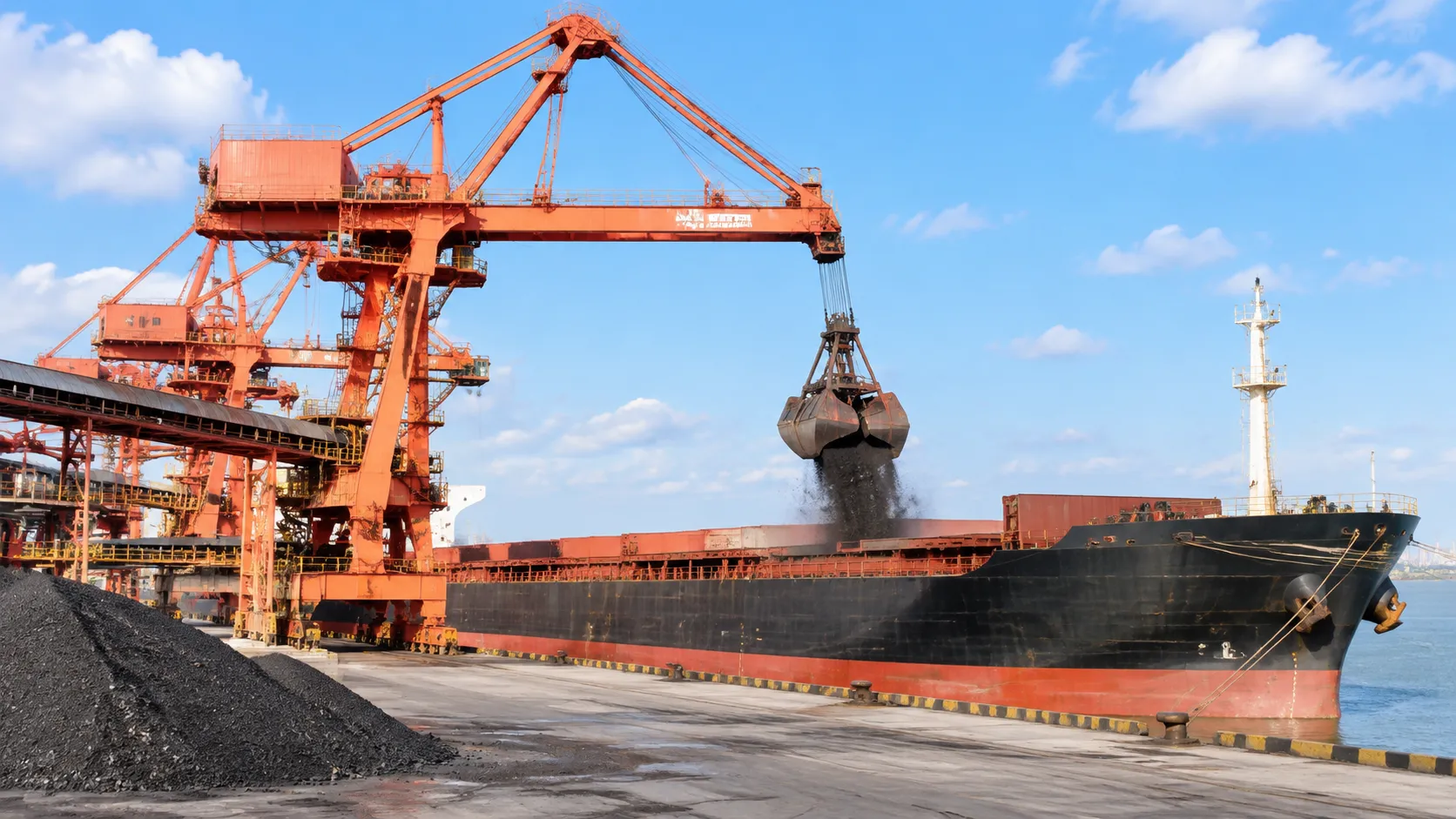
Bulk Material Ship Loader Overview
As modern port terminals face stricter environmental policies, larger vessel calls, and tighter laytime windows, continuous, automated shiploading has replaced slow, discontinuous grab or crane methods. Our systems provide constant transfer rates, precise trimming, and full hold coverage for global river jetties and deep-sea marine ports.
Purpose-Built for Marine and River Terminals
A high-performance dry bulk ship loader must adapt to dynamic water levels, shifting vessel drafts, and harsh waterfront conditions. We build our equipment to handle high-volume bulk commodities across diverse terminal footprints:
-
- Inland River Ports: Optimized for rapid barge loading with steep luffing angles to handle severe seasonal water-level variations.
- Deep-Sea Terminals: Built with extended boom reaches to clear the high freeboards and wide beams of Handymax, Panamax, and Capesize bulk carriers.
- Multi-Commodity Berths: Engineered to transfer materials ranging from free-flowing grain and fertilizers to heavy, abrasive iron ore and clinker without structural deformation or product contamination.
Operational Economics: Slashing Demurrage Costs
Vessel port turnaround time directly dictates berth profitability. Unexpected downtime, hatch repositioning delays, and low transfer capacities result in severe demurrage penalties from vessel charterers.
Our bulk ship loader solutions eliminate these bottlenecks through high continuous throughput and flexible boom kinematics:
| Operational Metric | Standard Crane/Grab Loading | Our Continuous Bulk Ship Loader |
|---|---|---|
| Average Transfer Rate | Discontinuous (300–800 TPH) | Continuous (1,000–8,000+ TPH) |
| Hatch Repositioning Time | 20–40 minutes per move | Seamless via slewing, luffing, and shuttling |
| Hold Trimming Precision | Manual leveling required | Automated via 360-degree rotating spouts |
| Laytime Utilization | Low efficiency; frequent stops | High continuous loading rate; zero demurrage |
By optimizing hatch-to-hatch transitions and sustaining rated throughput, our equipment cuts vessel loading times by up to 50%, maximizing berth throughput and keeping terminal operators ahead of contractual deadlines.
Structural Integrity for Severe Marine Environments
Offshore jetties and exposed coastal wharves subject handling equipment to salt-spray corrosion, violent wind gusts, and continuous mechanical vibration. Every dry bulk ship loader we fabricate complies with strict international offshore structural design codes:
-
- Design Standards: Fully engineered in compliance with FEM 1.001 and ISO 5049-1 rules for bulk material handling appliances.
- Wind Load Ratings: Operational stability in wind speeds up to 20 m/s (approx. 45 mph); safe stowed storm survival ratings engineered beyond 55 m/s (123 mph) utilizing automated rail clamps and mechanical tie-down anchors.
- Steel Construction: High-tensile structural steel profiles (S355J2 / Q355D) stress-relieved at critical boom pivots, mast hinges, and gantry joints.
- Corrosion Protection: Shot-blasted to Sa 2.5 standard and protected by multi-tier marine epoxy and polyurethane systems rated for ISO 12944 C5-M (Very High Marine) atmospheric corrosivity.
Dry Bulk Ship Loader Configurations
Every berth presents unique jetty dimensions, civil load ratings, and vessel clearance profiles. We engineer our bulk ship loaders across three primary structural configurations to match your quayside footprint, throughput targets, and vessel sizes.
Traveling Rail-Mounted Ship Loaders
Rail-mounted units serve as the backbone for high-volume, dedicated dry bulk terminals handling continuous export campaigns.
-
- Linear Berth Coverage: Travels smoothly along quayside rails to cover the entire length of the vessel without repositioning the ship.
- Massive Throughput: Designed to support high-capacity conveyor belts handling up to 10,000+ metric tons per hour (tph).
- Civil Integration: Requires a dedicated jetty structure with embedded rails, tie-downs, and storm anchor points to withstand severe offshore winds.
Radial Quadrant and Stationary Pivot Loaders
For narrow jetties, finger piers, or dolphin berths where rail installation is cost-prohibitive, radial quadrant loaders deliver maximum reach from a fixed anchor point.
-
- Compact Quayside Footprint: The loader pivots around a stationary feed point and sweeps along a single curved radial rail.
- Reduced Civil Works: Eliminates long-run jetty reinforcement and reduces quayside concrete infrastructure costs.
- Extended Boom Geometry: Uses long-reach slewing and shuttling booms to access all cargo holds on Handysize, Panamax, and Capesize vessels from minimal pier infrastructure.
Mobile Rubber-Tyred Bulk Ship Loaders
When multi-purpose berths cannot dedicate permanent quay space to bulk handling, a mobile dry bulk ship loader provides instant flexibility.
-
- Quayside Mobility: Self-propelled multi-wheel diesel-hydraulic or electric drive units with integrated all-wheel crab steering.
- Rapid Relocation: Clear the berth in minutes after loading to allow container ships, general cargo, or tankers to dock.
- Direct Feed Options: Accepts cargo directly from quayside dump trucks, mobile hoppers, or tripper conveyors without permanent civil mounts.
| Parameter | Rail-Mounted Traveling | Radial Quadrant | Mobile Rubber-Tyred |
|---|---|---|---|
| Typical Loading Rates | 2,000 – 10,000+ tph | 1,000 – 5,000 tph | 500 – 3,000 tph |
| Civil Infrastructure Need | High (full-length crane rails) | Moderate (single pivot + arc rail) | Low (flat concrete quay slab) |
| Berth Flexibility | Dedicated bulk berths only | Semi-dedicated piers/dolphins | Multi-purpose berths |
| Vessel Relocation Need | None (loader covers all holds) | Minimal (via boom shuttle/pivot) | None (unit drives hold to hold) |
| Primary Power Supply | High-voltage cable reel / busbar | High-voltage cable / hardwired | Onboard diesel generator / trailing cable |
Bulk Ship Loader Technical Specifications
Continuous Loading Capacity and Vessel Size Coverage
Our dry bulk ship loader equipment covers the full spectrum of merchant vessels, delivering uninterrupted flow rates matched to your berth intake conveyor.
-
- Barge and Coaster Berth Loaders: 500 to 1,500 TPH for river barges and coastal vessels up to 15,000 DWT.
- Handysize to Ultramax Systems: 1,500 to 3,500 TPH tailored for mid-range general bulk carriers up to 65,000 DWT.
- Capesize and Panamax Loaders: High-throughput units delivering 4,000 to 8,000+ TPH for large-scale ore, coal, and mineral export terminals up to 250,000 DWT.
| Parameter | Handymax / Supramax Class | Panamax Class | Capesize Class |
|---|---|---|---|
| Nominal Capacity | 1,500 – 3,000 TPH | 3,000 – 5,000 TPH | 5,000 – 8,000+ TPH |
| Max Outreach from Rail | 22 m – 30 m | 32 m – 42 m | 45 m – 55 m |
| Luffing Range | -12° to +18° | -14° to +20° | -15° to +22° |
| Slewing Arc | ±90° to ±110° | ±100° to ±120° | ±120° (Quadrant/Stationary) |
| Installed Power | 250 – 500 kW | 600 – 1,100 kW | 1,200 – 2,200 kW |
Boom Reach, Luffing Angles, and Slewing Limits
A reliable bulk ship loader requires an operating geometry that compensates for extreme tidal swings, vessel deballasting speeds, and hatch dimensions.
-
- Outreach Beyond Jetty Line: Main conveyor booms extend up to 55 meters from the water-side rail, clearing high-freeboard vessels even at extreme low tides.
- Dual-Cylinder Luffing Action: Controlled vertical movement from -15° below horizontal up to +22° for deep hold penetration and clearance of deck coamings.
- Precision Slewing Limits: Heavy-duty external slewing bearings allow continuous horizontal rotation across defined quadrant arcs or open quayside zones to service adjacent holds with minimal long-travel repositioning.
Drive Systems and Electrical Automation Ratings
We engineer our drive packages to handle harsh marine environments while syncing cleanly with the shore-side bulk loading dispatch system for automated feed regulation.
-
- Conveyor Drives: High-efficiency medium or low-voltage motors paired with bevel-helical speed reducers, fluid couplings, or variable frequency drives (VFD) to manage starting torque under full load.
- Travel and Slewing Motors: Inverter-controlled travel bogies with integrated storm brakes, fail-safe thruster brakes, and rail clamps rated for extreme wind loads.
- Power Supply Integration: High-voltage cable reels (6 kV to 10 kV) or heavy-duty conductor rails designed for long-stroke rail travel.
- Field Automation: Onboard PLC network paired with real-time fieldbus integration, dynamic belt scale calibration, and laser hatch-scanning to keep transfer points balanced without operator fatigue.
Cargo Handling Versatility for Dry Bulk
| Bulk Commodity Group | Bulk Density Range | Key Flow Challenges | Engineering Countermeasures |
|---|---|---|---|
| Heavy Ores & Minerals | 1.8 – 3.2 t/m³ | High abrasion, severe impact | Hardox 450/500 liners, dead-box chutes, heavy-duty troughing idlers |
| Energy Bulk (Coal & Petcoke) | 0.7 – 1.1 t/m³ | Combustible dust, flow cohesion | ATEX drives, wash-down belts, grounding straps, enclosed transfers |
| Agri-Bulk (Grains & Oilseeds) | 0.6 – 0.9 t/m³ | Particle breakage, dust explosion | Low belt drop speeds, food-grade belting, integrated aspiration |
| Corrosive Cargoes (Fertilizer & Clinker) | 0.9 – 1.6 t/m³ | Chemical corrosion, high dusting | 316L stainless chutes, sealed gearboxes, C5-M marine epoxy coating |
High-Density Abrasive Ores and Minerals
Loading iron ore, bauxite, and copper concentrates demands high structural impact resistance. Our heavy-duty dry bulk ship loader setups use ceramic-polyurethane impact beds and replaceable wear plates at every transfer zone. Heavy counterweight take-ups maintain belt tension under sudden surges in material mass.
Thermal Coal and Energy Bulk Materials
Coal terminals require fast throughput paired with strict explosion and fire mitigation. We equip each coal-handling bulk ship loader with:
Static-conductive, flame-retardant (ISO 340 compliant) conveyor belts.
Explosion-proof electric motors and spark-resistant composite idler rolls.
Water-mist nozzles at transfer head pulleys for immediate fugitive dust capture.
Food-Grade Agri-Bulk and Grain Loading
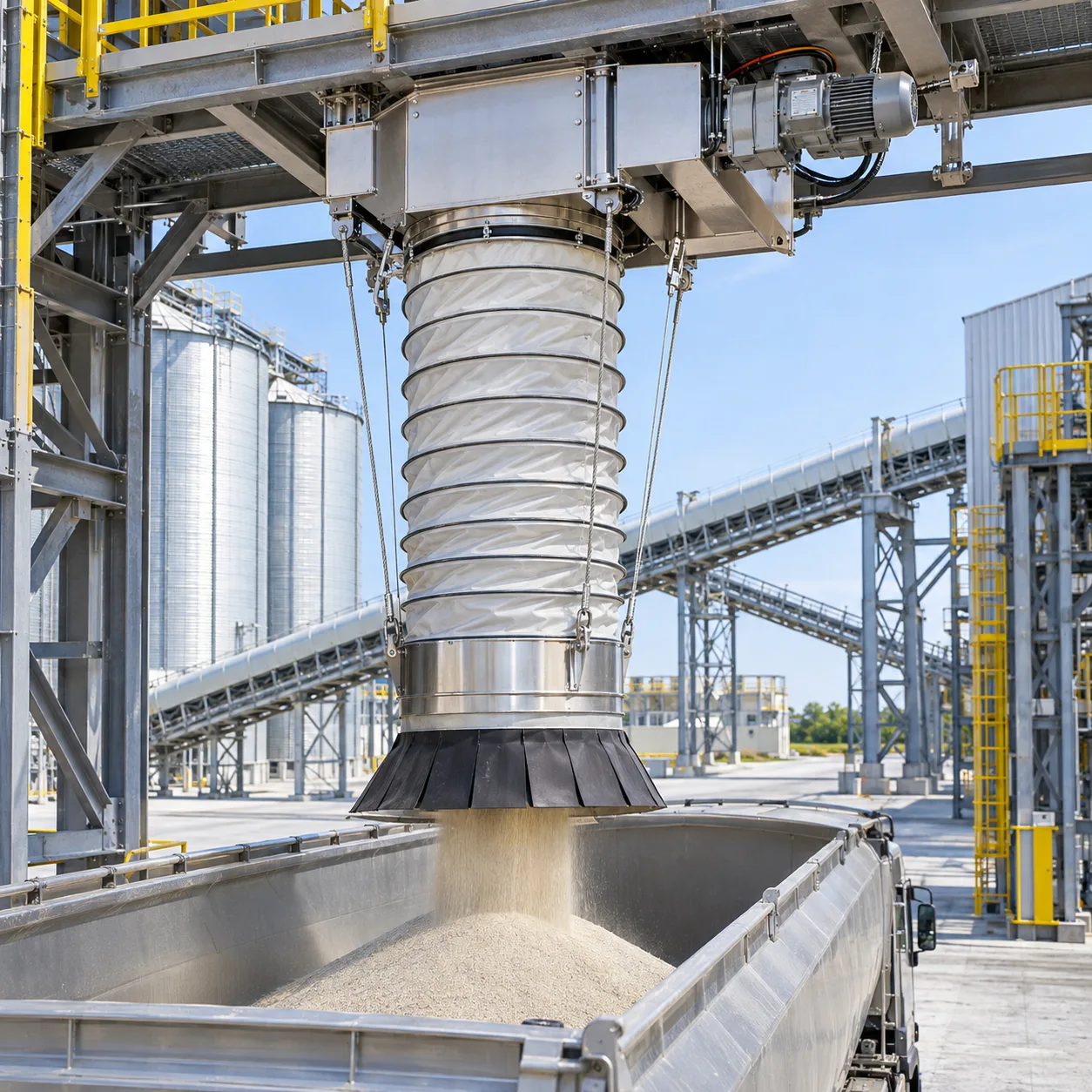
For wheat, corn, soybeans, and meal pellets, avoiding product degradation and kernel breakage is essential. We configure gentle-handling drop paths using variable-speed drives to soften drop velocities into vessel holds. Systems feature completely enclosed conveyor galleries to protect grain stocks from rain while keeping harbor areas clean. For specialized discharge setups, integrating purpose-built telescopic loading spouts ensures contained, low-dust distribution across the hold.
Corrosive Chemicals, Fertilizer, and Cement Clinker
Moisture-sensitive, abrasive, and corrosive products like potash, urea, and hot cement clinker demand specialized protection:
Corrosion Resistance: Enclosed cable trays, marine-grade stainless fasteners, and IP66 electrical enclosures.
Sealed Material Paths: Tight conveyor skirting and sealed hoods prevent ambient air moisture from caking product along our bulk loading equipment transport lines.
Thermal Protection: Heat-resistant carcass belting handles clinker discharge temperatures reaching up to 120°C without blistering.
Mechanical Subsystems and Boom Components
Our dry bulk ship loaders are built on robust mechanical foundations, engineered to withstand the continuous demands of marine and river terminal operations. We prioritize structural reliability and operational precision in every subsystem, ensuring your material handling remains consistent.
Boom Structure and Conveyor Dynamics
The conveyor boom is the backbone of the system. We utilize high-strength steel trusses designed for optimal stiffness and load-bearing capacity.
Impact Idler Arrangements: To protect the conveyor belt from heavy abrasive materials, we install heavy-duty impact idlers at all material transfer points, significantly extending belt lifespan.
Structural Integrity: Every boom is rated for severe marine environments, ensuring fatigue resistance even under high-wind conditions.
Telescoping Booms and Trimming Spouts
To maximize efficiency during cargo loading, our equipment features flexible reach and positioning capabilities.
Telescoping Extensions: Integrated boom extensions allow for precise reach into vessel holds, reducing the frequency of vessel warping.
Trimming Control: We equip our loaders with rotating trimming spouts that provide 360-degree material discharge. This ensures the cargo is trimmed evenly throughout the hold, minimizing voids and maximizing vessel capacity utilization.
Luffing and Slewing Drive Systems
Precise control over the loader's movement is essential for safe and rapid loading.
Dual Hydraulic Luffing: Our systems utilize dual hydraulic cylinder configurations, providing superior stability and smooth luffing motion for the boom, even when handling high-density bulk materials.
External Gear Slewing: We employ heavy-duty external gear slewing drives to manage large rotating loads. These drives are sealed against dust and moisture, delivering reliable performance and accurate positioning for the bulk ship loader during port operations.
Dust Control and Environmental Protection
Controlling dust and fugitive spillage is vital for environmental compliance, port safety, and preventing cargo loss. On every dry bulk ship loader we build, we engineer clean handling systems directly into the transfer points and boom discharge to stop particulates before they escape into the marine environment.
Cascade-Type Telescopic Discharge Chutes
Our dust-free ship loader configurations use heavy-duty telescopic discharge chutes designed to match changing hold depths and tidal variations.
-
- Controlled Material Velocity: Opposed internal cones slow material fall speeds, preventing heavy impacts that kick up dust plumes.
- Auto-Leveling Skirts: Flexible bottom skirts rest on the material pile, self-raising via level sensors as the hold fills.
- Wind Resistance: Outer flexible bellows protect dry bulk cargo from crosswinds during deep hold loading.
Integrated Dry-Fog Suppression and Negative-Pressure Extraction
For powdery, high-dust cargos like clinker, grain, or fine coal, we implement active suppression and extraction solutions. Our integrated setups combine high-pressure mist nozzles at the chute head with modular baghouse dust collectors mounted directly on the boom frame.
| Feature | Working Principle | Operational Target |
|---|---|---|
| Dry-Fog Mist | Sub-micron water droplets agglomerate airborne dust without wetting cargo | Moisture addition under 0.1% |
| Negative-Pressure Air Handling | Built-in fans draw displaced air upward through filtration media | Zero positive pressure at hold opening |
| Pneumatic Pulse Cleaning | Automatic reverse-jet pulses dislodge dust cakes back into cargo stream | 99.9% filtration efficiency down to 1 micron |
To isolate maintenance zones and control continuous stream feeds at critical transfer hoppers, we also fit heavy-duty slide gates alongside our industrial dust collection equipment for seamless port compliance.
Continuous Undertray Spillage Recovery Systems
Preventing deck and quayside fouling protects maritime ecology and cuts cleanup expenses. Every bulk ship loader boom includes full-length recovery mechanisms:
-
- Full-Length Boom Drip Trays: Heavy-gauge steel pans run underneath the boom conveyor to catch belt carryback and transfer spillage.
- Motorized Scraper Sweepers: Continuous internal chain or belt scrapers gather captured fines and return them directly into the main loading chute.
- Belt Cleaning Arrays: Multi-stage primary polyurethane blade cleaners and secondary carbide scrapers scrub the return belt before it clears the jetty footprint.
Terminal Integration and Automation Systems

PLC Control Architecture and Central SCADA Connection
Our bulk cargo loading automation relies on robust programmable logic controllers (PLCs) communicating via industrial Ethernet or dual-redundant fiber-optic networks.
-
- Central SCADA Integration: Real-time feedback feeds conveyor motor currents, bearing temperatures, hydraulic pressures, and hatch loading status directly into the central terminal control room.
- Upstream Feed Interlocking: Loading rates dynamically throttle jetty belt systems and transfer chutes, working in sync with upstream diverter valves to route cargo flows and prevent belt overloading during emergency stops.
- Automated Hatch Sequencing: Configurable batch routines allow operators to pre-program hatch-filling schedules, balancing vessel stability and trimming demands while minimizing physical repositioning cycles.
3D LiDAR Profiling and Anti-Collision Radar
Navigating booms inside vessel holds demands millimeter precision. We equip every bulk material ship loader with advanced spatial detection arrays to safeguard both the vessel structure and the machine itself:
-
- 3D LiDAR Hold Mapping: Scanners actively map hold contours, continuously tracking the material cone geometry to execute automated cascade trimming without burying the discharge spout.
- Anti-Collision Microwave Radar: Dual-channel sensors monitor distances to hatch coamings, stay wires, deck cranes, and vessel masts, instantly halting boom travel or slewing motions before a contact incident can occur.
- Tidal and Draft Tracking: Automated sensors detect vessel movement caused by tide variations and changing ballasting states, auto-adjusting boom elevation accordingly.
Pressurized Operator Cabin Design and Wireless Belly-Pack Remotes
Operator situational awareness and comfort directly influence berth turnaround times. We provide versatile dual-mode control setups for every bulk ship loader:
-
- Climate-Controlled, Pressurized Cabins: Mounted directly on the mast or boom support, the cabin features positive-pressure HEPA filtration to lock out fugitive dust, acoustic insulation, multi-monitor PLC diagnostic consoles, and floor-to-ceiling safety glass for an unobstructed view into the hold.
- Industrial Wireless Belly-Pack Remotes: Heavy-duty, frequency-hopping radio controllers give operators the freedom to step out of the cabin and control trimming spouts, luffing, and travel motions directly from the vessel deck or jetty edge.
- Fail-Safe Redundancy: Handheld units include integrated E-stops, tilt sensors, and dedicated dead-man switches to drop drive contactors instantly in the event of signal interruption or operator distress.
Maritime Standards and Corrosion Protection for Bulk Ship Loaders
Severe marine atmospheres quickly destroy substandard jetty machinery. We design every bulk material ship loader to withstand high salinity, storm winds, and relentless cyclic fatigue, ensuring long-term structural integrity at the berth.
Structural Calculations Under FEM 1.001 and ISO 5049
We engineer all structural steelwork to meet global port equipment criteria, avoiding premature stress cracks and dynamic deflection during peak transfer runs.
-
- Design Codes: Fully compliant with FEM 1.001 (Rules for the Design of Hoisting Appliances) and ISO 5049-1 (Continuous handling equipment – rules for the design of mobile equipment).
- Wind Load Resistance: Calculated for operational winds up to 20 m/s and stowed survival gusts exceeding 55 m/s.
- Fatigue Life: Heavy-gauge box girders and lattice booms analyzed via finite element analysis (FEA) for high-cycle marine loading.
- Stability Verification: Strict tipping and overturning safety factors applied under full boom extension and heavy material surcharges.
Multi-Layer C5-M Marine Anti-Corrosion Coatings
Salt spray and abrasive dry bulks rapidly strip conventional paint. We protect our dry bulk ship loader structures using heavy-duty industrial coating systems rated under ISO 12944.
| Coating Stage | Material Specification | Dry Film Thickness (DFT) |
|---|---|---|
| Surface Prep | Sa 2.5 abrasive blast profile (40–75 µm) | — |
| Primer Coat | Zinc-rich epoxy primer | 60–80 µm |
| Intermediate Coat | High-build epoxy micaceous iron oxide (MIO) | 150–200 µm |
| Topcoat | Aliphatic polyurethane (UV & chemical resistant) | 60–80 µm |
| Total System | C5-M Very High Marine Corrosivity Standard | 300–360 µm |
All fasteners, cable trays, and hydraulic fittings use 316L stainless steel or hot-dip galvanizing to stop galvanic corrosion along the marine bulk loading boom.
Factory Acceptance Testing and Mechanical Trial Assembly
We eliminate commissioning delays on your jetty by proving every motion before shipping. Every bulk ship loader goes through rigorous shop-floor validation:
-
- Complete Trial Pre-Assembly: Full mechanical shop fitting of the boom, slewing bearings, and gantry structure to guarantee bolt-hole alignment and eliminate field re-welding.
- No-Load Drive Runs: Factory testing of all luffing cylinders, slewing gearboxes, and conveyor drives to log vibration levels, oil temps, and electrical draw.
- FAT Sign-Off: Full verification of safety interlocks, limit switches, and marine-grade spare parts before packing for ocean transport.
Jetty Engineering and Lifecycle Support
Berth Load Balancing and Rail-Wheel Weight Distribution
Quayside load limits dictate structural geometry. We optimize the mass distribution of each rail-mounted bulk ship loader to prevent localized pier overload:
-
- Multi-Wheel Bogie Systems: Dynamic loads are shared across 8 to 32 equalized wheels to keep corner loads well below civil jetty thresholds.
- Three-Point Support Geometry: Prevents frame racking and structural twisting caused by normal rail settlement or tidal dock deflections.
- Storm Anchor Integration: Hydraulic rail clamps and mechanical stowage pins anchor the dry bulk ship loader against gale-force mooring winds when idle.
Modular Shipment, Ro-Ro Delivery, and Cold Commissioning
Minimizing berth downtime during installation protects terminal revenue:
-
- Pre-Assembled Modules: Major assemblies—including the gantry, slewing deck, and conveyor boom—are fully pre-wired and pre-piped at our production yard.
- Roll-on/Roll-off (Ro-Ro) Transport: We ship units fully erected via specialized heavy-lift deck barges, rolling the loader directly onto your quayside tracks in a single continuous tide window.
- Cold Commissioning on Arrival: Factory acceptance testing confirms all I/O loops, conveyor drives, and safety limit switches before the machine touches your pier, cutting on-site setup to days rather than months.
Preventative Maintenance Intervals and Fast-Wear Spare Supply
To secure uninterrupted ship turnaround times, we supply tailored maintenance schedules and critical spare packages:
| Component Group | Inspection Interval | Planned Action | Standard Lifetime |
|---|---|---|---|
| Chute Wear Liners | 250 operating hours | Check ceramic/Hardox thickness | 12–18 months |
| Luffing Cylinders & Seals | 500 operating hours | Fluid analysis, rod wipe check | 3–5 years |
| Slewing Ring & Pinions | 1,000 operating hours | Grease purges, backlash clearance check | 40,000 hours |
| Conveyor Belting & Idlers | 250 operating hours | Belt alignment and bearing thermography | 2–4 years |
Operators reviewing our engineering guidelines on how to select bulk loading spout know that wear-part durability directly dictates long-term operating costs. We stock matched fast-wear spare kits—including hydraulic cartridges, winch wire ropes, and discharge liner kits—ready for air dispatch to eliminate unplanned demurrage.
Dry Bulk Ship Loader Sizing and RFQ Parameters
Sizing a dry bulk ship loader requires clear terminal data to ensure safe quayside installation and peak transfer rates. We tailor each machine to your specific quay design, marine environment, and cargo mix. Precise upfront operational inputs prevent structural over-engineering, eliminate jetty structural overload, and avoid underperforming transfer systems.
| UPSTREAM FEED CONVEYORS |
| ↓ |
| Rail / Pivot Interface Quay Load Limits |
| ↓ |
| DRY BULK SHIP LOADER BOOM |
|
Luffing / Slewing
Outreach Reach
|
| ↓ |
| High Tide / Ballast Air Draft |
| ↓ |
| TARGET VESSEL HOLDS |
Material Density and Target Transfer Rates (TPH)
Bulk density, lump sizing, and flowability determine conveyor belt width, belt speeds, and drive power. We match mechanical throughput to upstream yard supply:
-
- Dense, Abrasive Ores: Iron ore, bauxite, and copper concentrates require heavy-gauge wear plating, reinforced impact zones, and high-torque drives to sustain 3,000 to 8,000 TPH.
- Variable Energy Bulks: Coal and petcoke require wider troughing belts running at controlled speeds to optimize volumetric flow at 1,500 to 5,000 TPH.
- Low-Density & Fragile Materials: Grains and wood pellets demand gentle degradation-limiting transfers and covered drops to avoid dust generation.
- Flow Rate Synchronization: We match loader intake ratings to yard belt conveyors to eliminate chute chokepoints and surcharges.
Vessel Dimensions, Tidal Swings, and Water-Side Reach Limits
Our engineering team models vessel geometry across all operational loading cycles. The marine boom reach must span hatch lines while clearing the vessel superstructure under extreme environmental shifts:
-
- Vessel Beam and Freeboard: From river barges up to Capesize bulk carriers, boom length and luffing ranges are sized to drop cargo squarely on the vessel centerline without blind spots.
- Tidal Range & Ballast Changes: Sizing calculations combine the highest astronomical tide (HAT) and empty-vessel deballasted air draft against lowest low-water conditions. This dictates boom hinge elevation and maximum clearance angles.
- Trimming Coverage: Chute drop envelopes ensure full cross-hatch coverage for uniform de-ballasting, protecting vessel hull stress limits.
Civil Berth Constraints and Electrical Supply Requirements
Quayside civil limits define the operational architecture of your bulk material ship loader:
| Sizing Parameter | Critical Data Required | Engineering Impact |
|---|---|---|
| Quay Load Bearing | Maximum allowable wheel/bogie load (kN/m) | Determines number of bogie wheels, track center spacing, or mobile tire footprint. |
| Berth Infrastructure | Rail gauge, dolphin spacing, or apron width | Dictates gantry span, rail-mounted base vs. quadrant pivot position. |
| Feeding Interface | Tripper car connection or dockside intake hopper | Sizes intake feed chutes and integration with terminal bulk conveying equipment. |
| Power Supply | Medium voltage (3.3 kV – 11 kV) vs. low voltage | Defines motor control center (MCC) layout, cable reel reel-span, or generator package. |
| Wind & Seismic Ratings | Max operating and tiedown storm wind speeds | Dictates storm pin design, rail clamp clamping force, and parking lock anchor points. |
Providing these exact site conditions ensures our engineering team delivers an optimized, turn-key bulk ship loader ready for seamless terminal integration.
Bulk Material Ship Loader FAQs
How do we determine the required TPH loading rate for our berth?
We calculate the target tons-per-hour (TPH) rating by balancing your annual berth throughput against allowable vessel turnaround times. Key variables include:
-
- Vessel deadweight tonnage (DWT): Handysize, Panamax, or Capesize requirements.
- Effective loading factor: We typically factor in an operational efficiency of 70% to 75% to account for hatch switching, trimming, draft surveys, and deballasting rates.
- Demurrage thresholds: Sizing the bulk material ship loader to clear standard laytime contracts under standard tidal windows.
Can a single ship loader handle both grain and corrosive fertilizers?
Yes, provided the machine is engineered with dual-service product pathways. When we configure a multi-cargo dry bulk ship loader, we incorporate:
-
- Corrosion protection: Marine-grade 316L stainless steel wear liners and continuous C5-M paint systems for aggressive chemical fertilizers.
- Cross-contamination barriers: Washdown-ready conveyor troughs, self-cleaning belt pulleys, and enclosed transfer drop points.
- Food-grade certified belting: Oil-resistant, anti-static white belts that comply with international food safety standards for grain handling.
What are the main advantages of a rail-mounted vs. mobile ship loader?
| Feature | Rail-Mounted Bulk Ship Loader | Mobile (Rubber-Tyred) Loader |
|---|---|---|
| Throughput Capacity | High to ultra-high (up to 10,000+ TPH) | Medium (typically 500 to 2,500 TPH) |
| Quayside Footprint | Fixed rail line along the jetty apron | Flexible, relocatable via all-wheel steering |
| Structural Stability | Maximum wind and seismic resistance | Dependent on hydraulic outriggers |
| Berth Infrastructure | Requires high-capacity civil pilings | Operates on standard reinforced concrete docks |
How do telescopic trimming chutes prevent dust dispersion in high winds?
Our discharge spouts maintain positive material containment right down to the bottom of the hold:
-
- Cascade cone geometry: Inner anti-segregation cones slow material velocity, keeping free fall to an absolute minimum.
- Outer skirt enclosure: Heavy-duty flexible bellows create a localized physical seal over the material pile, blocking crosswinds.
- Aspiration filtration: Integrated extraction hoods draw negative pressure directly at the discharge point, venting dust through dedicated dust collector filter bags installed in our quayside dedusting units.
What civil jetty modifications are required to install a quadrant ship loader?
A radial quadrant bulk ship loader drastically cuts dock civil construction costs compared to continuous runway rails, but it does require two dedicated load-bearing interfaces:
-
- Fixed center pivot point: A heavily reinforced concrete caisson or piling cluster situated landside to absorb the deadweight and horizontal slew overturning moments.
- Curved radial beam/track: An arc-shaped steel rail embedded along the seaside jetty edge designed to support the motorized wheel bogies under maximum boom reach loads.