Formula details
Product Details
Overview
What Is a Retractable Loading Spout?
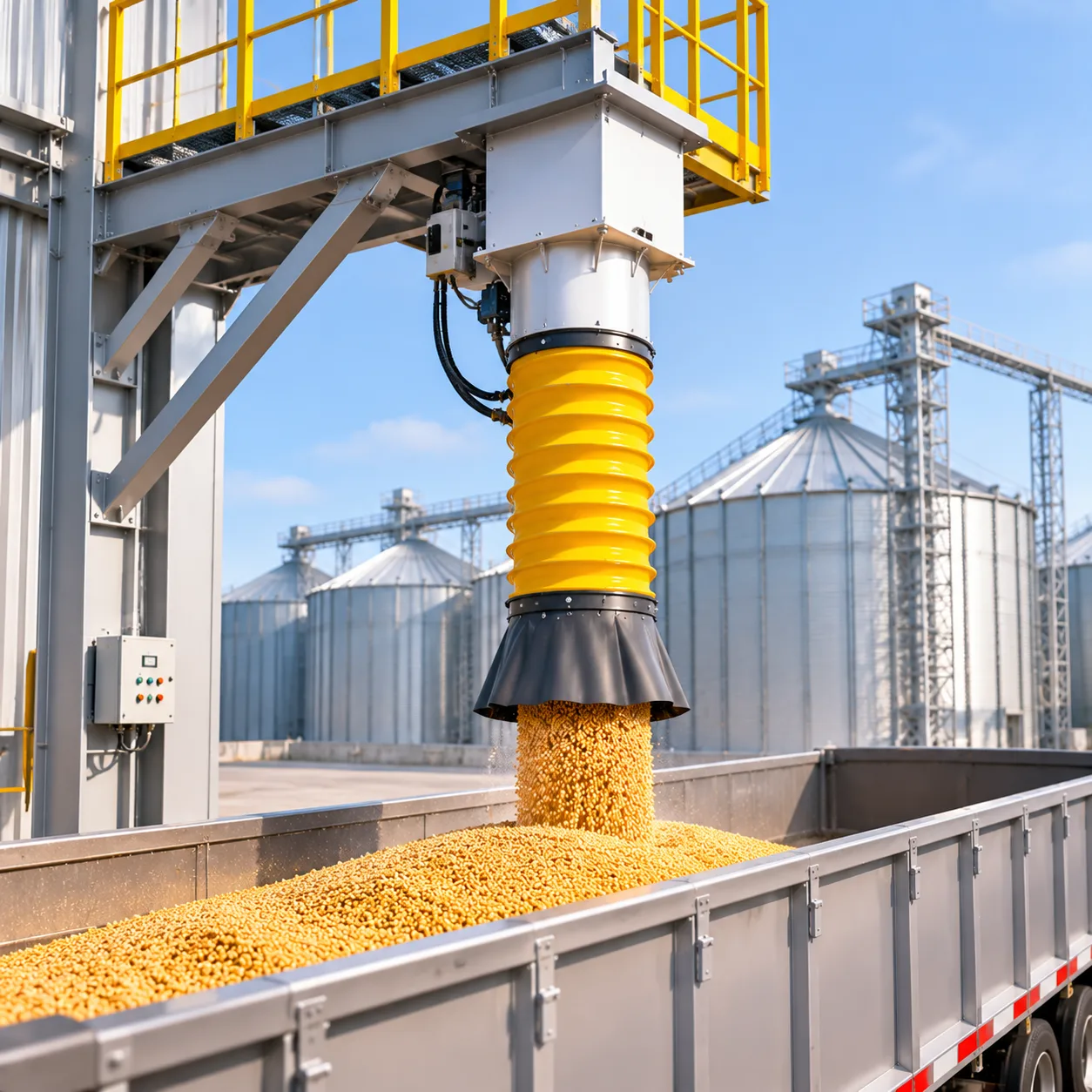
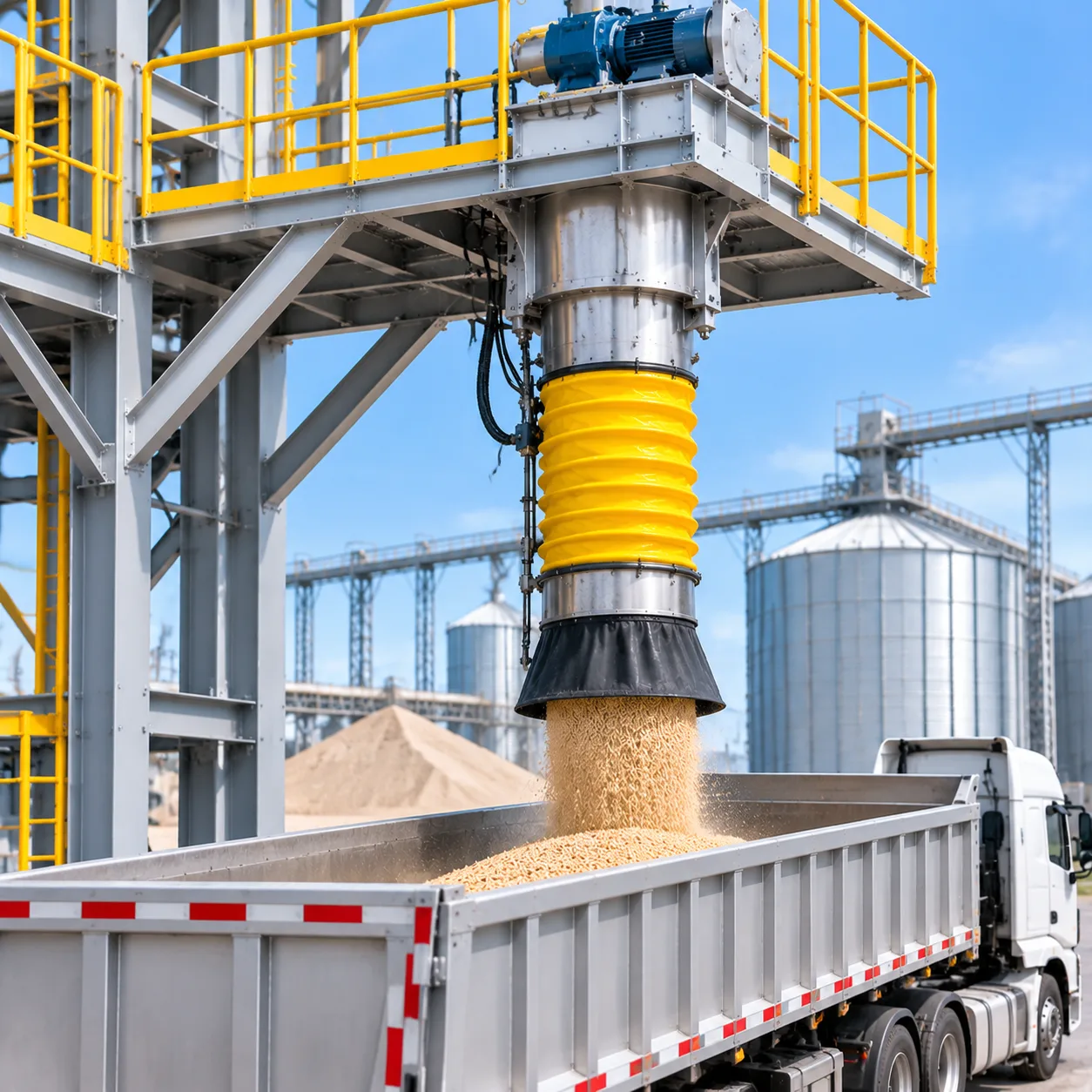
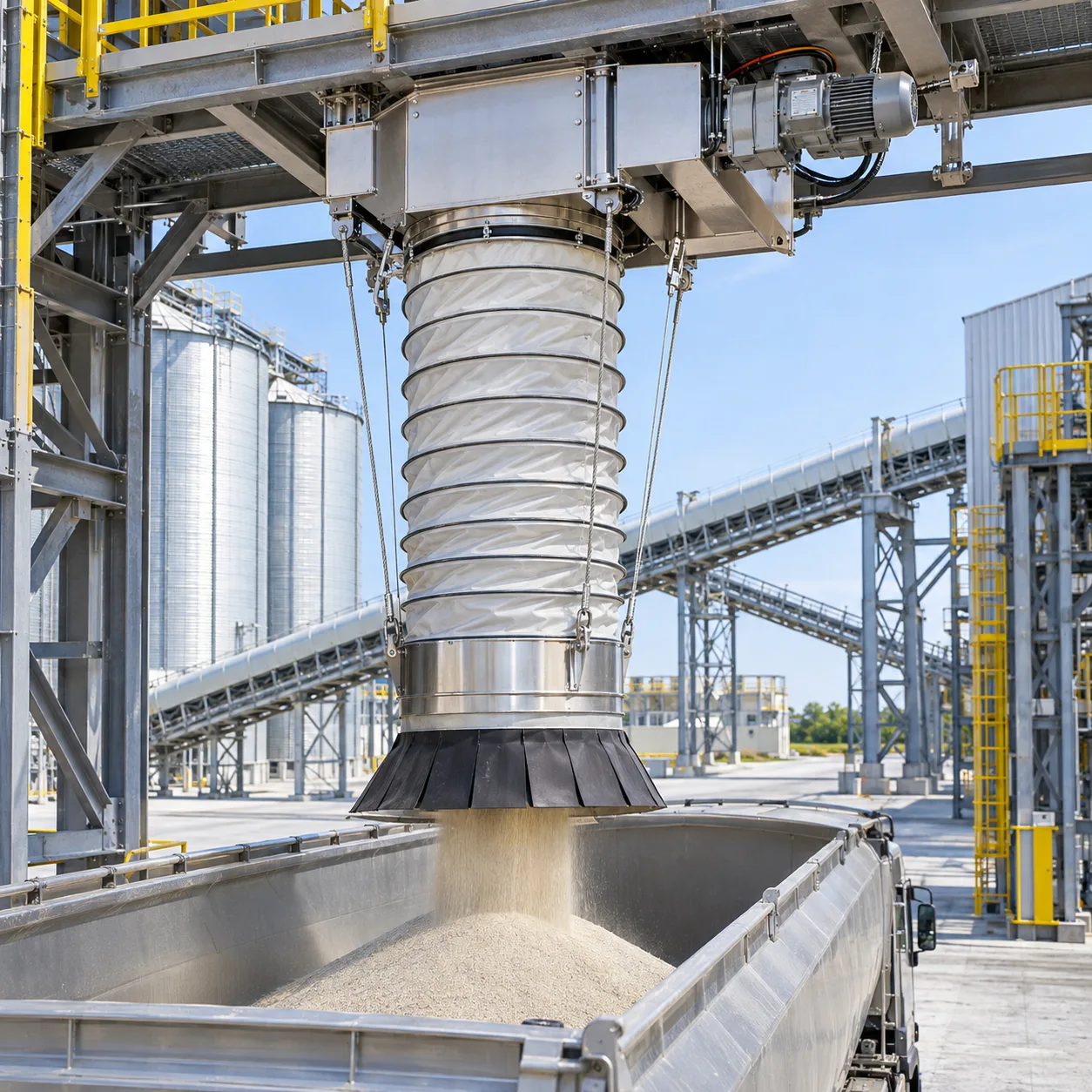
A retractable loading spout—also known as a telescopic loading spout or bellows loading chute—is an engineered bulk material handling solution designed to transfer dry, free-flowing solids from storage silos, hoppers, or conveyors directly into receiving vehicles and containers without releasing dust into the atmosphere.
At its core, the system expands vertically downward to bridge the open air between the discharge gate and the vehicle intake hatch, sealing the loading path completely. Once the transfer cycle finishes, it retracts swiftly back up to provide clear drive-through clearance for arriving and departing transport.
Basic Design and Working Principles
We engineer these spouts using a dual-path design that separates gravity material flow from air exhaust:
-
- Internal Material Flow Path: A series of heavy-duty, telescoping inner cones or an internal wear-resistant cylinder guides falling bulk solids directly into the target vessel, minimizing particle velocity and free fall degradation.
- Outer Bellows Dust Enclosure: An exterior flexible sleeve surrounds the inner stream, maintaining an airtight containment barrier that captures fugitive dust.
- Annular Vacuum Evacuation Zone: The negative pressure created between the inner cones and the outer sleeve continuously withdraws displaced air and dust back to a filtration unit.
- Drive Mechanism: High-strength lifting cables linked to a motorized winch or pneumatic drive control the continuous vertical extension and retraction of the assembly.
Retractable Loading Spouts vs. Fixed Discharge Chutes
Traditional fixed chutes create massive operational bottlenecks and clean-up costs. When loading bulk solids through open spaces with fixed chutes, the drop distance causes uncontrolled dust plumes, lost product, and frequent equipment strikes.
| Feature | Retractable Loading Spout | Fixed Discharge Chute |
|---|---|---|
| Dust Containment | Sealed, dust-free bulk loading via integrated exhaust paths | Poor; high airborne particulate escape |
| Height Flexibility | Adjustable travel stroke adapts to variable truck and tanker heights | Static height; leaves wide, exposed gaps |
| Material Degradation | Minimized via controlled internal cone staging | High particle breakage due to uncontrolled free fall |
| Loading Bay Clearance | Fully retracts overhead for safe, fast vehicle transit | Static obstacle risking vehicle impact |
| Housekeeping & Safety | Eliminates product spillage on bay floors and trucks | Requires frequent manual cleanup and washdowns |
Primary Role in Enclosed Dry Bulk Material Handling
In enclosed dry bulk operations, material safety, environmental compliance, and rapid vehicle turnaround times are critical. A retractable loading spout serves as the primary dust-controlled loading system connecting fixed storage infrastructure to enclosed road tankers, ISO containers, and covered railcars. By establishing a direct, sealed interface at the vessel hatch, our loading chutes prevent cross-contamination, stop fugitive emissions at the source, and ensure that every ton of product reaches its destination cleanly and efficiently.
Where to Use a Retractable Loading Spout
Enclosed Truck and Tanker Loading
Loading dry bulk solids into closed vehicles requires a dust-tight seal between the discharge equipment and the vehicle inlet.
-
- Pneumatic Dry Bulk Tankers: When loading road tankers, our specialized tanker loading spouts lower securely onto the hatch opening. The bottom sealing cone forms an airtight connection, allowing powder to discharge at high speeds while drawing displaced air and dust back out.
- Box Trucks and Sealed Vans: We configure durable truck loading spouts that adjust travel distance automatically to match varying bed and hatch heights, stopping dust from blowing back across the loading bay.
Open-Top and Enclosed Railcar Loading
Rail sidings demand heavy-duty performance and extended vertical reach. Railcars sit lower or higher depending on the track grade and carriage design, requiring a flexible, high-travel system.
-
- Enclosed Hopper Cars: The spout extends directly into hatch ports to contain fine granules, pellets, or grain, preventing wind-driven product loss.
- Open-Top Gondolas and Railcars: We equip the discharge end with an integrated dust skirt. The skirt rests directly on top of the rising material pile, capturing fugitive particulate matter right at the point of impact.
Barge, Ship, and Stockpile Loading Scenarios
Marine loading terminals and outdoor yards face harsh environments, huge drops, and erratic wind conditions.
-
- Barge and Vessel Holds: Deep holds require long-stroke telescopic travel. The spout extends deep into the belly of the vessel, minimizing product free-fall and degrading fragile bulk materials less.
- Open Stockpiling and Ground Storage: For outdoor stacking, explore our loading spout stockpiling solutions for bulk materials to manage continuous discharge while tracking pile growth and keeping dust drift down to regulatory thresholds.
Compatible Dry Bulk Materials and Industry Use Cases
Our retractable bulk loading chute designs handle free-flowing, aerated, and abrasive materials across diverse manufacturing and processing sectors:
| Industry Sector | Typical Materials Handled | Operational Priority |
|---|---|---|
| Cement & Building Materials | Portland cement, fly ash, clinker, dry sand, lime | Abrasive wear resistance, dust sealing |
| Mining & Minerals | Coal, iron ore fines, silica, potash, bentonite | Heavy-duty impact liners, high throughput |
| Agriculture & Grain | Corn, wheat, soybeans, animal feed pellets | Gentle handling, anti-breakage, dust mitigation |
| Chemicals & Plastics | Plastic resin pellets, soda ash, fertilizer granules | Clean discharge, contamination prevention |
| Food Processing | Flour, refined sugar, starch, bulk grain | Sanitary surfaces, food-grade contact materials |
How the Retractable Loading Spout Works
A retractable loading spout creates a completely enclosed transfer path between your overhead storage and the receiving vessel. It eliminates dust clouds, prevents product loss, and speeds up vehicle turnaround times through a synchronized mechanical and pneumatic cycle. If you are setting up a new loadout bay, reviewing our guide on how to select a bulk loading spout will help you align operating mechanisms with your product requirements.
Material Flow from Storage Outlet to Vehicle Hatch
Bulk solids drop by gravity from silos, bins, or hoppers directly into the inlet of the spout. The dry bulk material moves downward through a series of internal stacking cones or an inner sleeve. This interior column isolates the falling product stream, keeping it centered and moving at controlled velocities directly into the center of the tanker, railcar, or open truck bed.
Extension, Positioning, and Retraction Cycle
The loading cycle follows four straightforward mechanical steps:
-
- Resting position: The spout remains fully retracted above the loading lane, leaving clear drive-through clearance for incoming vehicles.
- Lowering to hatch: Once the transport vehicle parks, the operator activates the drive system to lower the bellows loading chute until the discharge cone seats firmly over or inside the vehicle inlet.
- Sealed discharge: The product flows continuously while the internal cones shield the falling stream and the flexible outer sleeve contains expanding displaced air.
- Automated raising: When loading finishes, the drive hoists the telescopic loading chute back up to its compact park position, preventing any damage during vehicle pullout.
Integrated Dust Containment and Vacuum Exhaust Airflow
As dry bulk solids displace air inside an enclosed container, high air velocity forces fine particulate upward. Our retractable bulk loading chute uses a dual-path design:
-
- Inner conduit: Carries the bulk material downward into the vessel.
- Outer annular space: Draws fugitive dust back upward through the space between the inner cones and the outer sleeve.
- Negative pressure evacuation: Connected directly to a dust collection system, the vacuum pulls displaced air away from the hatch, capturing airborne fines before they can escape into the plant atmosphere.
Operator Controls and Automated Level-Sensing Shutoff
To prevent messy overfills and eliminate operator guesswork, the discharge end features an integrated level-sensing system. Tilt switches, vibrating probes, or capacitance sensors monitor the product pile height as the vessel fills.
When the material reaches the set high-level point, the sensor immediately signals the feed gate or valve above to shut off material flow. In open-truck applications, the control logic can automatically raise the spout incrementally as the pile builds, maintaining a tight dust seal throughout the entire filling run without manual intervention.
Retractable Loading Spout Configurations and Options
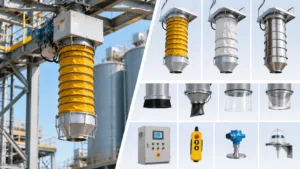
Outer Sleeve and Inner Cone Construction Materials
The inner cones direct dry bulk discharge, while the flexible outer bellows loading chute contains displaced air and fine particles. Selecting the right combination ensures long service life and zero fugitive dusting:
-
- Outer Sleeves: Standard heavy-duty polyester with PVC or neoprene coating resists UV exposure, moisture, and continuous flexing. High-temperature silicone-coated fabrics handle hot materials such as clinker or fly ash up to 250°C (482°F). Food-grade white polymer sleeves are available for sanitary food processing.
- Inner Cones: Formed from carbon steel for non-abrasive powders, Hardox or AR400 abrasion-resistant steel for minerals, and 304 or 316 stainless steel for corrosive chemicals and food-grade bulk solids handling.
Drive System Options: Electric Winch vs. Pneumatic Actuation
Reliable vertical positioning prevents product pile-ups and maintains a sealed loading interface.
-
- Electric Winch Drives: The industry standard for variable vehicle heights and long strokes. Utilizing dual or three-cable hoisting drums with heavy-duty gearboxes, electric winches ensure smooth, level raising and lowering for truck loading spout and railcar loading spout operations.
- Pneumatic Actuation: Best suited for short-stroke applications, hazardous explosion-proof areas, or tight vertical clearances where electric motors add unnecessary maintenance or weight overhead.
Integrated Dust Collection vs. Central Dust Collector Hookup
A dust-free loading spout requires continuous negative pressure to evacuate air displaced by incoming solids. We provide two distinct air-handling configurations:
-
- Central System Connection: Designed with an upper exhaust port that links directly to facility-wide pulse-jet dust collectors. This setup reduces top-weight on the spout support steel and leverages existing plant vacuum capacity.
- Integrated Self-Venting Modules: Equipped with integral cartridge dust collectors positioned on top of the spout. The reverse-pulse cleaning cycle releases trapped product back down into the receiving vessel, eliminating cross-contamination and disposal steps.
Wear Liners and Sanitary Contact Surfaces
High-velocity bulk solid discharge accelerates wear along chute surfaces. To reduce downtime and prevent structural failure:
-
- Abrasive Materials: We equip high-wear impact zones with replaceable ceramic tiles, polyurethane bolt-in liners, or hardened steel stacking cones.
- Food and Pharmaceutical Grades: Contact parts feature continuous welds ground smooth, electro-polished stainless surfaces, and FDA-compliant sealing materials to eliminate entrapment areas and cross-batch contamination.
Custom Travel Lengths and Diameter Sizing
We manufacture each telescopic loading spout to match target throughput rates and vehicle height variances:
| Configuration Parameter | Standard Range | Heavy-Duty / Custom Range |
|---|---|---|
| Inlet Diameter | 300 mm to 400 mm (12" – 16") | 500 mm to 800 mm+ (20" – 32"+) |
| Retracted Height | 1,000 mm – 1,500 mm | Application specific |
| Extended Stroke Length | 1.5 m to 4.5 m | Up to 12 m+ for marine/stockpiling |
| Drive Power | 0.75 kW – 1.5 kW Electric Motor | 2.2 kW – 5.5 kW / Pneumatic Cylinders |
| Venting Flow Rate | 1,500 – 3,500 m³/h | Sized to material displacement rate |
Key Benefits of Retractable Loading Spouts
Operating an efficient bulk outloading bay requires tight control over product flow, dust, and turnaround time. Integrating a high-performance retractable loading spout directly targets the main pain points in dry bulk handling: product loss, airborne dust, and high maintenance overhead.
Here is how our engineered telescopic loading spouts transform daily loading operations across bulk terminals and industrial facilities:
-
- Effective Dust Control and Fugitive Emission Reduction: The dual-bellows or inner-cone design isolates the falling material stream while pulling displaced air and dust upward into filtration systems, keeping your plant clean and compliant.
- Prevention of Material Loss and Spillage: A sealed discharge interface ensures that bulk powders and granular products enter the vehicle hatch directly without blowing away or accumulating on vehicle decks.
- Adjustable Travel Distance for Various Vehicle Heights: Telescoping vertical travel easily bridges the clearance gap between discharge hoppers and varying truck beds, low-profile tankers, or high-sided railcars.
- Enhanced Worker Safety and Simplified Housekeeping: Keeping dust contained eliminates slick walkways, minimizes explosive dust accumulation, and cuts hours of manual cleanup around the bay.
Direct Operational Advantages
| Operational Focus | Standard Fixed Chute Issues | Our Retractable Spout Solution |
|---|---|---|
| Dust Containment | Severe fugitive plumes, high product waste | Dust-free loading spout design with integrated negative pressure extraction |
| Loading Flexibility | Fixed height causes excessive free-fall distance | Motorized vertical extension matches exact vehicle hatch height |
| Housekeeping & Labor | Daily cleanup required around loading lanes | Contained transfer keeps bays clear, cutting labor costs |
| Material Integrity | High drop impact causes product degradation | Controlled descent cones preserve particle structure and prevent segregation |
Whether you are configuring a dedicated truck loading spout or an open-stockpile discharge chute, our heavy-duty systems provide the durability and precise vertical positioning needed for fast, clean, and reliable bulk solids outloading.
Technical Specifications and Parameters
Matching the right retractable loading spout to your loadout operation requires evaluating transfer volumes, vertical clearances, and product characteristics. We design and size our bulk material loading equipment to integrate cleanly into existing loadout bays, silo outlets, and marine systems like our high-capacity ship loaders.
Standard Retractable Loading Spout Specifications
| Parameter | Standard Range | Heavy-Duty / High-Capacity Range |
|---|---|---|
| Inlet / Spout Diameter | 300 mm to 500 mm (12" to 20") | 600 mm to 1,000+ mm (24" to 40"+) |
| Loading Capacity | Up to 400 m³/h (approx. 14,000 ft³/h) | Up to 2,000+ m³/h (approx. 70,000 ft³/h) |
| Travel Stroke | 1,000 mm to 4,500 mm | Up to 15,000 mm (custom builds) |
| Retracted-to-Extended Ratio | ~1:3 to 1:4 (spout style dependent) | Engineered per bay clearance limits |
| Motor Drive Ratings | 0.75 kW to 2.2 kW (1 HP to 3 HP) | 3.0 kW to 7.5 kW (winch dependent) |
| Operating Temperatures | -20°C to +80°C (-4°F to 176°F) | Up to 250°C (482°F) high-temp builds |
Spout Diameter and Bulk Transfer Capacity Ratings
Flow rates dictate your inner cone and outer bellow dimensions. For standard truck loading of dry bulk materials like cement, fly ash, or grains, a 300 mm to 400 mm dust-free loading spout provides steady rates up to 250–350 m³/h. For open railcars, barges, or high-volume aggregates, spouts up to 1,000 mm handle rapid bulk solid discharge without choke feeds or bottlenecking.
Extended Height, Retracted Height, and Travel Stroke
Clearance beneath your feed gates determines the retracted height of the telescopic loading chute.
Retracted Height: Designed to sit clear above the tallest tanker, flatbed, or railcar passing through the bay.
Extended Height: Extends down to meet the vehicle hatch or sit low inside an open truck bed to suppress dust generation.
Travel Stroke: The working distance between fully raised and fully lowered positions, driven by multi-cable winch systems designed for smooth, level vertical travel.
Construction Materials for Sleeves, Cones, and Cables
Every material contact zone is engineered to resist abrasion, chemical attack, and ambient weather wear:
Inner Stacking Cones: Carbon steel, AR400 abrasion-resistant plate, 304/316 stainless steel, or polyurethane-lined steel for highly abrasive ores and silica.
Outer Bellows & Sleeves: Heavy-duty polyester with PVC or polyurethane coating, hypalon, neoprene, or silicone-coated fiberglass for elevated temperatures.
Lifting Cables: High-tensile galvanized steel or 316 stainless steel wire ropes routed through heavy-duty machined pulleys to ensure anti-sway stability.
Power Requirements and Operating Temperature Limits
Our bellows loading chute drive systems operate on standard industrial three-phase power supplies (230V/460V/400V, 50/60 Hz). For hazardous operating areas containing combustible dusts—such as grain elevators, coal transfer depots, or chemical plants—we provide ATEX and IECEx-rated drive motors, limit switches, and level sensors rated for high-ambient and elevated process temperatures.
Retractable Loading Spout Installation and Plant Integration
Mounting Configurations Under Silos, Bins, and Hoppers
We engineer our mounting flanges to bolt directly beneath silo discharge gates, feed hoppers, or diverters. Key mounting considerations include:
Rigid Top Flange: Connects directly to round or square outlet patterns to support the static and dynamic loads of the spout assembly.
Vertical Alignment: Precise plumb alignment prevents uneven sleeve wear and ensures the inner cones nest cleanly during retraction.
Flow Control Pairing: Seamlessly positions under slide gates or feed valves to meter bulk material directly into the transfer chute.
Connecting to Facility Dust Collection Systems
To maintain a completely dust-controlled loading system, exhaust ports on the outer head connect directly into your central venting line or dedicated dust collection equipment.
Vent Port Sizing: Standard extraction ducting draws displaced air and airborne fines upward between the inner cones and the outer bellows.
Balanced Airflow: Proper negative pressure prevents positive pressure blowouts at the vehicle hatch while avoiding excessive product pickup into the dust stream.
Electrical Wiring, Position Switches, and Controls
Every bulk material loading spout comes ready for quick electrical termination to local control boxes or central plant PLCs:
Position Limit Switches: Factory-set rotary and proximity switches govern full retract, intermediate hold, and extended travel limits.
Slack Cable Detection: Safety switches immediately cut drive motor power if the lower cone settles onto an obstruction, protecting the lift cables.
Control Interlocks: Spout controls interface with feed gates, ensuring product flow only starts once the hatch seal is confirmed and stops immediately upon level-sensor trip.
Clearance Checks and Vehicle Approach Considerations
Safe vehicle turnaround depends on calculated clearance margins:
Retracted Clearance: We match the fully retracted height to ensure maximum headroom above the tallest truck, railcar, or container entering the lane.
Hatch Alignment Tolerance: Bays should provide sufficient spotter guides or positioning indicators to center the hatch opening within the spout’s vertical drop zone.
Working Envelope: Clearance checks must verify side clearance for dust ducting, cable hoists, and maintenance access platforms.
Retractable Loading Spout Operation, Inspection, and Maintenance
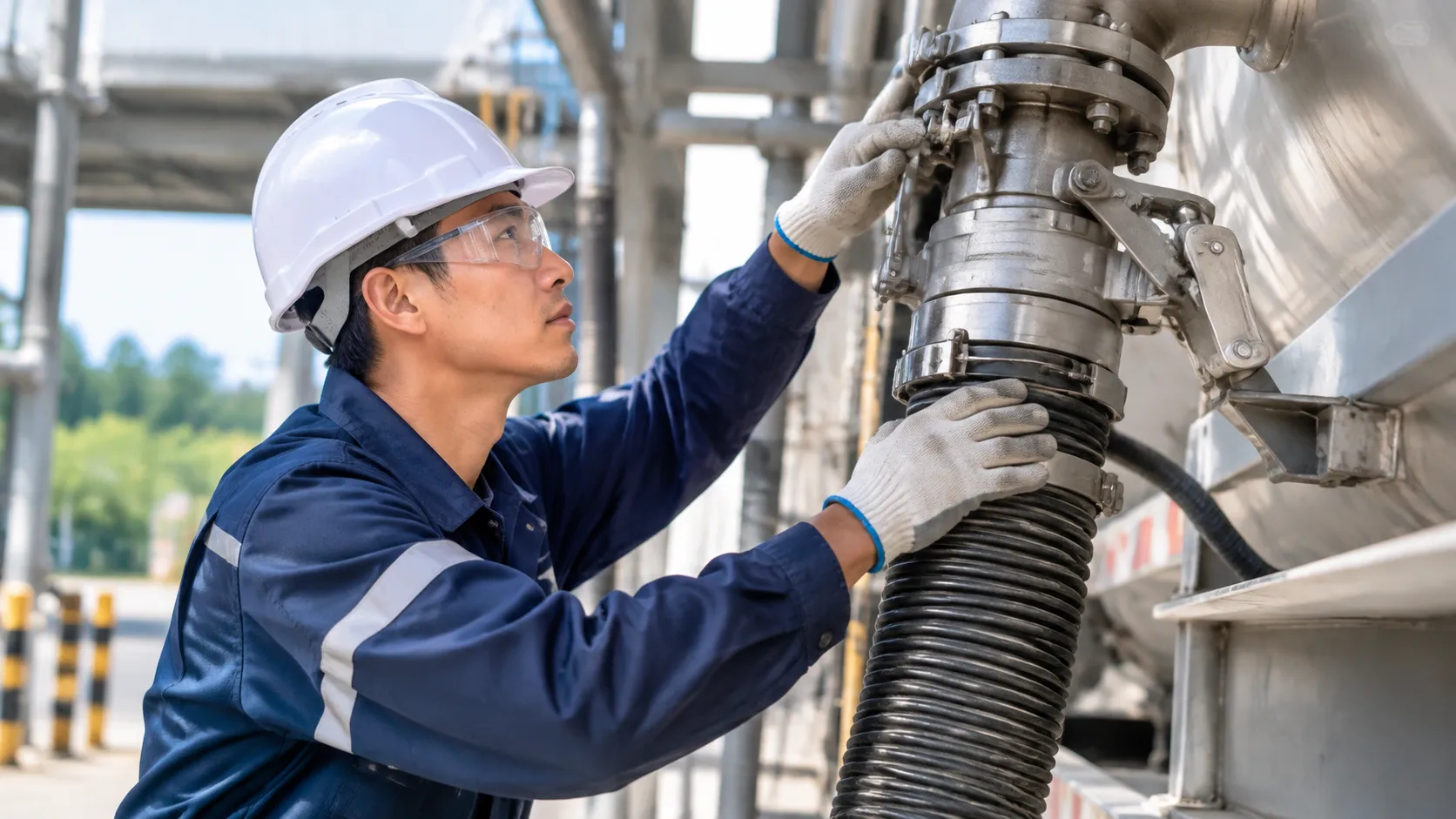
Daily Operating Sequence and Safety Checks
Before starting any load-out cycle, operators should run through a quick visual and operational check:
-
- Pre-start visual check: Ensure the vehicle hatch is properly centered beneath the spout discharge cone. Check that no tools, foreign debris, or ice buildup obstruct the vertical travel path.
- Lowering sequence: Lower the telescopic loading spout until the discharge cone seats firmly inside the vehicle hatch or rests on the open pile. Verify limit switch engagement so the hoist cables do not go slack.
- Dust extraction verification: Start the dust collection system or integrated venting fan before opening the material supply valve to establish steady negative pressure.
- Discharge cutoff: Watch the level-sensing probe during loading. The discharge gate must shut off automatically once the vehicle reaches target fill height, followed by a brief delay to clear residual material before retracting the unit.
Wear Parts Inspection: Cables, Pulleys, and Liner Cones
Abrasive bulk solids naturally wear down internal contact components over time. We recommend a scheduled monthly inspection of critical mechanical parts:
-
- Lifting cables: Inspect wire ropes for fraying, kinking, bird-caging, or corrosion. Replace cables immediately if broken strands appear.
- Pulleys and sheaves: Check cable sheaves for smooth rotation, proper alignment, and groove wear. Ensure cable guards are tight.
- Inner liner cones: Inspect the nested cones for localized thinning, cracking, or drop-out wear caused by high-velocity dry bulk materials. Rotate or replace cones before product cuts through to the outer fabric.
- Drive components: Check gearmotor oil levels, brake holding strength, and chain/sprocket tension on winch-driven models. For ongoing maintenance, keeping standard industrial spare parts on hand prevents extended bay shutdowns.
Bellows and Sleeve Maintenance and Replacement
The flexible outer bellows keeps dust sealed inside the exhaust stream. Punctures or tears quickly lead to environmental releases.
-
- Fabric sleeve condition: Look for pinch marks, abrasion spots, and chemical degradation on the outer fabric. Ensure clamps and retaining rings maintain a tight seal at both top flange and bottom discharge.
- Replacement procedure: When swapping a worn sleeve, fully lower the unit, lock out electrical power, loosen the band clamps, and slide the old bellows off over the inner cone assembly. Fit the new sleeve evenly without twisting to ensure straight vertical travel.
Troubleshooting Common Positioning and Dust Leakage Issues
| Problem | Root Cause | Corrective Action |
|---|---|---|
| Spout does not lower or raise evenly | Slack or uneven cable tension; misaligned guide sheaves. | Level the discharge cone and re-tension the hoisting cables evenly on the winch drum. |
| Dust escaping around vehicle hatch | Poor hatch seal contact; weak vacuum airflow; clogged dust collector filter bags. | Inspect bottom sealing cone gasket; clean or replace dirty filter media to restore proper intake draft. |
| Spout fails to stop at upper or lower limit | Faulty or misadjusted rotary limit switches. | Re-index and test upper/lower travel limit switches in manual jogging mode. |
| Material overflow during loading | Dirty tilt switch or failed level sensor probe. | Clean built-up crust or dust off the sensor head; test signal loop back to the main discharge gate. |
How to Choose the Right Retractable Loading Spout
Selecting the proper retractable loading spout comes down to matching your bulk solids with your physical loading bay requirements. We evaluate four critical operational factors to configure an efficient, low-maintenance discharge system for your facility.
Key Selection Criteria
| Factor | Critical Considerations | Design Impact |
|---|---|---|
| Material Behavior | Bulk density, particle size, abrasiveness, moisture, aerated flow | Selection of inner stacking cones, food-grade contact surfaces, and specialized wear-resistant finish options |
| Throughput & Speed | Target tons per hour (TPH), vehicle cycle times, gravity vs. feeder flow rate | Spout diameter sizing, venting capacity, and inner cone taper dimensions |
| Vehicle Interface | Enclosed tanker hatch diameters, open truck beds, railcar heights, overhead clearance | Retracted height, extended stroke length, and automated level-sensor selection |
| Operating Environment | Duty cycles, outdoor exposure, corrosive dusts, hazardous locations | Winch drive enclosures, NEMA/ATEX electrical ratings, and outer bellows fabric |
Material Bulk Density, Abrasiveness, and Flow Characteristics
Fine powders behave differently than coarse aggregates. Aerated powders require larger venting paths to prevent blowback, while sharp minerals quickly wear through standard sheet steel. For abrasive transfer, we configure your telescopic loading chute with heavy-duty abrasion-resistant liners or polyurethane cone overlays to extend operating life and reduce downtime.
Required Discharge Throughput and Loading Speed
Matching spout diameter to your upstream feed rate prevents product backups and sleeve over-pressurization. Our engineered bulk loading equipment configurations balance material volume with vacuum exhaust rates, ensuring peak flow speeds remain cleanly contained without product bridging or spillage.
Receiving Vehicle Hatch Dimensions and Clearance Limits
A reliable truck loading spout or railcar loading spout must accommodate the full range of transport heights entering your terminal:
-
- Retracted Clearance: Ample overhead clearance above incoming tanker hatches and truck side walls.
- Extended Reach: Full stroke down to the bottom of deep containers to eliminate free-fall dust generation.
- Hatch Sealing: Sized discharge cones that securely seat against vehicle hatch openings for dust-tight containment.
Environmental Duty Cycle and Explosion-Proof Requirements
High-throughput terminals running multi-shift operations demand continuous-duty motors, heavy-gauge lifting cables, and reinforced guidance pulleys. For combustible materials like grain, flour, or coal, we supply complete explosion-proof packages—including static-dissipative fabric bellows, intrinsically safe level probes, and explosion-rated drive motors built to meet strict plant safety standards.
Engineering Support and Customization for Your Retractable Loading Spout
Every bulk loading terminal faces distinct site constraints, material properties, and vehicle profiles. We provide end-to-end engineering support to adapt every retractable loading spout directly to your process requirements, ensuring smooth throughput and dependable dust control from day one.
Application-Specific Engineering and Custom Dimensions
Standard, off-the-shelf equipment rarely meets the tight clearance limits and diverse hatch profiles found in modern bulk terminals. We tailor spout geometry, drive mechanisms, and material contact surfaces to fit your precise layout:
-
- Extended and Retracted Lengths: Engineered travel strokes match varying vehicle heights, from low-profile flatbed trucks to high-clearance bulk railcars.
- Targeted Product Contact Liners: Choice of AR400, ceramic tile, or 304/316 stainless steel to match abrasive or corrosive bulk solids.
- Custom Inner Cone Sizing: Inner cone and outer sleeve diameters calibrated directly to your target discharge rates, preventing product choke-off and fugitive dust blowback.
- Specialized Environmental Packages: High-temperature fabrics, food-grade contact surfaces, and explosion-proof electrical ratings for hazardous operating zones.
| Engineering Parameter | Standard Baseline | Custom Options Available |
|---|---|---|
| Travel Stroke | Fixed standard stroke ranges | Custom strokes up to 10+ meters |
| Material Contact | Carbon steel cones | Hardened alloy, ceramic liners, food-grade 304/316 SS |
| Sleeve Fabric | Standard heavy-duty polymer | High-temp silicone, anti-static, polyurethane coated |
| Drive Configuration | Standard electric cable hoist | Dual-cable hoist, pneumatic cylinder, integrated winch |
| Dust Ducting | Standard flanged top port | Integrated fan/filter units, custom duct transitions |
Retrofit Solutions for Existing Loading Bays
Replacing an outdated, high-maintenance loading chute should not require rebuilding your structural steel. We design drop-in retrofits that mount directly below your existing silos, discharge hoppers, or diverter valves.
-
- Custom Transition Flanges: We supply custom upper transition plates that bolt directly to existing silo discharge patterns without field modifications.
- Integrated Slide Gates: Compact configurations fit between existing storage outlets and the spout collar, easily integrating with existing components or an automated railcar loading spout line.
- System Integration: Each unit is designed to interface with your plant's established automation architecture and broader bulk material handling solutions to minimize downtime during installation.
Factory Testing, Documentation, and Technical Support
Reliability starts before the equipment ever reaches your plant floor. We subject every telescopic loading spout to rigorous multi-point verification before release:
-
- Pre-Shipment Functional Trials: Full extension, retraction, cable tensioning, and limit switch calibration are fully tested at the factory.
- Complete Documentation Packages: Shipments include mechanical general arrangement drawings, electrical connection diagrams, load calculations, and comprehensive spare parts catalogs.
- Lifecycle Engineering Assistance: Our technical team provides hands-on commissioning guidance, remote troubleshooting, and rapid-dispatch wear parts support to keep your loading bays operating at peak efficiency.
Frequently Asked Questions About Retractable Loading Spouts
What dry bulk materials can a retractable loading spout handle?
Our retractable loading spout designs handle a wide variety of dry bulk solids across heavy industrial, mineral, agricultural, and chemical processing facilities. We regularly configure equipment for:
-
- Fine Powders: Cement, fly ash, hydrated lime, bentonite, flour, and alumina powders delivered from storage bins or upstream air slide conveyors.
- Granular Solids: Plastic pellets, dry grains, animal feed, corn, sugar, and synthetic fertilizer granules.
- Abrasive Aggregates: Frac sand, dry clinker, crushed limestone, iron ore concentrates, and gravel.
We match interior cone liners (such as Hardox, AR-400, stainless steel, or ceramic tiles) and outer bellows materials to the specific abrasiveness, density, and temperature of your product.
How does the spout automatically stop when the truck is full?
We integrate automated level-sensing probes into the lower discharge cone of the telescopic loading spout to prevent overfills and vehicle backup:
-
- Detection: As the bulk solids accumulate and reach the discharge tip, the pile contacts a rugged level sensor—typically a tilt switch, vibrating fork, or rotating paddle.
- Signal: The sensor triggers an electrical signal back to your loading bay PLC or control panel.
- Action: The system automatically stops the upstream feed valve (slide gate, feeder, or rotary valve). In automated raising cycles, it can also index the winch up to allow full-capacity loading before sounding the final shut-off alarm.
Can this spout connect to our existing dust collector?
Yes. We build our bulk loading chute heads with dedicated off-take exhaust ports designed to integrate smoothly into your plant's central dust collection system. The negative-pressure exhaust draws displaced air through the annular ring between the inner cone assembly and outer bellows, transporting airborne fines directly to your baghouse or cartridge collector without letting dust escape into the loading bay. If your facility lacks available negative pressure capacity, we also supply compact, spout-mounted integrated dust filters that pulse product directly back down into the loading stream.
What is the difference between open and closed vehicle loading spouts?
The main distinction lies in the discharge interface at the bottom of the dry bulk loading spout:
| Feature | Closed Vehicle Loading Spouts | Open Vehicle Loading Spouts |
|---|---|---|
| Target Vehicles | Enclosed tanker trucks, pressurized bulk trailers, closed railcars | Open-top trucks, flatbeds, gondola railcars, stockpiles |
| Discharge Interface | Heavy-duty sealing cone with a resilient rubber gasket that seals tightly against the round vehicle hatch | Flexible canvas or rubber dust skirt that drapes over the growing material pile |
| Level Control | Integral level sensor halts flow when the closed vessel fills up to the neck | Sensor raises the spout automatically as the material pile grows, maintaining continuous skirt contact |
| Primary Dust Seal | Direct mechanical hatch seal under positive contact pressure | Perimeter curtain capturing dust under negative draft |
What routine maintenance is required to prevent sleeve wear?
Keeping a dust-free loading spout running at peak performance involves straightforward periodic checks:
-
- Lifting Cable Inspection: Inspect the wire ropes or hoist cables monthly for fraying, kink spots, or uneven tension to keep the inner cones tracking straight.
- Bellows Alignment: Verify that the outer fabric or neoprene bellows folds evenly without pinching or rubbing against structural steel when raising or lowering.
- Wear Liner Monitoring: Check the lower stacking cones periodically for wall-thinning, especially when loading abrasive minerals or high-velocity aggregates.
- Seal and Gasket Integrity: Inspect the bottom sealing cone gasket for tears or hardening to maintain a tight seal over tanker hatches.
What details are needed to request a price quote?
To help our team size and configure the right retractable bulk loading chute for your application, check our bulk handling technical resources and prepare the following basic operating parameters:
-
- Material Properties: Product name, bulk density (lbs/ft³ or kg/m³), particle size distribution, and material temperature.
- Flow Requirements: Target loading rate (tons per hour or cubic meters per hour).
- Dimensional Clearances: Height from your silo shut-off flange down to the top of the receiving vehicle hatch, along with minimum retracted height limits for truck drive-through clearance.
- Vehicle Types: Enclosed tanker trucks, open-top trailers, railcars, or dual-purpose loading.
- Dust Mitigation Setup: Connection to an existing central dust collector (specifying required CFM) or a self-contained, spout-mounted reverse-pulse filter module.
- Electrical Environment: Supply voltage and any local hazard classifications (such as Class II, Div 1/2 dust explosion ratings).